Diagnosis first
Confirm the assessment charge and whether it is separate from the repair. Ask what tests are included and what findings you will receive.
ABS or DSC warning on your BMW? Arrange diagnosis in Al Quoz to distinguish sensor, wiring, power-supply and module faults. Discuss suitable repair options and an itemised quote once the cause is confirmed. If braking feels abnormal, stop safely and ask about recovery.
Read the dash
BMW calls its stability system DSC, and it shares sensors and the hydraulic unit with ABS. That is why one fault often switches on several lights at the same time. The warning message helps guide initial advice but does not identify a failed part. Share your model, year and braking symptoms; a dashboard photo is optional.
Anti-lock assistance may be unavailable. Read the accompanying message and arrange diagnosis.
Check soonCheck the exact symbol and message. The system may be restricted, initialising or deactivated, depending on the vehicle and selected mode.
Check soonDuring driving this commonly indicates DSC intervention. Reduce speed and adjust to the road conditions.
Adapt your speedSeveral functions can be restricted by one fault. Testing is needed to locate the cause.
Check soonCan mean low brake fluid or a braking fault. Stop when it is safe and call us.
Stop and callOn some models the flat tyre monitor uses ABS wheel speed signals, so it comes on too.
Check soonKnow the cost before approving repairs
The cost depends on whether testing identifies a sensor, wiring fault, electronic module problem or hydraulic fault. Ask for a quote matched to your BMW and confirmed diagnosis.
Confirm the assessment charge and whether it is separate from the repair. Ask what tests are included and what findings you will receive.
Request separate prices for the suitable repair or replacement options, including removal, refitting, parts and any specialist testing.
Ask whether programming, initialisation, brake fluid, bleeding where required and final checks are included. Confirm turnaround, warranty terms and collection or recovery charges.
How it works
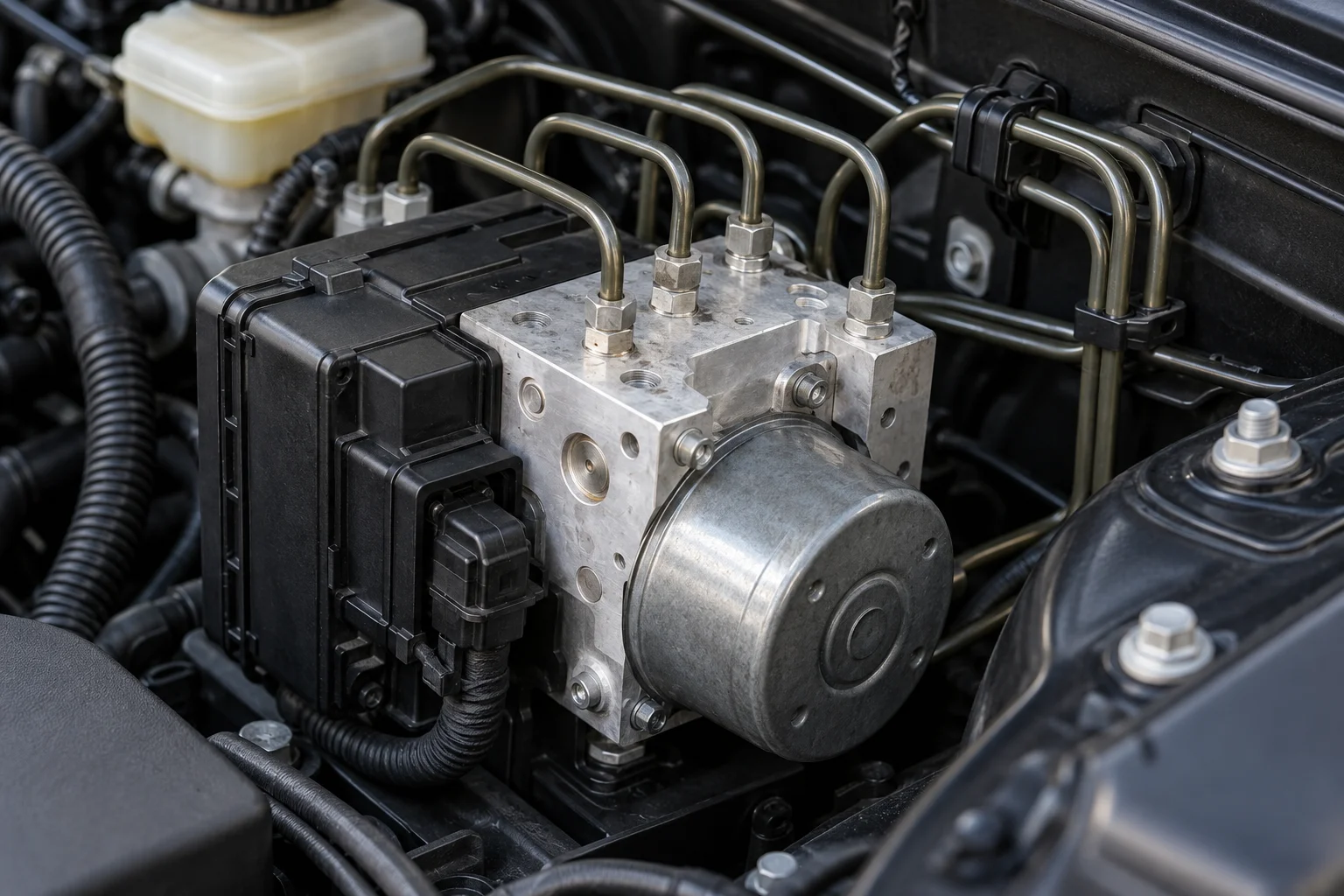
Behind the warning lights is one combined unit, usually mounted in the engine bay near the brake master cylinder. It reads signals from all four wheels many times a second and adjusts brake pressure at each wheel when it needs to.
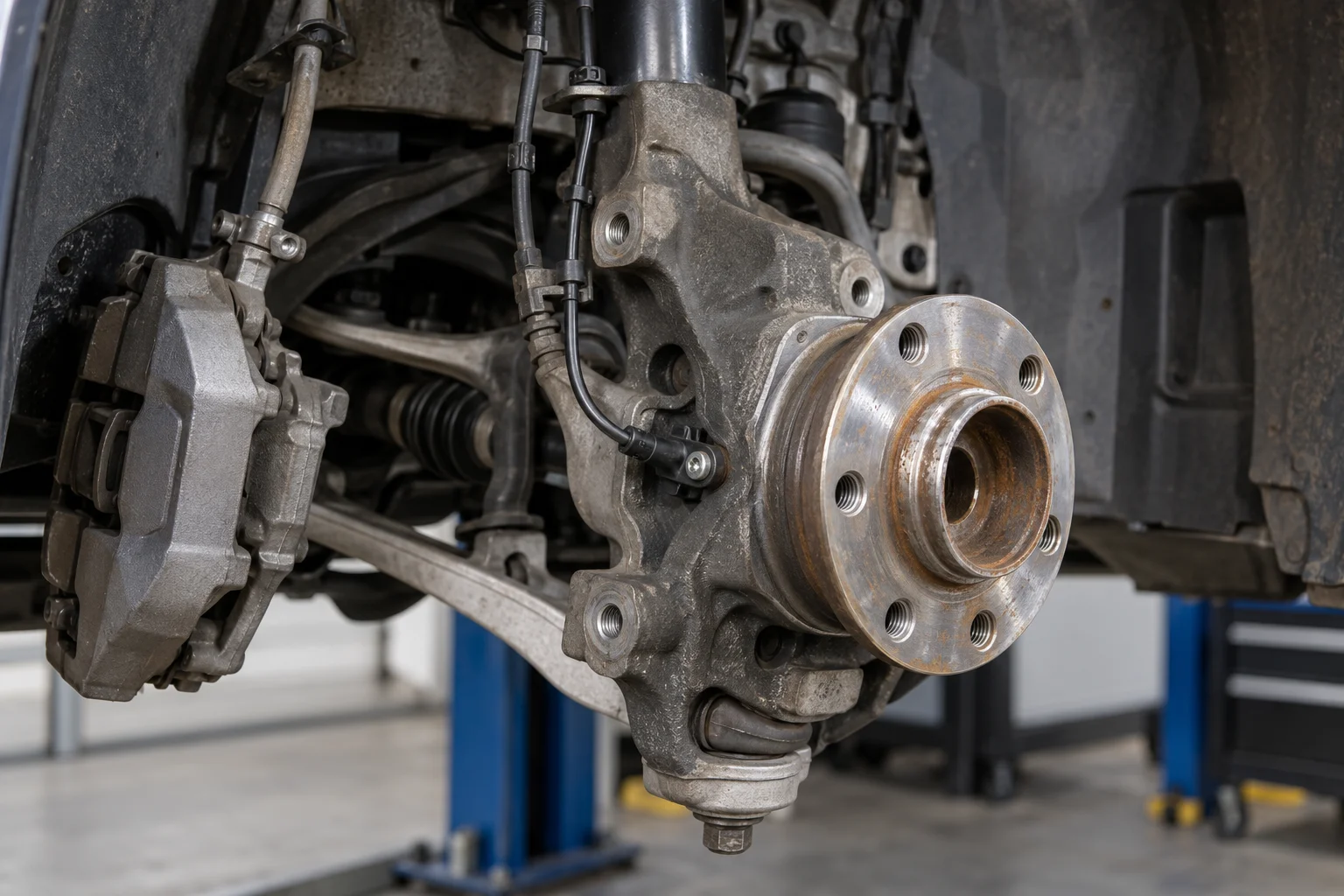
One at each wheel, reading a magnetic or toothed ring as the wheel turns.
The electronic part bolted to the hydraulic unit that makes the decisions.
Holds, releases and rebuilds brake pressure at each wheel.
Returns brake fluid during ABS stops and builds pressure for DSC.
Tell DSC where you are steering and how the car is actually turning.
Check the simple things first
Diagnosis follows the fault information and BMW test procedure. These checks help distinguish external problems from an internal module fault; they are not a fixed replacement order.
A sensor with a broken signal, often from age, dirt or a damaged tip.
Check signalWires chafed at the wheel arch or a corroded plug near the hub.
Check signalLow battery voltage or poor earth connections can trigger ABS and DSC faults.
Check signalA worn wheel bearing or damaged ring gives the sensor an unstable reading.
Check fitmentCheck readings and carry out calibration when required by the applicable repair procedure.
Check fitmentInternal circuit faults, often on older models, confirmed by testing.
Confirm firstWarning signs
These symptoms are diagnostic clues, not proof of a failed module. Power, earths, wiring, sensors and network communication must also be considered.
Warnings appear on bumpy roads or in heat, then clear after a restart.
Fault memory shows signals missing from more than one wheel at once.
Other modules report they cannot talk to the ABS or DSC module.
On some older models the speedometer can stop when ABS signals are lost.
Unexpected pump operation needs assessment. An audible startup test is not a universal check for every BMW.
A pedal that pulses at low speed or feels unusual needs checking straight away.
Decide what to do next
The exact Check Control message, vehicle handbook and braking symptoms determine the appropriate response. A photograph cannot establish that a car is safe to drive.
Stop safely and arrange suitable recovery if braking is reduced, the pedal is soft or sinking, fluid is leaking, or the display tells you to stop. Do not drive the car to the workshop.
A red symbol can have different meanings, including the parking brake. If it remains after release or accompanies a braking fault message, follow the handbook and get advice before continuing.
Anti-lock braking or stability functions may be restricted. Follow the vehicle-specific warning instructions and arrange prompt diagnosis. If you are unsure about braking safety, request recovery.
A collection driver should not drive an unsafe vehicle. Confirm the appropriate transport, availability and charges before dispatch.
Before we test
A few details from you shorten the diagnosis and point us at the right wheel or circuit. You can answer most of them in a short WhatsApp message with a photo of the dashboard.
Right after a tyre change, a kerb hit, a battery change or out of nowhere on a normal drive.
Note when warnings occur and whether a restart changes them. Intermittent behaviour alone does not identify the failed component.
A hum or grind from one corner can mean a wheel bearing affecting the sensor signal.
Recent brake, suspension or alignment work can disturb a sensor wire or the steering angle setting.
On some older models, lost wheel-speed information can affect the speedometer. Test the signal path rather than assuming module failure.
A normal pedal versus a soft or pulsing one changes how urgently the car should be checked.
Choose after diagnosis
The available option depends on the exact unit, failure and supported repair procedure. Compatibility and repairability must be checked before ordering parts.
Some electronic faults may be repairable. Confirm whether the specific unit is supported, who performs specialist work, the testing provided, turnaround and written warranty.
Confirm supplier, compatibility, test documentation, core-return requirements and warranty. An exchange unit is not necessarily equivalent to an untested used part.
Check condition, part compatibility and programming feasibility before purchase. Not every used unit can be adapted to every BMW. Confirm limitations and coverage in writing.
Select the correct part or approved supersession. Confirm whether the job needs a control unit or complete assembly, plus availability, programming and commissioning.
Electronic module repair does not automatically mean the brake circuit has been opened. Replacement control units require the applicable programming, coding and initialisation. If the hydraulic circuit is opened or a hydraulic unit is replaced, follow the specified filling, bleeding and functional checks. Modern integrated braking units need their own BMW repair procedure.
Identify first then choose the repair
The model badge alone does not identify the fitted brake electronics. These generation groups are a starting point; the actual unit determines the repair options.
On applicable E-generation cars, electronic and hydraulic components may have separate repair routes.
Identify the fitted unit. Do not assume E46, E39, E38 or Z4 systems use interchangeable modules.
F-generation and other later systems require checks of hardware, software, sensor inputs and commissioning requirements.
A wheel-speed fault code does not by itself prove a defective sensor. Test the relevant signal and circuit.
Some newer BMWs use integrated braking systems. Their electronics may not have the same separate repair options as an older ABS module.
Confirm the fitted system and applicable BMW repair instructions. Check outstanding campaigns by VIN.
Our process
Testing establishes the repair before parts are ordered. The time required depends on the fault, unit type, parts availability and any specialist work.
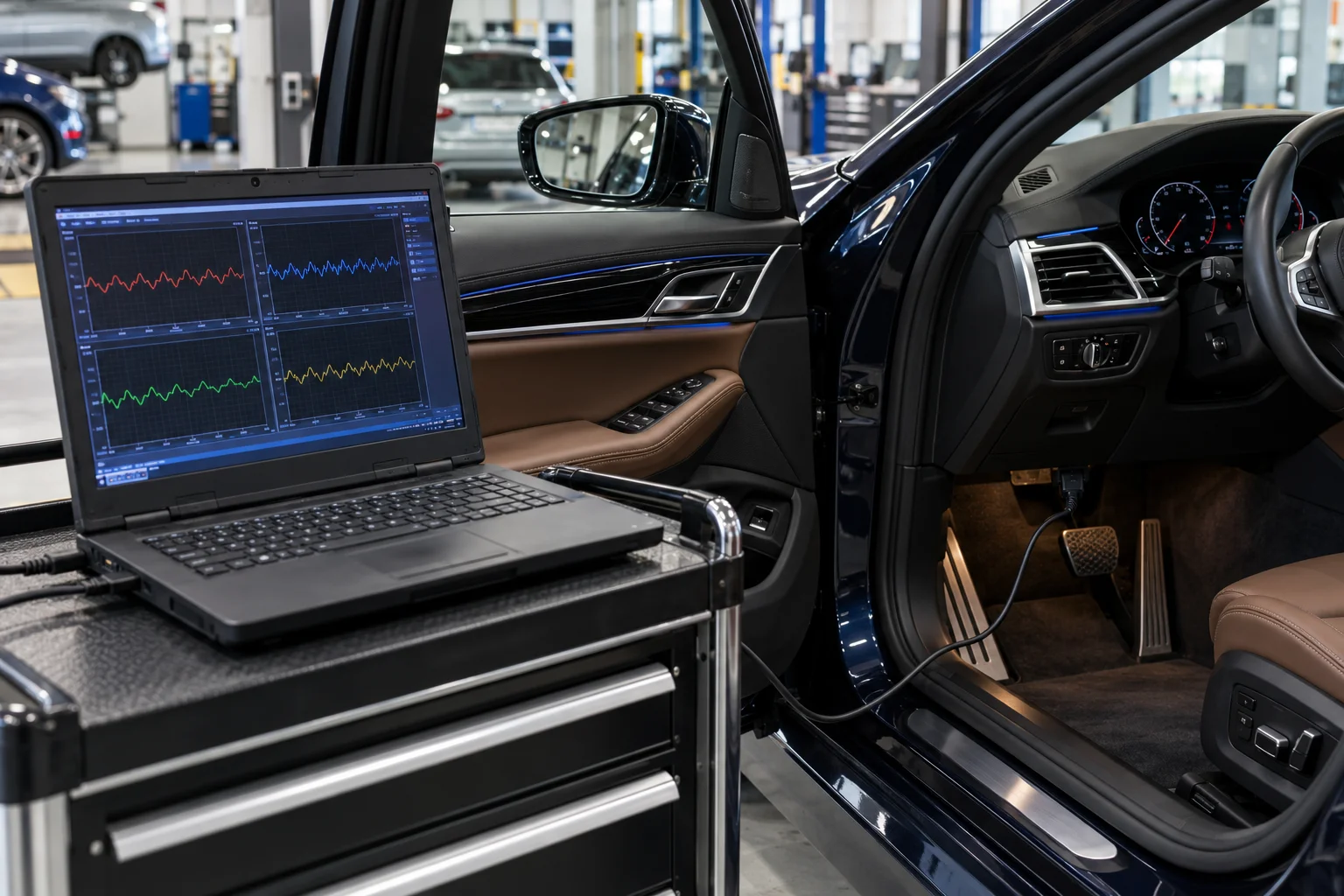
Fault codes and freeze frame data read from ABS, DSC and related modules.
Compare wheel-speed signals using appropriate tests. Carry out a road test only after an initial braking-safety assessment.
Sensors, plugs and wires checked at the wheel, and battery voltage tested.
Module power, earth and signals checked before the module is blamed.
Repair or replace the confirmed faulty component and complete programming or initialisation where required.
Brakes bled where needed, faults cleared and the car tested on the road.
Hydraulic side
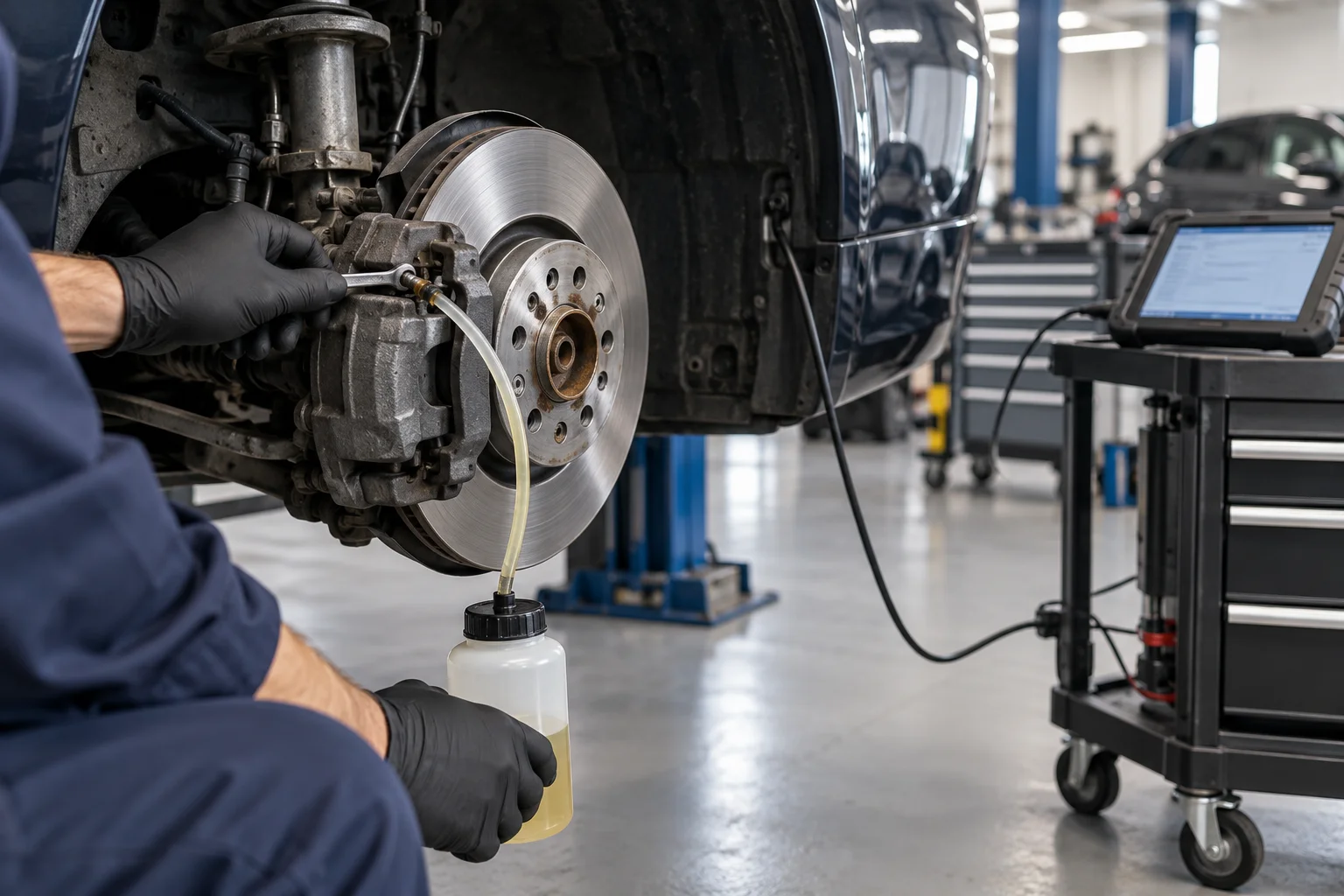
The ABS unit is full of small valves and passages that depend on clean brake fluid. Old fluid, air in the system or a weak pump can cause problems that look like electrical faults.
Brake fluid absorbs moisture over time. Old fluid can corrode the valves inside the ABS unit, and heat makes the problem worse.
After the hydraulic unit is opened or replaced, a normal bleed is not always enough. The diagnostic tool cycles the valves and pump to push out trapped air.
The pump motor can wear or its supply can fail, which is tested separately from the control module.
Wheels and tyres
ABS and DSC compare the speed of all four wheels. Anything that makes one wheel read differently, even without a broken part, can set off the warnings. This is why we always look at the tyres and wheels before going deeper.
Check approved tyre fitment, pressures and rolling circumferences. Factory-approved staggered sizes are not automatically incompatible.
Play in a bearing or a damaged ring upsets the sensor signal at that wheel.
A hard knock can damage a sensor, its wire or the steering angle setting.
Related work
ABS faults often link to other brake, wheel and electrical work. These pages cover the jobs that usually go with an ABS diagnosis, and several can be done in the same visit to save you a second trip.
Local help for your BMW
BMW Repair Dubai is an independent workshop at 39 Al Quoz 4, Dubai, not affiliated with BMW AG. Contact us during Monday to Saturday, 9am to 7pm to discuss the warning, diagnosis and suitable transport.
Ask who will perform any specialist module work, how the unit will be tested and what written coverage applies. Agree the assessment charge, repair authorisation and estimated turnaround before work begins.
The total depends on the diagnosed fault and suitable parts route. Request an itemised quote covering diagnosis, repair or replacement, fitting, any required programming and hydraulic work, final checks.
Follow the exact warning message and your vehicle handbook. Stop safely and arrange recovery if braking is abnormal, fluid is leaking or the display instructs you to stop. Amber warnings can mean assistance functions are restricted; a photo cannot confirm driving safety.
No. Power supplies, earth connections, wiring, wheel-speed signals and network communication can cause related faults. Diagnosis must establish the cause before a module is ordered.
Some faults and unit types may be repairable. Confirm suitability, the specialist performing the work, testing, turnaround and warranty for your particular unit before approving a repair.
Programming, coding and initialisation depend on the fitted system and replacement part. Bleeding follows the relevant procedure when hydraulic work or an opened brake circuit requires it. Electronic repair alone does not automatically require opening the hydraulics.
Only after compatibility and adaptation feasibility are confirmed. Matching appearance is insufficient. Used and remanufactured exchange units differ in condition, testing and warranty.
Timing depends on diagnosis, repairability, parts availability, any specialist work and final checks. Ask for an estimated completion time after assessment rather than assuming same-day repair.
Low voltage or poor connections can contribute to warning messages. Battery and charging-system checks may be needed, but replacing a battery without confirming the cause may not resolve the fault.
During driving, flashing commonly indicates DSC intervention. Reduce speed and adapt to road conditions. A persistent light or additional warning message needs the vehicle-specific handbook guidance and assessment.
Check correct tyre fitment, pressures, wiring and relevant sensor readings. Approved staggered front and rear sizes are not automatically a fault. Steering-angle calibration is carried out when the applicable procedure requires it.
The checks depend on the repair and can include fault-memory and live-data verification, required programming or calibration, hydraulic leak and pedal checks, and a road test only after the car is assessed as safe.
Ask for written terms for the selected repair or part, including exclusions and the claim process. Free pickup is offered in Dubai, subject to arrangements. Unsafe vehicles need suitable recovery; confirm availability and any charges.
Book now
Call with your BMW model, year and warning message. Discuss diagnosis, a quote and the appropriate transport. Photos are optional. Confirm repair availability, turnaround and written terms before booking.