
Intake and exhaust camshaft position sensors
BMW Camshaft Sensor Replacement in Dubai
Long cranking, an engine warning or reduced power can have several causes. Our Al Quoz workshop checks camshaft sensor signals, wiring and relevant timing data before recommending replacement. Send your model, year and any fault code to request an assessment and fitted quotation.
Your fitted quotation
BMW camshaft sensor replacement cost
The total depends on the exact sensor, access and diagnostic findings. A parts-only catalogue price is not a fitted replacement price. Request a quote for your engine before ordering a sensor.
Diagnosis first
Agree the assessment charge and what it covers. Fault-code reading, circuit checks and further timing investigation are different amounts of work.
Confirmed sensor replacement
The quote should identify intake or exhaust position, bank where relevant, part manufacturer and number, seal, fitting and final checks.
Separate related repairs
Connector damage, oil leaks, VANOS and mechanical timing work need their own findings and approval. Oil contamination alone does not justify two new sensors.
Before approving work, confirm diagnosis, parts and labour, expected availability, completion estimate and written warranty terms. If testing identifies another cause, ask for the revised repair recommendation and cost.
How it works
What the Camshaft Sensor Tells Your BMW Engine
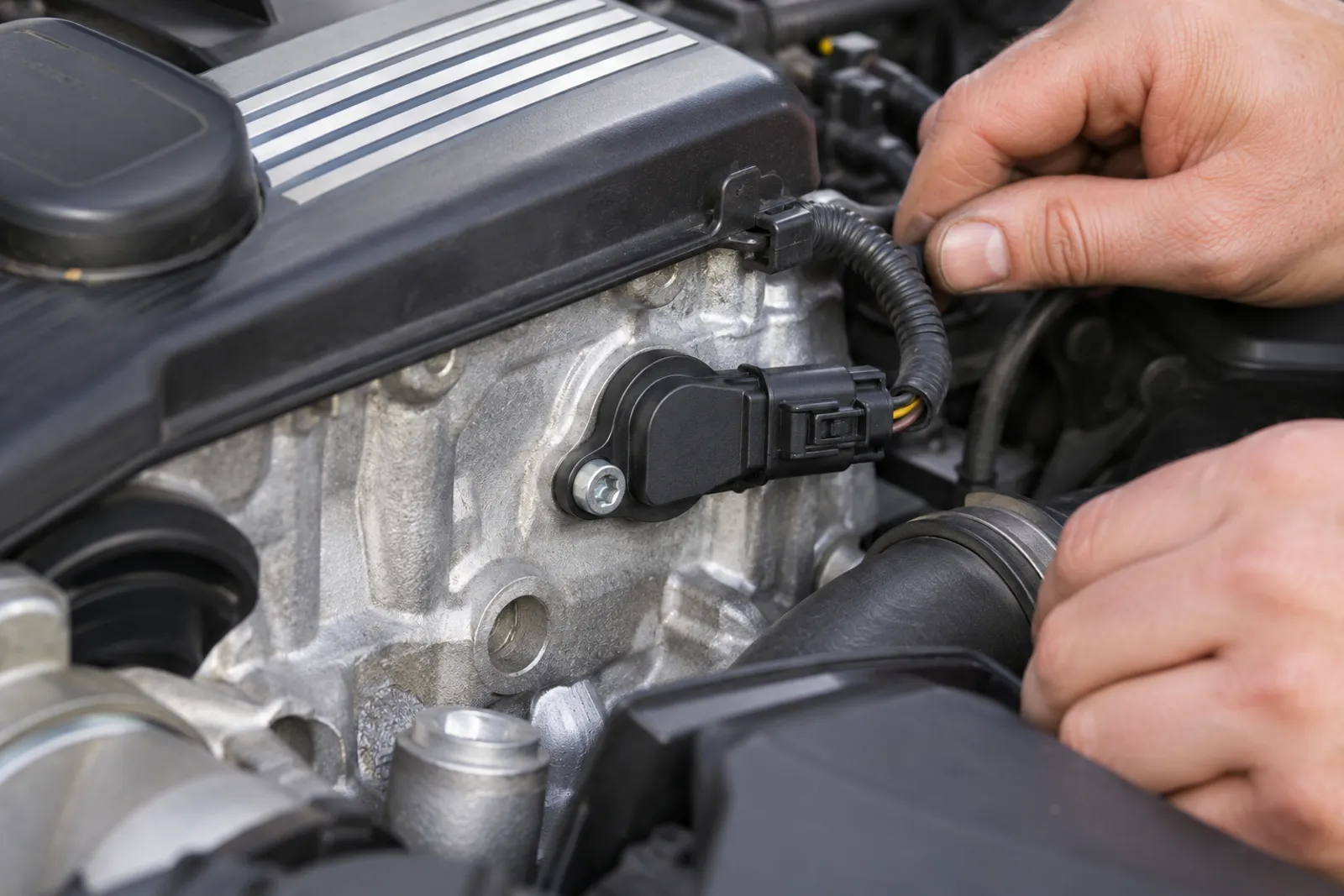
The camshaft position sensor reads a target on the camshaft and sends a signal to the engine control unit. Together with the crankshaft signal, this helps identify engine phase and control injection and, on petrol engines, ignition. Target design and sensor layout vary by engine.
On engines with VANOS variable valve timing, the control unit compares actual camshaft position with the requested position. A sensor circuit fault, an implausible signal and a camshaft-to-crankshaft correlation fault are different findings. Each calls for the relevant test plan rather than an automatic sensor order.
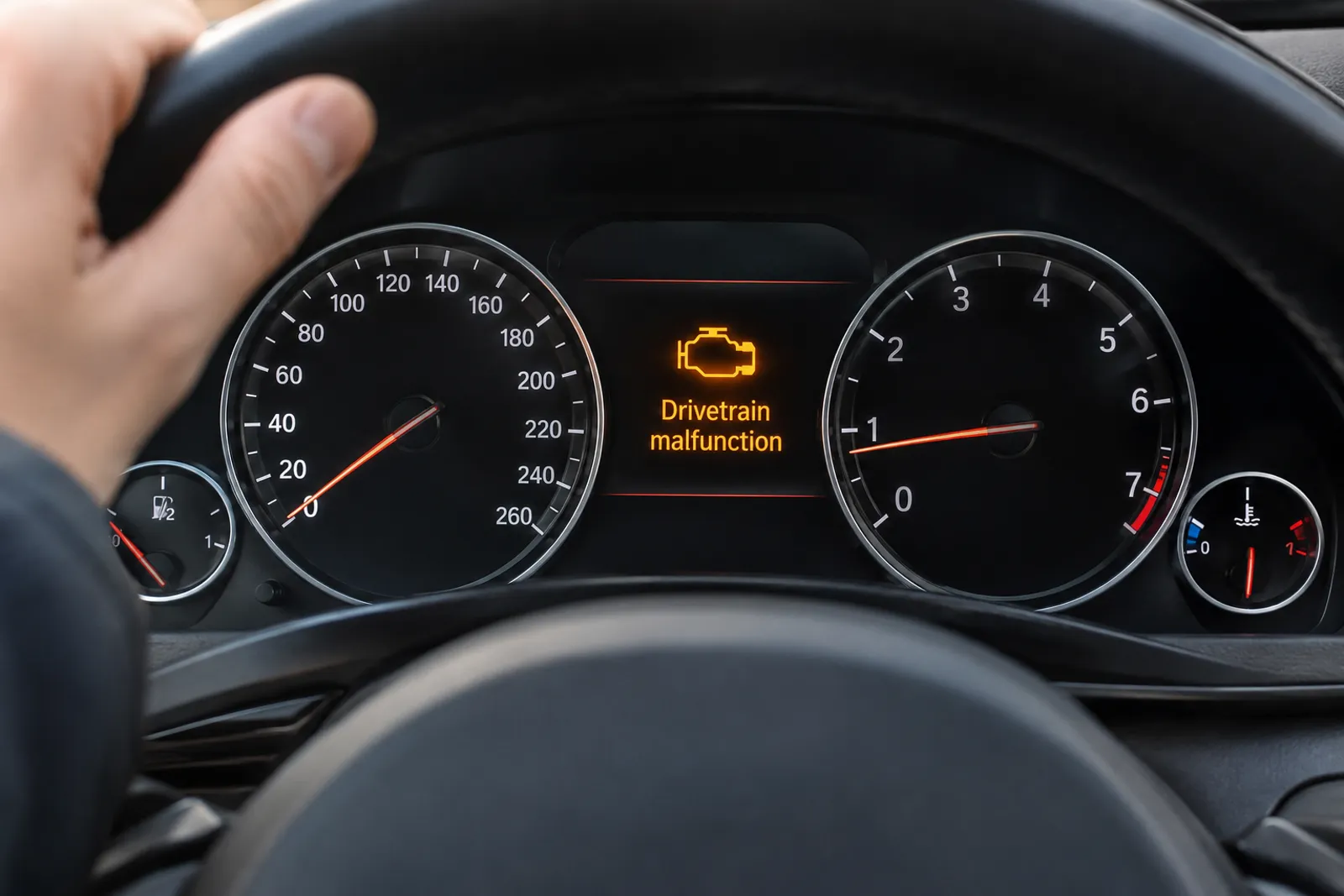
If the signal disappears or no longer matches the crankshaft sensor, the DME stores a fault, turns on the warning light and often limits power until the problem is fixed.
Symptoms
Signs of a Failing Camshaft Sensor on a BMW
When the camshaft signal drops out or looks wrong, the DME falls back on backup settings. That is why the symptoms range from a simple warning light to a car that will barely start. Some faults only appear when the engine is hot, so note when the problem happens and tell us when you call.
Local conditions
Conditions that can affect sensor operation
Sensors, seals and engine wiring age in a demanding environment. Heat, damaged connectors or contamination may contribute to a fault, but symptoms alone do not prove the cause. Inspect the exact sensor location and electrical circuit on your engine.
Oil condition and pressure can affect hydraulic camshaft adjustment. A VANOS problem may appear in camshaft data without an electrical sensor failure. Check the vehicle-specific oil requirements and investigate relevant timing faults separately.
Check before replacing
When a Camshaft Code Is Not the Sensor
A camshaft fault code says the signal is wrong. It does not always say why. Replacing the sensor without checking these first is how owners end up paying twice for the same fault.
A leaking sensor seal or valve cover gasket lets oil soak into the plug and wiring, which needs assessment for terminal, seal or wiring damage.
Heat near the engine makes wiring brittle, and a circuit interruption can resemble an internal sensor fault.
If a camshaft cannot reach its target, the code can point at the sensor when the solenoid is to blame.
A worn chain shifts the camshaft against the crankshaft and sets correlation codes.
VANOS works on engine oil pressure, so low or worn out oil upsets camshaft timing.
Rarely, the fault is in the DME itself rather than anything on the engine.
Diagnosis combines recorded faults and operating conditions with supply, ground and connection checks. Live camshaft and crankshaft data guide the investigation; waveform testing may be needed to assess signal quality. Mechanical timing or VANOS checks follow where the findings justify them.
Which sensor
Intake and Exhaust Camshaft Sensors Explained
Sensor count, position and access depend on the engine variant. Where separate intake and exhaust sensors are fitted, the fault description identifies the affected circuit or camshaft, not necessarily the failed part. Confirm the engine, production date and part number before ordering.
The two sensors on an engine often look alike but are not always the same part, so the part is confirmed from the chassis number before it is ordered. Fitting the wrong one can bring the warning light straight back.
Many petrol variants use intake and exhaust sensors; location and count must be checked by engine.
Many petrol V8 variants use intake and exhaust sensors on each bank; confirm the exact engine.
Replace only sensors confirmed faulty. Oil in two connectors is a reason to inspect both circuits and locate the leak, not automatic proof that both sensors need replacing.
Our process
How We Replace a BMW Camshaft Sensor
Access and diagnosis determine the work involved. Confirm the failed component before fitting, protect the sensor opening from contamination and follow the engine-specific installation procedure. Timing or wiring work is explained and quoted separately.
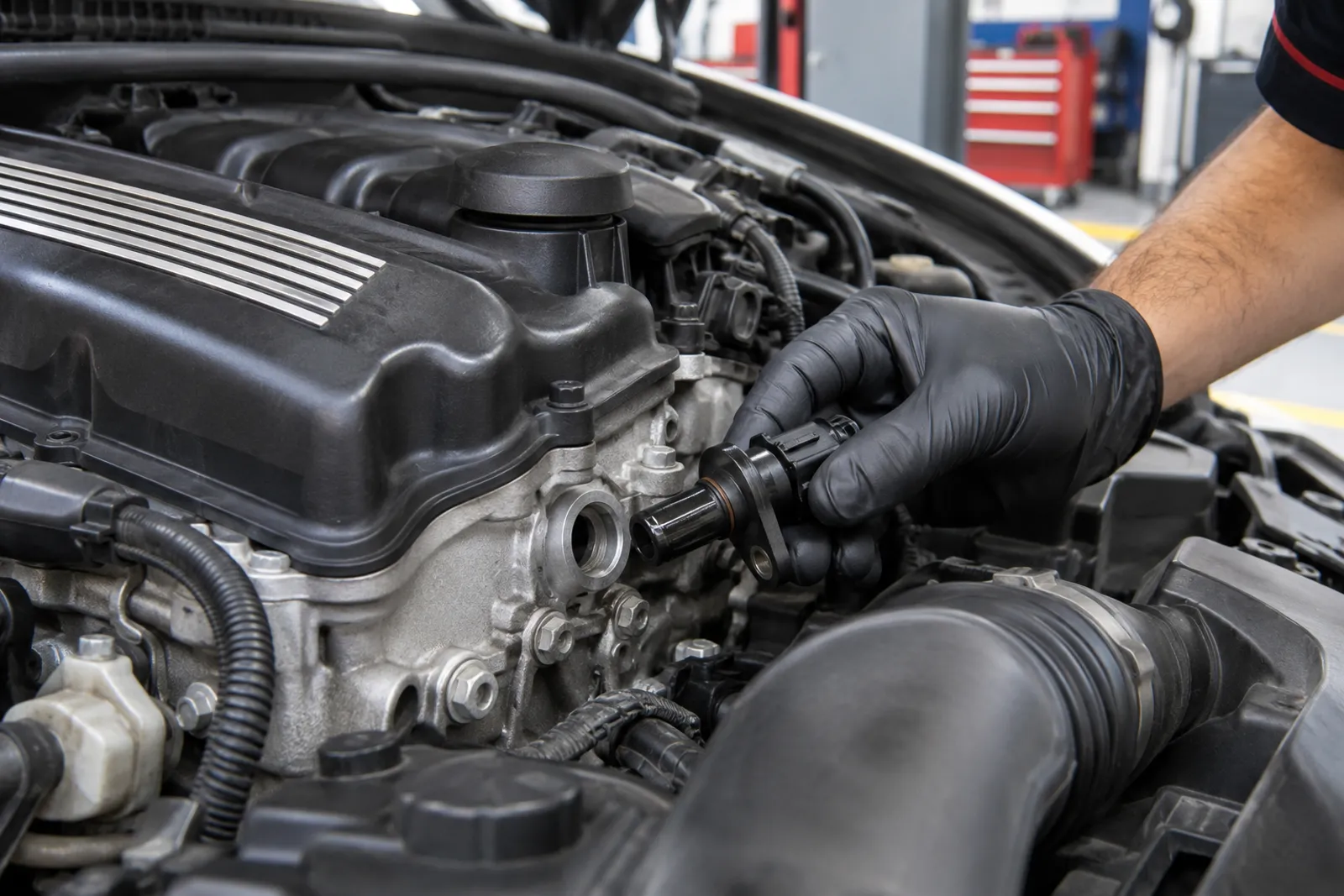
- Read the fault codesThe DME is scanned with a BMW level diagnostic tool and the codes noted.
- Compare live signalsAssess relevant live data and use electrical or waveform checks where needed to distinguish signal and timing faults.
- Check oil, wiring and connectorThe plug, wiring and seals are inspected for oil and damage.
- Agree the fix and priceWe explain what has failed and confirm the price before work starts.
- Fit the new sensorConfirm fitment, clean the mounting area, replace the required seal and follow the specified installation procedure.
- Clear codes and test driveRecord findings, clear applicable faults, check starting and operation, and rescan after an appropriate test.
The hidden cause
Oil Leaks and Camshaft Sensor Faults on BMW
Oil may reach a connector from an external leak or through a failed component, depending on engine design. Locate the actual source rather than assuming the valve cover gasket is responsible.
Inspect terminals, seals and the affected harness for contamination or damage. Assess the electrical circuit before deciding whether cleaning, connector repair, wiring work or sensor replacement is needed.
See our valve cover gasket replacement and oil leak repair pages.

Driving with the fault
Can You Keep Driving With a Faulty Camshaft Sensor?
A warning or fault code does not establish whether the car is safe to drive. Follow the vehicle warning instructions and describe any stalling, shaking, noise or loss of power when contacting the workshop. Some engines use fallback operation, but its behaviour depends on the fault.
If the car is not driveable, there is no need to risk it. Send us the location and we arrange free pickup in Dubai.
Follow the vehicle warning instructions and arrange prompt diagnosis. A steady light alone does not confirm a sensor fault.
Stop safely if power loss is severe, the engine shakes strongly or the warning flashes. Arrange assistance rather than continuing.
Stop safely and arrange assistance. Do not keep cranking a non-starting engine; report any abnormal noise or oil-pressure warning.
Your parts choice
Genuine or Branded Camshaft Sensor?
Choose a sensor by exact application, part number and electrical compatibility. A familiar brand or matching mounting shape alone does not establish fitment. Compare the supplied part, warranty and fitted cost before approving the work.
We explain the options for your car and the price of each before ordering, so you can choose what suits how long you plan to keep it.
A genuine part selected for the exact engine and production details. Confirm availability and written warranty terms.
A branded alternative with verified catalogue fitment and signal specification. Confirm the manufacturer and part number in the quote.
Very low cost sensors can give a weak or noisy signal and bring the same fault back. We do not recommend them.
By engine
Camshaft Sensors on Popular BMW Engines
Engine code and production date determine the sensor arrangement and access. The examples below help identify the engine family; they do not replace a VIN-specific parts check. Petrol and diesel configurations can differ.
Send the model and year first. If required, provide the VIN details needed for a parts check; a full registration-card photograph is unnecessary. Confirm the sensor position and part number before booking replacement.
After the work
What to Expect After a Camshaft Sensor Replacement
After replacement, check the original complaint and the relevant signals. Starting checks, hot or cold checks where relevant, leak inspection and a post-repair scan help verify the result. The appropriate test depends on the original fault.
If the warning returns or symptoms remain, contact us for reassessment. Recheck the diagnosis, fitment, replacement part, installation and related circuits without assuming a second fault. Keep the invoice and test findings for follow-up.
Related work
More BMW Engine Sensor and Timing Repairs
FAQ
BMW Camshaft Sensor Questions Answered
Short answers to the questions owners ask most before booking a camshaft sensor check.
What does a camshaft sensor do on a BMW?
It tells the engine computer where each camshaft is, so injection, spark and VANOS timing can be set correctly.
What are the signs of a bad camshaft sensor?
A check engine light, a long crank before starting, rough idle, reduced power and stalling are the most common signs.
Does a camshaft code always mean a new sensor?
No. Circuit, plausibility, correlation and VANOS control faults require different checks. Wiring, supply, target-wheel, adjustment or mechanical timing faults may be involved. Testing determines whether the sensor itself has failed.
Should both camshaft sensors be replaced together?
Not automatically. Replace only sensors confirmed faulty. Oil contamination requires source, connector and circuit checks; it does not by itself prove that either sensor has failed.
What is the difference between intake and exhaust sensors?
They monitor their respective camshafts where fitted. Engine-specific fault information identifies the affected circuit or position; it does not alone prove which component needs replacement.
Why did my new camshaft sensor fail again?
A returning warning does not establish that the new sensor has failed. Recheck the original diagnosis, exact part, installation, connections, signal and any related timing fault before ordering more parts.
Is a camshaft sensor the same as a crankshaft sensor?
No. The crankshaft sensor reads engine speed and piston position. Both send signals to the DME and both are checked when there is a timing fault.
How much does BMW camshaft sensor replacement cost in Dubai?
The fitted price depends on your engine, exact sensor, access and diagnosis. Request a quotation identifying the part, seal, labour and testing. Any leak, wiring or timing work should be listed separately.
Can I drive with a faulty camshaft sensor?
A code alone cannot establish safe driving. Follow the vehicle warning instructions. Stop safely and arrange assistance for repeated stalling, severe shaking or power loss, a flashing engine warning, abnormal mechanical noise or an oil-pressure warning.
Does a new sensor need coding or adaptation?
A sensor replacement does not automatically require control-unit coding. Follow the applicable engine repair procedure for any required initialization or adaptation, then verify signals and operation. Do not assume persistent rough running is normal relearning.
How long will the replacement take?
Access, diagnostic work and part availability determine the time. Ask for an estimate after the engine and affected sensor are identified, with separate timing for any wiring or mechanical investigation.
What warranty is included?
Request written parts and labour terms for the specific work before approval, including duration, exclusions and the procedure if symptoms return. Keep the invoice identifying the sensor supplied.
Do you collect the car?
Yes. We offer free pickup in Dubai, and the work is done at our Al Quoz workshop, open Monday to Saturday, 9am to 7pm.
Book a sensor check
Find the cause before replacing the sensor
Send your model, year and any fault code, and describe whether the problem occurs cold, hot or during starting. We can plan the assessment; testing confirms the proposed repair and fitted quotation. A WhatsApp inquiry is not a confirmed booking.
- Free pickup in Dubai
- Al Quoz workshop
- Monday to Saturday, 9am to 7pm