
Engine cannot be started
The start request was refused. Usually voltage, key, pedal or starter.
Starter and ignition warnings on the dashboard
BMW will not start, clicks without cranking or displays an ignition fault? Our independent Al Quoz workshop checks the battery, starting circuit and start authorisation before recommending parts. Get the findings and a repair quote before work starts.
Initial fault-code scan and report from AED 150 · Further testing and repair quoted separately
Know what you are paying for
An ignition warning does not identify one failed part. Start with a scan, then agree any electrical testing needed to separate a weak battery, starter circuit fault or access-system problem.
Reads stored module faults and provides a report. This is not a complete electrical investigation or a repair price.
The fitted cost depends on the model, confirmed fault, parts and access required. Ask for testing, parts, labour, programming, VAT and any recovery charge to be itemised before approval.
Battery condition, specification and charging tests determine whether recharge, replacement or further investigation is appropriate. Registration and coding are separate procedures where required.
The quote depends on starter access, the compatible unit and whether a cable, ground or control fault also needs attention. Repair and replacement options depend on the findings.
Power supply and communication checks come before module replacement. Parts, programming and key matching must be included where needed.
Battery budget reference Our battery replacement page explains published supplier examples of AED 1,200 for an 80Ah AGM and AED 1,350 for a 95Ah AGM with fitting and registration. These are market references, not our fixed prices or guaranteed fitment. Starter and access-module repairs require a vehicle-specific quote.
Confirm the assessment fee, whether it is credited against an approved repair, VAT treatment and any additional testing before booking. An intermittent fault may require further agreed diagnostic time.
Read the message before choosing a repair
On many BMW petrol and diesel models, starting depends on valid key authorisation, adequate battery power and the required pedal and selector signals. The access system and engine control unit coordinate the start request. A fault can prevent cranking or prevent the engine from running.
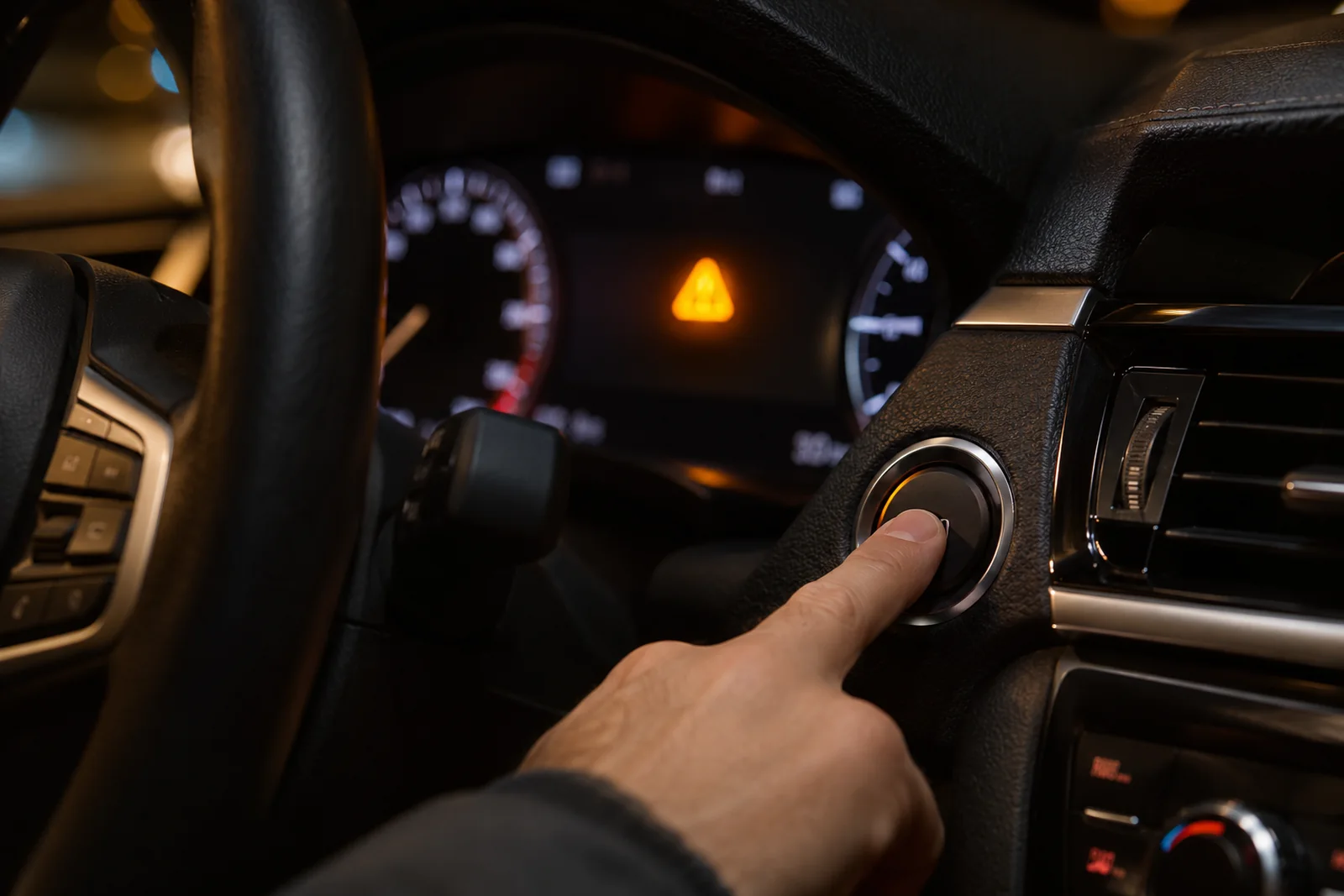
The start request was refused. Usually voltage, key, pedal or starter.
The car is running, but it may not restart once it is switched off.
A yellow or red steering lock symbol on cars with an electric steering lock.
The car cannot read the key, so it will not allow a start.
The message is a summary, not a diagnosis. The same warning can come from a tired battery, a starter that draws too much current, a key the car cannot read or a module that has stopped talking to the rest of the car. That is why the fault memory of several modules has to be read together, not only the engine computer.
Tell us what the car does
How the car behaves when you press the button or turn the key narrows the search a lot. These are the three patterns we hear most, and where each one usually points.
No crank at all, sometimes a click or a dim cluster.
The engine turns over normally but never runs.
Runs for a second or two, then cuts out.
When safely parked, record the exact dashboard wording or take a photo. A photo of the message and the time it appeared helps us match it to the stored faults, especially when the problem comes and goes. It also helps to note whether the car was hot or cold, how long it had been parked and whether anything was charging or switched on at the time, because each of those details points to a different part of the system.
Test the power supply first
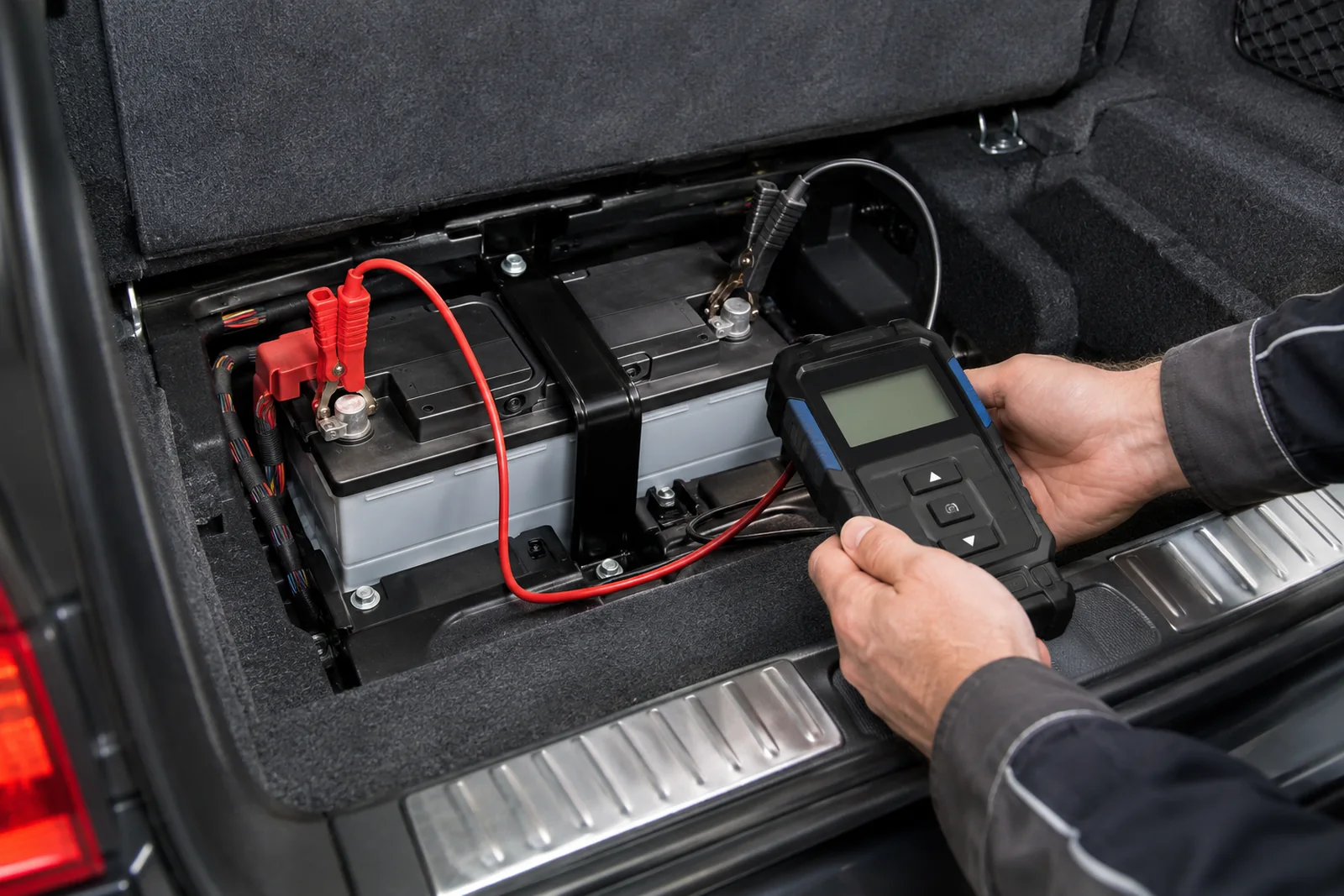
Low voltage can produce faults in several modules and prevent a successful start. We distinguish a discharged battery from one that has lost starting capacity. Charging and retesting may be needed before a reliable battery-health assessment; replacement is appropriate only when the findings support it.
A battery can show normal voltage at rest and still collapse the moment the starter draws current. That is why we test it under load.
Many BMWs use an intelligent battery sensor, or IBS, and energy management. A replacement battery must match the required technology and capacity. Registration records a replacement where required; changing the configured type or capacity may also require coding. We check the requirements for your vehicle.
We also check the alternator output and the main cables. A battery that keeps going flat is often a symptom of a charging fault or a module that stays awake after the car is locked, and replacing the battery alone will not stop it happening again.
The module that says yes or no
Access and start authorisation depend on the vehicle generation and equipment. We identify the fitted system from the VIN and diagnostic scan rather than assuming every E, F or G series uses the same module.
The car access system reads the key, controls the steering lock where fitted and sends the start signal. Faults include keys not recognised, no crank and lost communication with the engine computer.
The front electronic module combines access, lighting and body functions. Low voltage and water damage can cause starting and communication faults.
The body domain controller manages access and start authorisation on applicable models, including the F15 X5. We check power supply, network communication and relevant software before recommending module work.

A module that has stopped working can sometimes be repaired, and sometimes needs replacing with a unit programmed to your car. In other cases the fault is cleared with a software update or by fixing its power supply and ground. A used module is not automatically compatible or reusable; security matching and programming requirements must be checked before purchase. We explain which route your car needs and why. When a module does need replacing, the job includes programming it to your car and testing every key you have, so you are not left with a spare that no longer works.
Two common no start causes
On applicable models, the access system must recognise a valid key and confirm that the electronic steering lock has released. Not every BMW uses the same steering-lock arrangement.
Some E series models in the 1, 3 and 5 Series lock the steering column with a small electric motor. When the lock wears, the car shows a yellow or red steering lock symbol and may refuse to start. We read the lock faults, check its power supply and confirm whether the lock, its wiring or the access module is at fault.
The key holds a transponder that the car reads before it allows a start. A discharged key battery, interference, a damaged key or antenna fault can affect normal key detection. Try the spare and follow the model-specific emergency key-detection procedure in the owner’s manual. On applicable BMWs, a marked steering-column detection point can allow starting when normal radio detection fails. We test the key and antennas before suggesting replacement.
If your BMW has a key switch rather than a button, wear in the switch itself can cause the same no start symptoms. Our ignition switch replacement page explains how that is checked.
Simple signals that block a start
Applicable push-button models need valid start-condition signals. A missing signal can resemble an ignition or starter failure.
Automatic models need the brake signal. A missing brake-pedal signal can prevent starting. We check the switch signal and brake-light operation.
If the gearbox does not report park or neutral, the start is refused.
Manual models need the clutch switch signal before the starter will turn.
Insufficient voltage can prevent cranking or disrupt start authorisation.
Live data shows whether the vehicle sees the required signals. A failed signal is a starting point for testing the switch, wiring or module input, not proof that one part needs replacing. The required tests and time depend on whether the fault is present during assessment.
Decide safely before travelling
This warning can mean the engine may not restart after shutdown. It is not permission to keep driving regardless of other warnings. Follow the exact Check Control message and the owner’s manual for your BMW.
Stop safely if there is smoke, a fuel smell, overheating, an instruction to stop, or a loss of braking or steering assistance. Arrange recovery rather than continuing to the workshop.
Describe the full warning and how the vehicle behaves. Do not use your phone or photograph the dashboard while driving.
If the warning is isolated, seek advice before continuing. Do not leave a running vehicle unattended or idle it in an enclosed space. Always switch off before refuelling.
Tell us if the car is in a basement, cannot select Neutral or has locked steering. Confirm suitable collection and any separate recovery charge.
Dubai conditions
Tell us whether the fault follows a hot restart, repeated short journeys or several weeks parked. Reproducing those conditions helps select the right tests.
High temperatures speed up the internal wear of a battery, so it can lose starting power with little warning, often after a car has been parked in the sun.
Heat-related faults can appear only on a hot restart. We compare the start signal, voltage drop and starter behaviour while the problem is present rather than assuming the starter is defective.
Repeated short journeys may not restore the energy used during starting, especially with heavy electrical loads. Battery state of charge and charging-system operation need checking.
Cars left for weeks at the airport or during travel drain slowly, and the first start after return is where faults appear.
Temperature-dependent electrical faults require testing under the conditions in which they occur. Heat alone does not establish that a module needs replacement.
From the first test to the repair decision
We connect the warning, the live signals and the electrical measurements before recommending work.
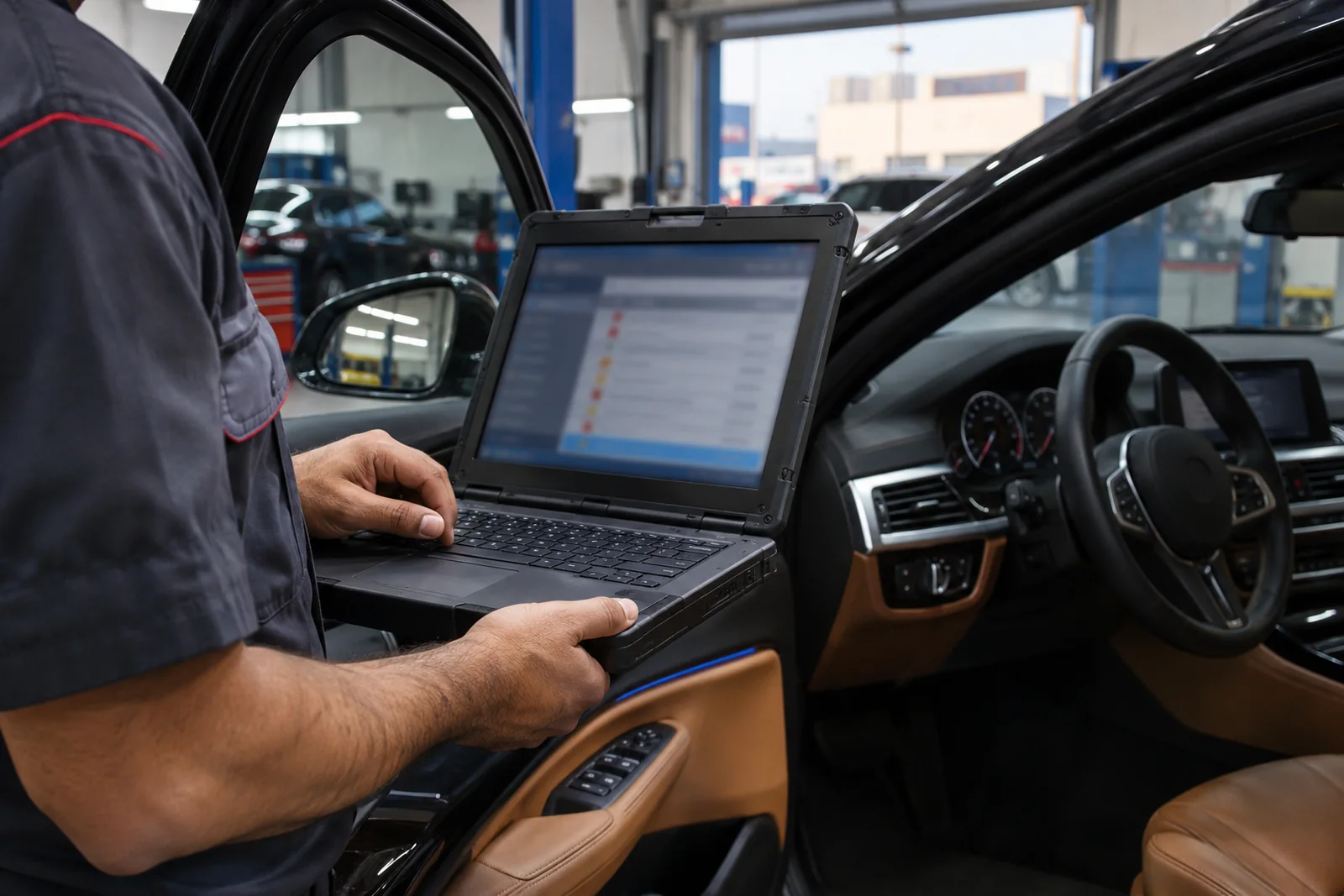
Voltage at rest, under cranking load and with the engine running.
Faults from the access system, DME or DDE engine control unit, steering lock where fitted and gearbox are considered together. A code guides testing; it does not prove a component has failed.
Brake, clutch, gear selector and key signals are checked one by one.
We check the start command, supply and grounds, including voltage drop and starter current where appropriate. This separates poor power delivery from a defective starter.
You get the finding, part options and cost before any work starts.
The car is started several times hot and cold, and the faults are read again.
Independent BMW workshop in Al Quoz
Our workshop at 39 Al Quoz 4 uses BMW diagnostic equipment and works with genuine BMW and OEM parts. The important decision is which work your car actually needs, with the reason and price explained before approval.
Ask which fault codes, battery findings or electrical measurements support the recommendation. A low-voltage code alone does not prove a battery or module needs replacing.
Discuss recharge and retest, connection repair, compatible component replacement or module work as appropriate. Confirm what is included and what remains to be diagnosed.
The process includes repeated starts and a fault recheck. For a hot or intermittent complaint, ask which original conditions were reproduced and whether further observation is needed.
For a confirmed component fault, see starter motor replacement, battery replacement or ignition switch replacement. A starting warning alone is not a reason to order any of these parts.
Before you arrange an assessment
The initial fault-code scan and report starts from AED 150. Physical circuit testing, intermittent-fault investigation and repairs are quoted separately. Confirm VAT, the assessment scope and whether any fee is credited against approved work before booking.
The warning alone cannot establish that the car is safe to drive. Follow the exact Check Control instruction. Stop safely and request recovery for smoke, fuel smell, overheating, loss of assistance or an instruction to stop. An isolated restart warning still needs advice before further travel.
No. A low battery, poor connection, starter fault, key-detection issue or missing start-condition signal can produce similar symptoms. Battery testing and relevant module data help decide which circuit needs further checks.
A present fault is usually easier to assess than one that occurs only after a hot soak or overnight parking. Repair time also depends on access, parts and programming. Ask for the assessment slot and expected repair time after the initial findings; a same-day repair is not guaranteed.
Sometimes. The power supply, grounds, communication and relevant software must be checked first. If the module is faulty, repairability, compatible replacement options and security programming requirements determine the quotation.
Many BMW energy-management systems require replacement registration. An approved change to capacity or battery technology can also need coding. These are different procedures and the requirements depend on the vehicle.
Try the spare key and check your owner’s manual for emergency key detection. Applicable models have a marked detection point, often on the steering column. Normal radio detection can fail because of a discharged key battery or interference without requiring a new vehicle key.
Tell us the exact model and whether it fails to crank or fails to enter drive-ready mode. Electric BMWs do not have a conventional petrol-engine ignition system, and hybrid starting arrangements vary. Low-voltage and authorisation checks must be distinguished from specialist high-voltage diagnosis.
Ask for the compatible genuine BMW or OEM option and availability in the quote. Any repair or remanufactured option must be identified separately. Request the written parts and labour warranty terms, duration, exclusions and claims process for the selected work before approval.
Free Dubai pickup and delivery is offered. A non-running car may need specialist recovery. Tell us about basement height, locked steering, a stuck selector or damaged wheels so collection suitability and any separate recovery charge can be confirmed.
Send the model, year, exact warning, whether it clicks or cranks, when the fault happens and the collection area. Include recent battery, key or electrical work. A safely recorded photo helps; send the VIN privately if requested for parts identification.
No. This page concerns starting warnings and start authorisation. A petrol-engine misfire can involve coils, plugs, fuel delivery or mechanical causes and needs a different diagnostic path. The warning wording and how the engine behaves determine the appropriate checks.

Car will not start or keeps warning you?
Send the warning message, model, year and whether the engine cranks. Mention your collection area and access restrictions. We will confirm the assessment arrangements and explain the repair quotation before work starts.