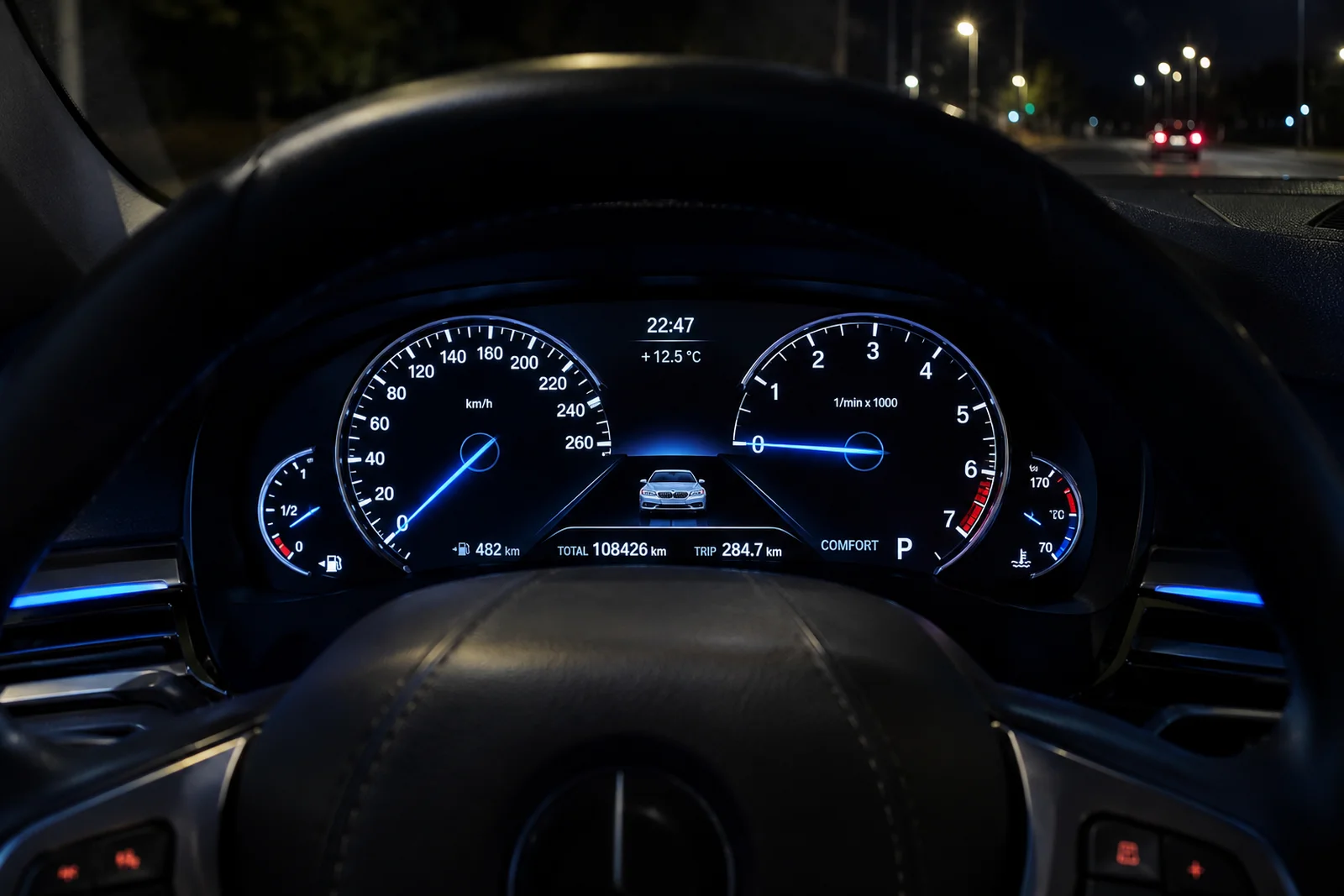
Display and illumination
- Ribbon connections
- Poor display connections can leave missing lines or pixels.
- Backlighting
- Failed lighting or its control circuit can make the display difficult to read.
Gauges, displays and warning lights
Missing pixels, unreliable gauges or a black instrument display? Our Al Quoz workshop checks the cluster, its power supply and incoming signals before recommending board repair, software work or replacement. Diagnostic scans start from AED 150; cluster repair is quoted separately after testing.
Cannot read your speed or essential warnings? Stop somewhere safe and call to discuss collection.
Understand the quote
Full module fault-code scan with a clear report. Circuit measurements and bench assessment may require additional work; confirm the scope first.
Your cluster repair cost depends on the display type, recoverable data, failed components and availability of a compatible replacement.
Confirm removal, bench testing, parts, refitting, programming or coding and final checks. Ask about diagnostic-fee credit and charges if no fault is found or repair is unsuccessful. The scan starting price is not the price of cluster repair.
What sits behind the glass
The cluster is a computer in its own right. It takes data from the engine, gearbox, ABS, airbags and body modules over the car network, then turns it into needles, numbers and warnings. Depending on the generation, it stores vehicle and service information and communicates with other control units.
Speed and revsOn applicable models, vehicle speed arrives through ABS/DSC data and engine speed from the engine electronics.
Fuel and temperatureFuel and temperature displays depend on the fitted sensors and architecture. Check whether the gauge shows oil or coolant temperature.
Warning lightsCheck Control messages and lamps for brakes, oil, airbags, tyre pressure and engine faults.
Mileage recordDistance and identification data can be stored in more than one location, with generation-specific replacement rules.
Service dataService interval or Condition Based Service information, depending on the model and equipment.
Network gateway roleOn older models the cluster passes messages between parts of the car network, so its faults can spread.
Because the cluster sits at the end of so many signals, a gauge that misbehaves is often reporting a problem elsewhere. A dead speedometer can be a wheel speed sensor, and a fuel gauge that reads empty can be a failed tank sender. That is why testing comes before any decision to repair or replace the cluster. A proper test takes in the whole car, not just the dashboard, and it often saves owners from buying a part they did not need.
Start with what you see
Choose the closest symptom to see what needs checking. A warning or failed gauge alone does not identify the faulty component.
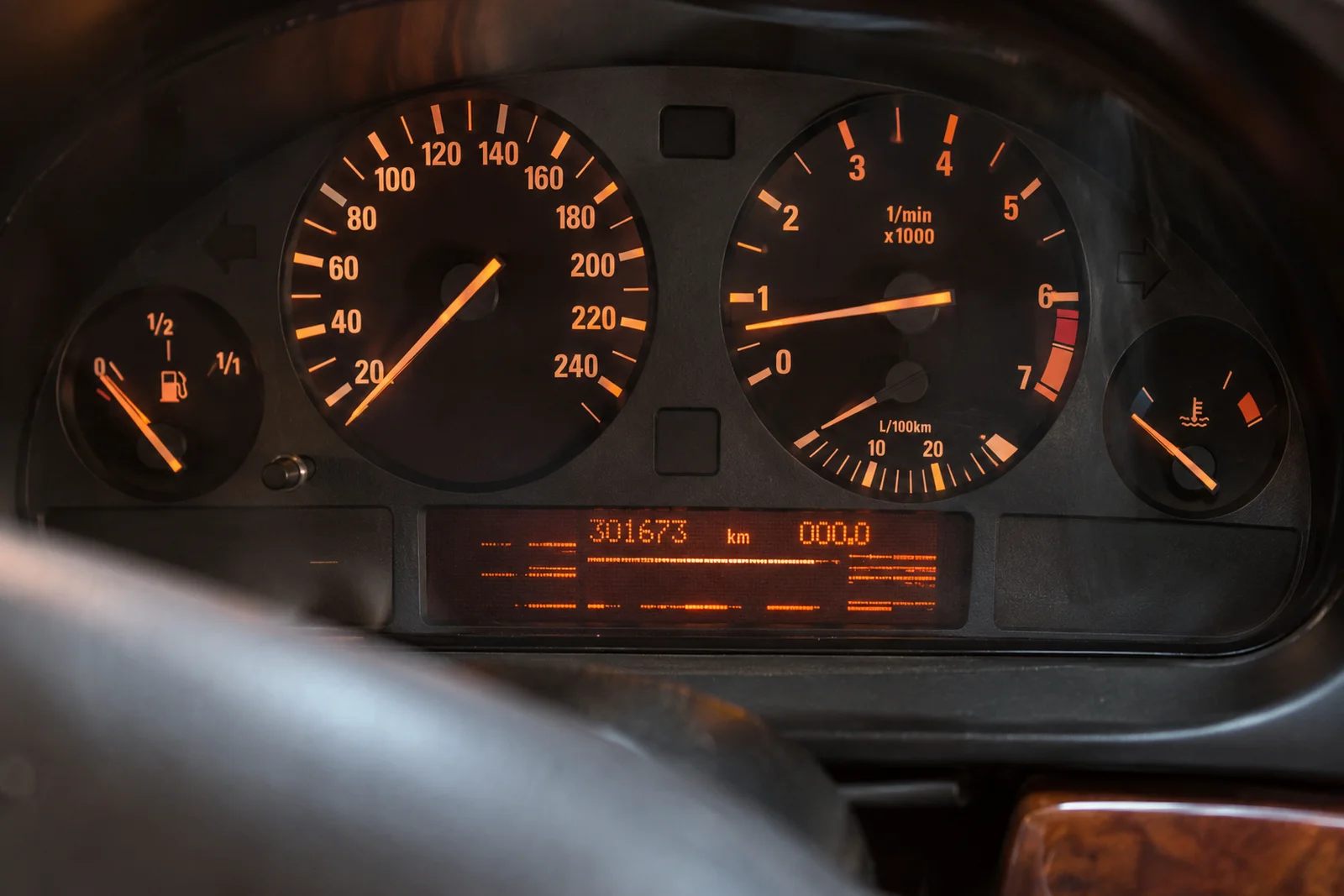
Check display connections, backlighting and brightness control. A ribbon, display or board repair may be possible once the failed component is identified.
Check fuses, supply voltage, grounds and network communication before bench testing. A black digital display may have a software or hardware cause.
Compare the displayed value with available live data from the DSC/ABS or engine electronics, then check network delivery and cluster response.
Compare sender or sensor data with the gauge response. Confirm whether the fitted gauge represents coolant or oil temperature; the meaning varies by vehicle.
Test battery condition, voltage during cranking, charging and communication faults. Do not assume every warning is caused by the battery or that the cluster is healthy.
Recheck the affected system and recorded fault before clearing memory. An active fault or incomplete setup needs attention; suppressing the warning is not the repair.
Identify before ordering
BMW cluster equipment varies within a model generation. Send your model, year and a dashboard photograph; the VIN, build date, part number and equipment list confirm compatibility.
Applicable E chassis cars can use IKE or KOMBI cluster designs with analogue gauges and pixel displays. Inspect the actual unit for display, backlight, motor or board faults.
Exact unit identification comes firstBasic, extended-display and multifunction digital equipment can differ within the same model family. Check the part number, hardware, software and head-up display compatibility where fitted.
A matching model badge is not enoughIdentify the installed display and software level before choosing a test plan. The instrument display behind the steering wheel and centre infotainment screen serve different functions.
Diagnose before programming or replacingFor the centre iDrive screen see navigation screen repair. For damaged dashboard trim see dashboard replacement.
Inside the cluster
A faded display, sticking needle and intermittent blackout can have different causes. The cluster design determines what we inspect and test.
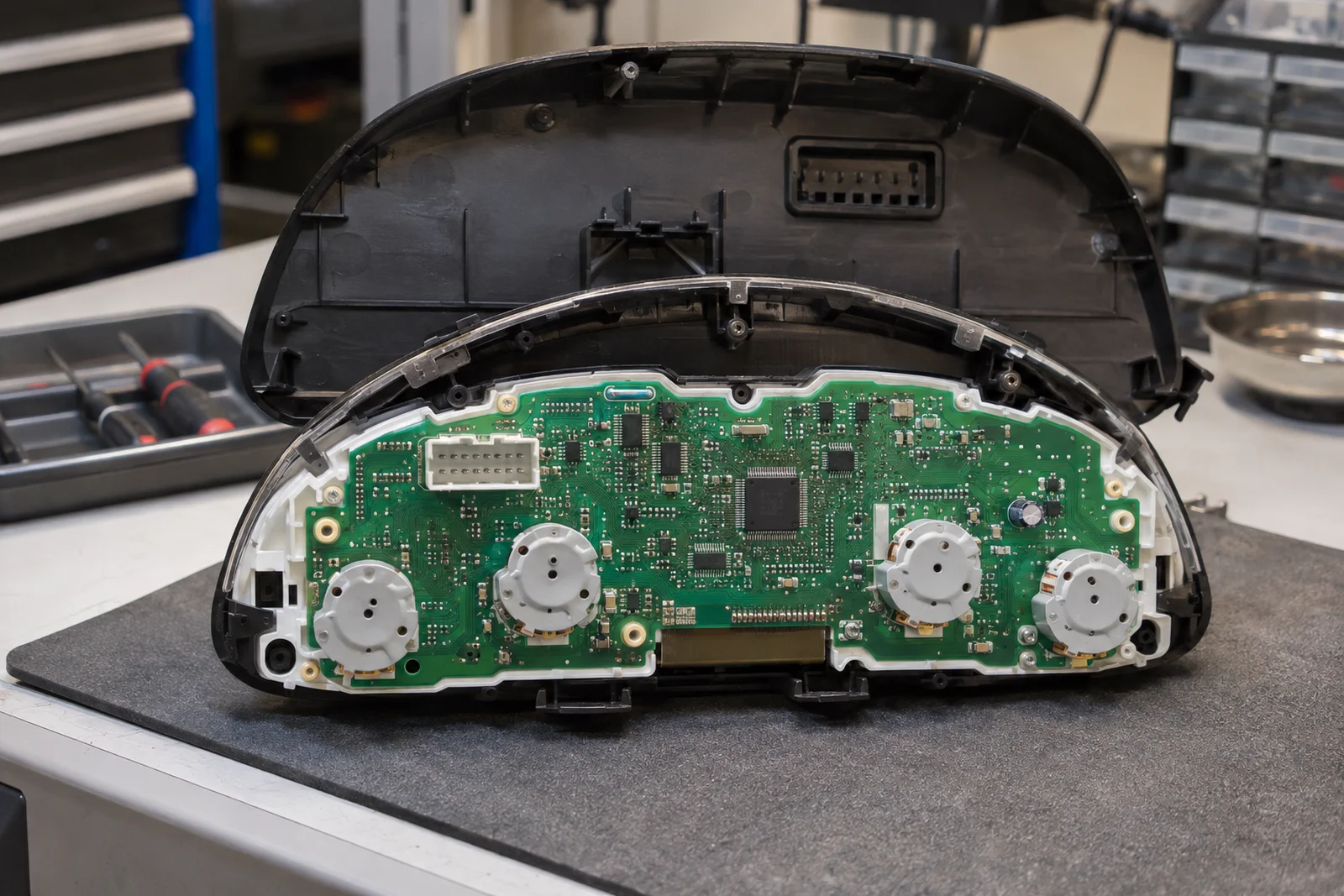
Board inspection looks for damaged components, solder faults and corrosion. Bench checks assess the display, gauge movement and lighting where supported.
Power supply and vehicle-side checks help separate a cluster defect from a fault elsewhere.
Connected systems
Diagnosis follows the signal as well as the gauge. The repair recommendation should explain which tests point to the cluster and which point elsewhere.
Vehicle identity and records
The aim is to retain the vehicle’s genuine recorded distance and correct configuration. Data recovery depends on the condition of the original unit and the replacement procedure supported by your BMW.
Document the displayed distance, vehicle identity and available service data. Save readable configuration where possible; a dead or damaged unit may prevent a complete backup.
Check the VIN, part number, hardware, software, market and fitted equipment. Used-cluster commissioning is not supported for every vehicle or unit.
Follow the applicable setup procedure and record the resulting readings. Check identity mismatch indicators, service information and returning faults.
Coding configures a compatible unit for the vehicle and its equipment. Programming writes applicable software where the test plan requires it. Data recovery concerns readable information in the original unit; none of these operations is a guarantee that damaged data can be recovered.
Data storage differs by generation and can involve a coding plug, lighting module, CAS or other vehicle electronics. Matching readings alone do not prove the complete mileage history. We do not offer mileage reduction or misrepresentation. For a used-car assessment, combine electronic checks with service records and a BMW inspection.
Your options
There are three ways to fix a faulty cluster. Which one fits depends on the test results, the age of the car and the price of parts.
We replace the failed parts on your cluster board, such as the display ribbon, gauge motors, lights or damaged components, and resolder cracked joints. We aim to preserve readable original data, then verify configuration and any setup required by the repair.
For confirmed repairable component faultsWhen the board is burnt, the screen is cracked or water has done too much damage, we assess compatible replacement options and the supported commissioning procedure. A used unit is considered only where compatibility and legitimate data handling can be confirmed.
Fits burnt boards and broken screensSome digital cluster faults, such as freezing or random reboots, come from software. Updating the cluster and the modules around it can clear them without any parts. We confirm this with testing before advising it.
Fits digital clusters with software faults
Dubai conditions
A car parked in the sun can get far hotter inside than the air outside, and the dashboard takes the full force. The cluster sits right under the windscreen, so it goes through a large heat cycle almost every day.
Tell us whether the fault follows hot parking, a cold start, vibration or cranking. Those conditions help reproduce an intermittent complaint; temperature alone does not identify the failed part.
How we work
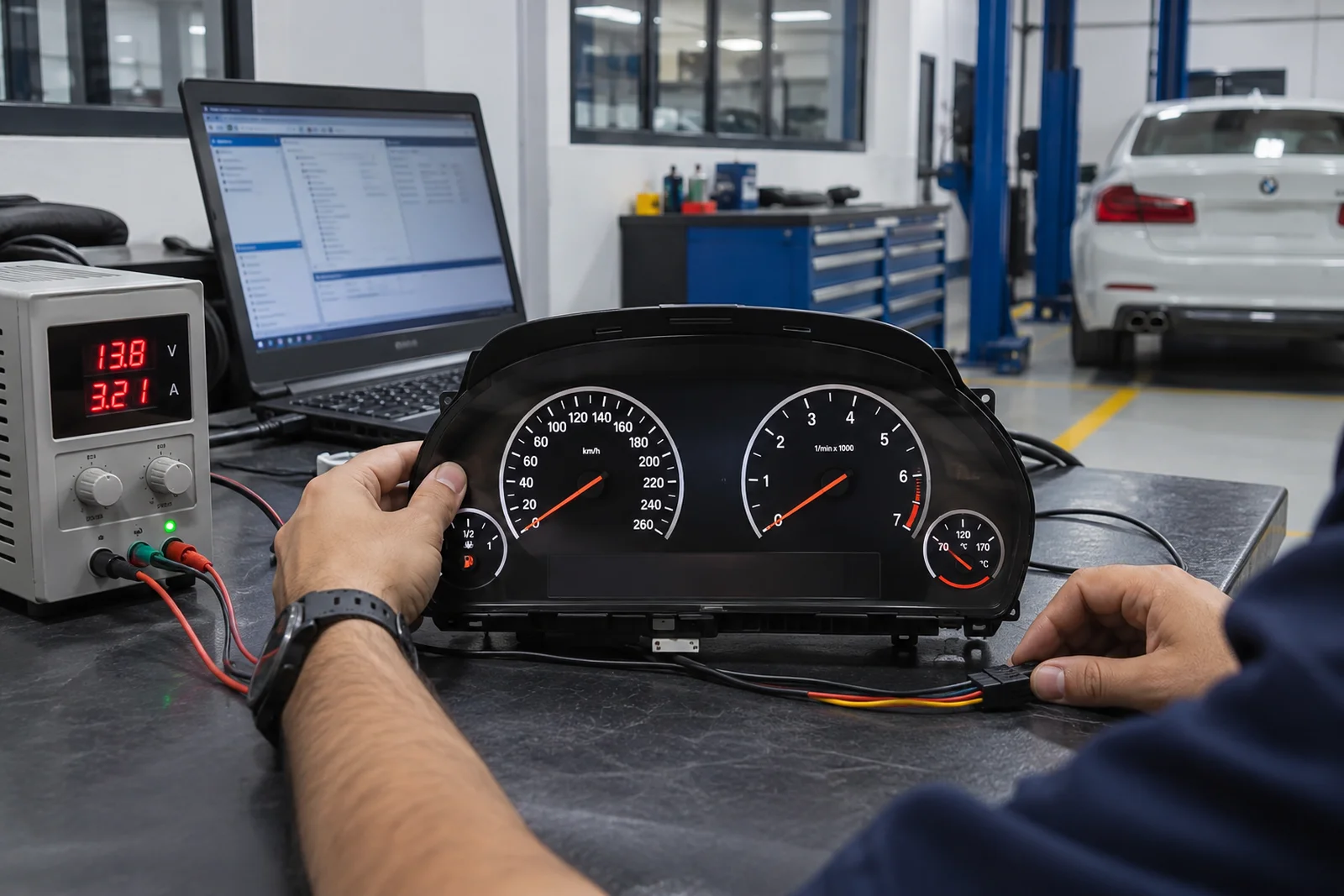
Connected systems
The cluster works with many other modules. If our tests point elsewhere, these are the repairs that usually follow.
Before you arrange a repair
A full module diagnostic scan starts from AED 150. Cluster repair is quoted separately after testing. Confirm circuit or bench assessment, removal, parts, refitting, required setup in the complete quote.
Some display, backlight, gauge and board faults are repairable. Diagnosis determines whether repair is suitable, a software remedy applies or a compatible replacement is needed. A cracked screen does not by itself establish which assembly must be replaced.
We aim to preserve genuine recorded distance and readable original data. A damaged or unresponsive module may limit recovery. The available records, supported procedure and before-and-after readings should be documented rather than guaranteed before assessment.
Only if the exact unit is compatible and the supported commissioning and vehicle-data requirements can be met. Confirm this before buying a donor cluster; matching the model or connector alone is insufficient.
It can indicate disagreement in vehicle identification or stored data after a component change or other fault. It needs diagnosis and record review; it is not by itself a complete conclusion about the vehicle’s history.
Some faults have model- and software-specific remedies. Check power, grounds, communication, equipment and applicable test guidance first. Programming is recommended only when indicated, using appropriate voltage support.
If you cannot reliably read your speed or essential warnings, stop somewhere safe and contact the workshop about collection. A missing pixel with all critical information readable is a different situation; describe exactly what has failed.
The time depends on reproducing the fault, bench work, data accessibility and parts availability. Confirm assessment timing first and the expected completion time with the repair quote.
Ask for the written terms for the specific board repair or replacement, including parts and labour coverage and exclusions. Confirm the terms before authorising the work.
Contact us before removal. The complete vehicle allows supply, network and incoming-signal checks as well as final verification. A bench-only assessment cannot rule out every vehicle-side cause.
Confirm diagnostic and bench fees, any repair-credit arrangement and unsuccessful-repair charges before assessment. Request a separate replacement quote if the original unit cannot be repaired.
Free pickup and delivery are offered across Dubai. Explain whether the car can be driven safely so the team can confirm suitable collection or recovery arrangements. Your appointment is confirmed after the inquiry.
Book a cluster check
Send your model, year, affected gauges and whether the fault is constant or intermittent. Mention recent battery work and include a dashboard photo taken while parked. Our BMW-focused team uses BMW diagnostic equipment, explains the assessment and confirms the repair quote before approval.
Confirm the test scope, completion estimate and written warranty terms with the team. An inquiry is not a confirmed booking.