Control or air leak
Repair after testingA pipe, sensor or actuator fault may not require a turbo. Quote the confirmed repair separately.
Low boost, smoke, whine and limp mode
A failing BMW turbo costs you power and can send oil and debris through the engine. We confirm the turbo is really the problem, find out why it failed and replace it with a new, remanufactured or rebuilt unit, along with the lines and seals that should be renewed at the same time.
Know what you are approving
The fitted repair price depends on the confirmed fault, VIN, access and selected parts. A part-only price cannot represent the complete job. Send the model, year and symptoms for an initial discussion; the repair quotation follows diagnosis.
A pipe, sensor or actuator fault may not require a turbo. Quote the confirmed repair separately.
Specify genuine BMW or the named supplier, installation kit and required oil or coolant work.
Confirm testing, actuator calibration, core deposit, return conditions and warranty.
Suitability depends on the housings, rotating assembly and controls. Agree inspection charges before dismantling.
This is the published starting price for a fault-code scan, not the full turbo diagnosis. Confirm additional test or dismantling charges and whether any diagnostic fee is credited before authorising them.
Ask for parts and labour, consumables, VAT treatment, any transport charge and exclusions in writing. Include core deposits and contaminated intercooler or exhaust work where applicable. Extra work needs approval.
Confirm parts availability, workshop time and the expected handover date after inspection. Ask for the applicable parts and labour warranty duration, mileage limit, exclusions and claim process on the estimate.
Before you buy a turbo
Many turbos are replaced when the real fault is a split boost pipe, a sticking wastegate, a boost sensor or a vacuum leak. A turbo is expensive, so these three questions come first.
These checks guide the diagnosis; no single symptom proves that a replacement is needed. Our turbo oil leak repair page covers leaks that do not need a new turbo.
The technician checks wheel damage, housing contact and radial or axial movement against the turbo specification. Some dry journal-bearing movement is normal; visible contact or damage needs specialist assessment.
Confirm the finding firstOil pooling and blue smoke require checks of the oil feed and return, crankcase ventilation and other engine oil-burning causes. Oil in the pipework alone does not prove internal turbo failure.
Confirm the finding firstActual and requested boost are compared with charge-air leaks, sensor readings, actuator operation and exhaust restriction. A fault code alone cannot distinguish these causes.
Confirm the finding firstRecognise the symptoms
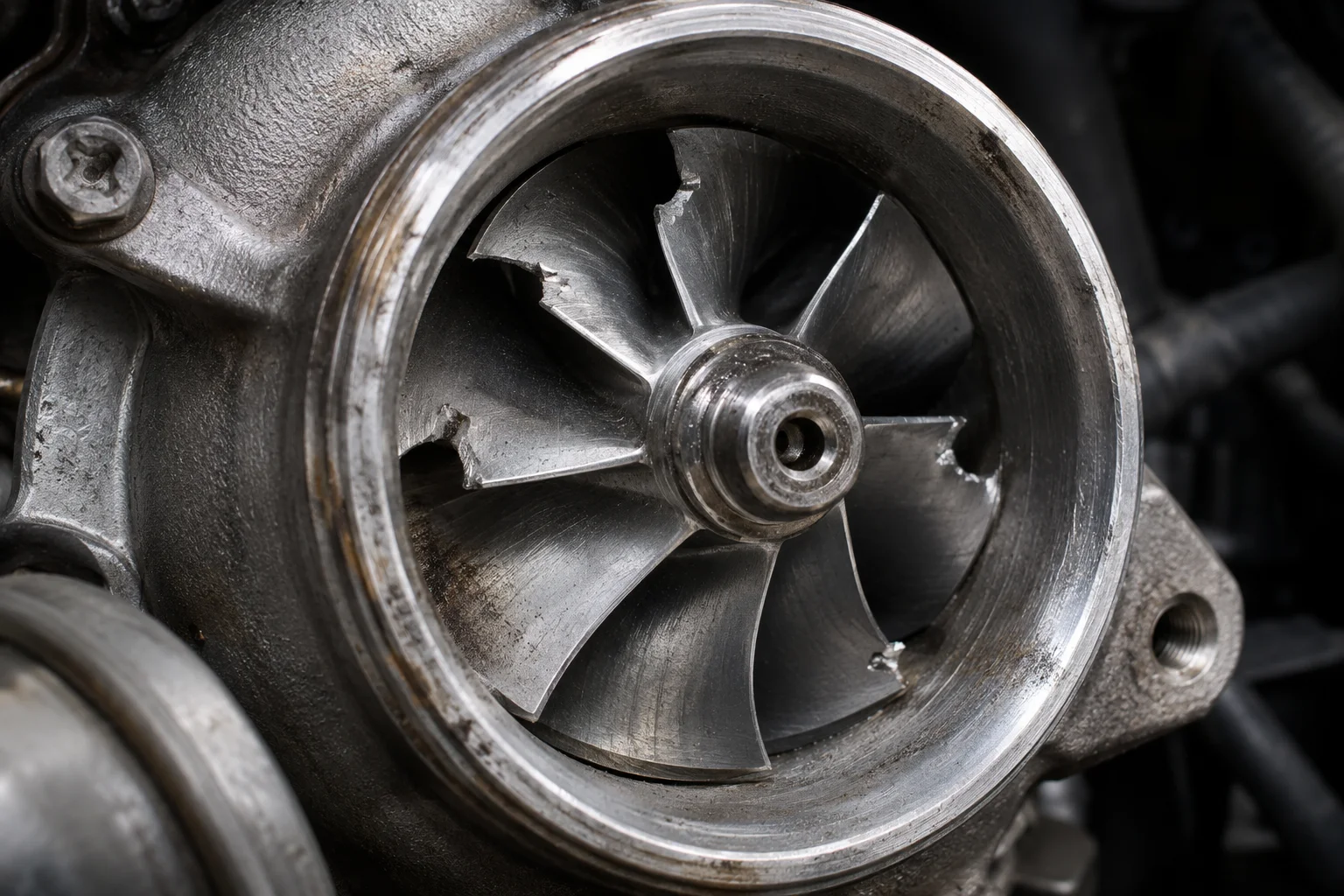
A warning sign starts the diagnosis
It does not confirm a new turbo
A split boost pipe, sensor fault or control problem can produce similar symptoms. A fault scan alone is not enough to condemn the turbo.
The car feels slow to pull, especially at mid range where the turbo should be doing most of its work.
A drivetrain malfunction message, reduced power mode or underboost faults stored in the engine computer.
A new whistle can come from escaping air; grinding can indicate internal damage. Stop driving if the noise is severe.
Oil burning in the exhaust, usually most visible under acceleration or after idling.
Possible air, boost, fuelling or emissions-system faults. A diesel particulate filter can mask visible smoke; smoke colour alone is not a diagnosis.
On some engines a loose wastegate rattles when cold or on and off the throttle.
Choose by condition and documented specification
Compare the actual supplier, test evidence and fitted quotation. The cheapest part is not necessarily the lowest total repair cost, and not every turbo can be rebuilt.
The CHRA is the centre housing rotating assembly containing the shaft, bearings and wheels. Replacing it does not resolve a cracked housing or worn control mechanism by itself. The technician checks the manifold, wastegate or variable vanes and actuator before recommending a route.
The job depends on the engine
BMW has used several turbo layouts, and each one changes the parts, the labour and what is replaced with the turbo.
Two turbochargers serve separate cylinder groups. Assess both individually. Shared access labour may favour replacing both when both show damage, but one failed unit does not automatically condemn the other.
One turbo with a divided exhaust inlet. On the N55 the turbo and exhaust manifold come as one assembly.
Electronic wastegate control on relevant versions. Follow the exact actuator setup and adaptation procedure for the fitted turbo; this is not automatically ECU coding.
Two turbos between the cylinder banks. Access is tight and heat is high, so lines, seals and coolant pipes are always reviewed.
High boost performance engines where turbo condition is checked closely on tuned and track cars.
Single and multi-turbo variants exist within these families. Verify the VIN, turbo stage and electric or vacuum actuator before choosing parts or assessing variable-vane operation.
Access depends on the engine, chassis, drivetrain and installed equipment. Heat shields, exhaust connections and surrounding components affect dismantling time. Model badges alone are not sufficient for ordering; the VIN, production date and existing turbo part number establish compatibility.
Fix the cause with the turbo
A new turbo fitted to an engine with the same fault will fail the same way. Each common cause has a matching fix that belongs in the same job.
When we remove a failed turbo, we look at how it failed. Blue staining and coked oil point to oil supply, chipped blades point to debris, and a cracked turbine housing points to heat. That evidence tells us what else needs fixing before the new unit goes in.
A blocked or coked feed line, or low oil level, cooks the bearings.
New feed line, oil and filterLong oil intervals leave sludge that wears the bearings.
Correct oil and appropriate service intervalsA failed ventilation valve pushes oil past the seals.
PCV system checkedGrit, a broken air filter or debris chips the compressor blades.
Contamination assessed and damaged parts replacedBoost leaks or aggressive tuning spin the turbo too fast.
Boost system testedA blocked catalyst or diesel particulate filter overheats the turbine.
Exhaust back pressure checkedNot just the turbo
Installation items depend on the vehicle and turbo supplier instructions. The quotation should identify mandatory replacement parts and any additional parts required because of damage or contamination.
If the turbo shed metal or oil, the whole charge-air path needs inspection. The intercooler is downstream of the compressor, so retained debris can reach the engine. Replace a contaminated cooler when safe cleaning cannot be assured, particularly after wheel break-up; cleaning is not an automatic substitute. On diesels the particulate filter and catalyst are checked for blockage, since a restricted exhaust is a common reason a turbo overheats.
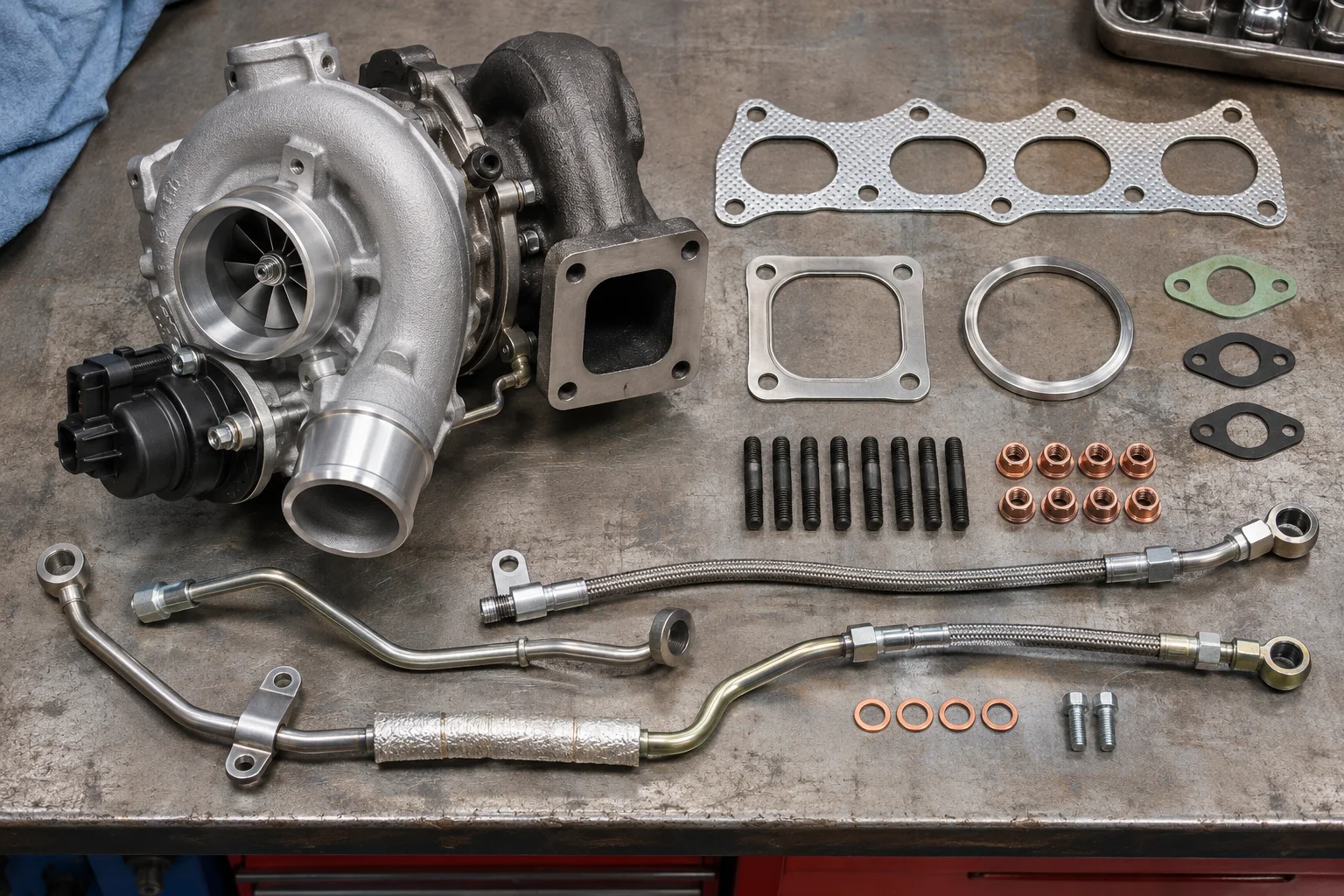
More boost, more stress
Tuned BMWs often run more boost than the factory turbo was designed for, and that is one of the reasons turbos fail early on modified cars. When a tuned car needs a turbo, the first question is whether to return it to standard or fit an upgrade.
An upgraded turbo needs matching software, fuel delivery and cooling to work properly. Without them it can make less power than standard or put the engine at risk. Our BMW tuning page explains remaps and what they ask of the engine.
Factory turbo and factory software. The simplest route for a car that will be kept or sold.
Possible on mild tunes, but boost should be checked against what the turbo can handle.
A larger unit with matching software. More power, more cost and more supporting parts.
Make the new turbo last
The technician follows the turbo supplier priming and first-start procedure, verifying lubrication before loading the engine.
Follow the specific turbo supplier and BMW instructions. There is no single break-in mileage that applies to every turbo replacement.
Avoid high load while the engine oil is cold. Follow the vehicle instructions for cooling down after sustained high load.
Use the BMW approved oil grade and change it on time, sooner if the car does a lot of short trips.
Cooling arrangements and after-run operation vary by model. A fixed idling time is not a universal requirement. Use the correct BMW oil approval, maintain the specified level and discuss service intervals appropriate to the vehicle and driving conditions. Report renewed smoke, oil consumption or boost warnings promptly.
How the job is done
Fault scan, boost and smoke tests, shaft play check.
Oil supply, crankcase pressure and exhaust restriction checked.
Part options, the cause, related parts and the full cost.
Old turbo removed; intake, charge-air cooler and exhaust checked for contamination. Replace parts that cannot be safely cleaned.
Specified installation parts renewed; oil supply and return verified before fitting.
Oil pressure built before firing, then idled and checked for leaks.
Required actuator setup completed. Keep diagnostic evidence, check for leaks, then verify boost safely and recheck faults.

If anything else is found during the job, such as a cracked manifold or a leaking coolant pipe, we send photos and price it separately, and nothing extra is done without your approval. The old turbo is kept for you to see, unless it is returned as an exchange core.
Clear answers before you book
Compare the repair options, understand the quote and know when to arrange recovery.
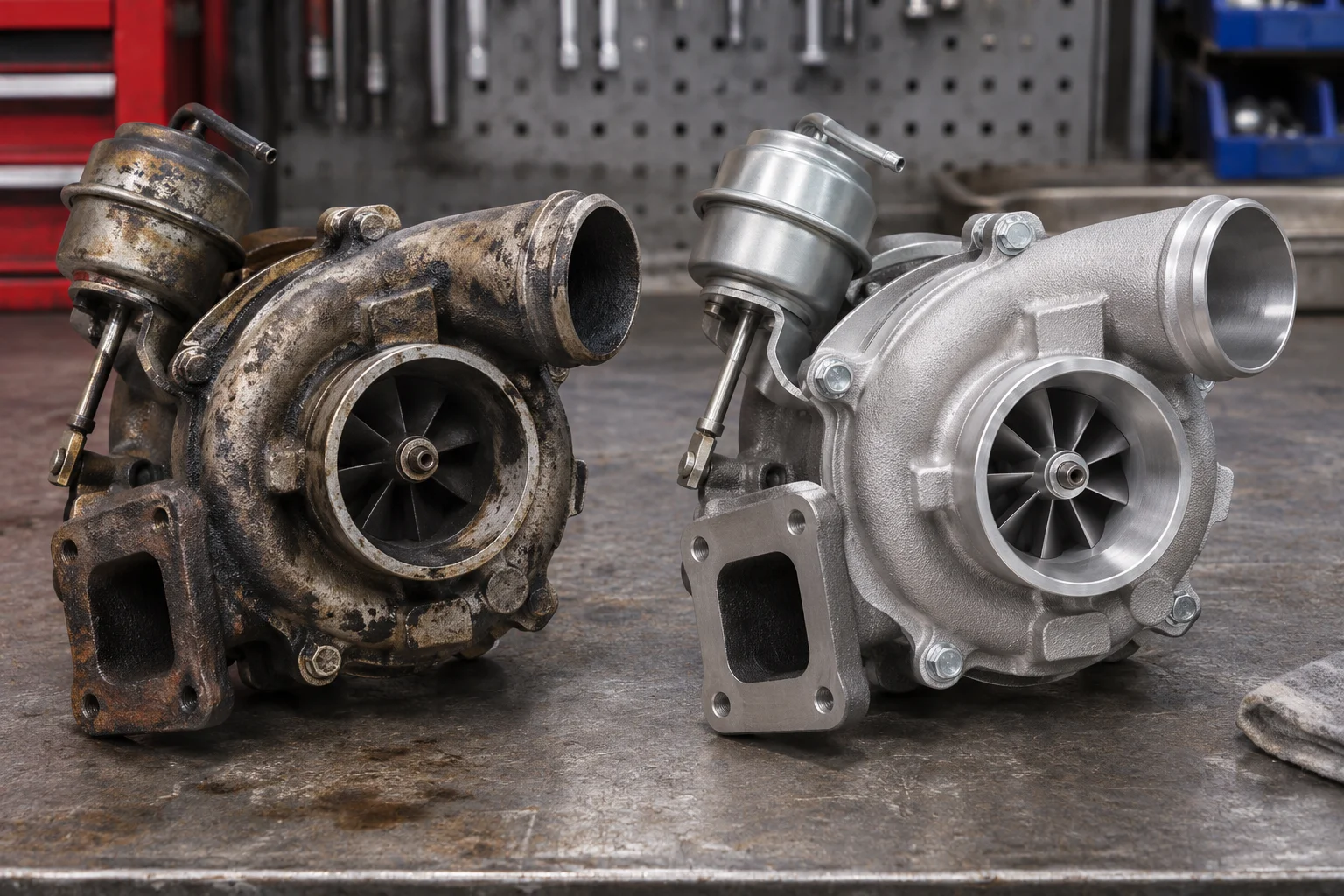
After identifying the fault, the estimate should separate the selected part, labour, related installation items, diagnostic charges and VAT treatment. Any recovery, exchange-core deposit or extra dismantling should be stated before approval.
Coverage depends on the selected part and agreed work. Request the duration, mileage limit, parts and labour coverage and exclusions in writing before choosing an option. There is no single warranty promise here covering every supplier or repair.
Contact us to confirm pickup eligibility, access and scheduling. A car with severe smoke, oil-pressure warnings or mechanical noise may need recovery; confirm its charge separately before dispatch.
Not automatically. Both units need inspection. Compare a single-unit repair with a pair only when the condition of the second turbo and shared access labour justify it. The estimate should state the evidence and price difference.
A quality remanufactured unit from a known supplier is a good value option for many owners. We explain the supplier, the terms and any core return before you choose, so you can compare it fairly with a new unit.
If the housings are sound, the core can sometimes be replaced. We check the housings and wastegate before suggesting it.
A turbo is not automatically an ECU coding job. Some versions require actuator adjustment, calibration or adaptation; others have different installation procedures. Confirm the requirement for the exact part and engine.
We can fit genuine BMW, OE supplier, remanufactured or rebuilt turbos. We price the options and you choose which one is fitted.
Do not assume it is safe to drive. Stop safely and arrange recovery for heavy smoke, grinding, rapid oil loss, an oil-pressure warning or sudden severe power loss. Do not rev a smoking diesel to test it. Describe milder symptoms by phone so the transport decision can be made before the car moves.
Not always. Sticking vanes, a boost pipe leak or a blocked particulate filter can cause the same symptom. We test the relevant turbo stage and controls before quoting. Cleaning is considered only where the unit is serviceable and the manufacturer or specialist procedure permits it.
Old lines can hold carbon that breaks loose and blocks the new turbo oil supply. Replacing them protects the new unit, and most turbo suppliers expect it.
Many last a very long time with good oil care, warm ups and cool downs. Short trips, long oil intervals, heat and tuning all shorten that life.
Request the fault report, relevant test readings and photos of confirmed damage. The estimate should explain why a control repair, specialist rebuild or replacement is appropriate. Keep the supplier identity, part number and warranty with the invoice. Page images show components and repair concepts; they are not presented as records of your car.
Technical references include Garrett turbo diagnosis guidance and Nissens charge-air cooler contamination guidance. The exact BMW and component installation procedure takes precedence for your vehicle.
Low boost or a turbo warning?
Tell us your model, engine and what the car is doing. Tell us whether it is safe to move. Confirm pickup availability or a recovery arrangement and any transport charge before booking. We confirm the turbo condition and quotation before repair approval.