Bolt-on hub assembly
AED 900 to 1,800Estimated total for one new application-matched aftermarket hub unit, routine fitting, standard replacement hardware and final mechanical checks.
Front and rear wheel bearings and hubs
Humming, grinding or vibration from a wheel? Arrange a BMW wheel bearing inspection in Dubai. We distinguish bearing faults from tire and brake noise, explain whether a bearing or hub is needed and quote before replacement.
Plan your repair
These estimated budgets cover one wheel, not an axle pair. They help compare the likely repair options and are not fixed workshop offers. The final quotation depends on inspection, part choice and access.
Estimated total for one new application-matched aftermarket hub unit, routine fitting, standard replacement hardware and final mechanical checks.
Estimated total for one new aftermarket bearing, routine removal and pressing, required standard hardware and final checks, assuming the existing hub is reusable.
Estimated total when both a pressed bearing and its separate hub need replacement. Includes routine fitting, standard hardware and final mechanical checks.
Genuine BMW or specialist assemblies may cost more. Additional ABS diagnosis, wheel alignment where needed, seized shaft removal, damaged wheel carriers, tires, brakes and recovery are excluded unless listed in your quotation. Routine removal of a serviceable unit is different from repairing impact or corrosion damage.
The written quote should state the affected corner, part brand and number, labor, hardware, additional tests and total payable. Any inspection fee, parts lead time and applicable warranty terms should be clear before approval. If removal reveals further damage, the revised work and cost should be explained first.
Warning signs
Bearing, tire, brake and drivetrain problems can produce overlapping symptoms. These signs do not follow a reliable sequence, and none proves which component has failed. A noisy bearing may have no obvious hand-detectable play.
When driving is unsafe Severe grinding, excessive wheel looseness or unstable handling needs a safety assessment and suitable recovery. Do not wait for another symptom or attempt a diagnostic drive yourself.
Finding the right corner
Cupped or worn tyres can sound almost the same as a failing bearing, and noise travels through the body so it is hard to tell which corner it comes from. These are the checks we use.
After a safety assessment, a technician may compare noise with speed, road surface and gentle cornering. Sound can travel from another corner, so this is one clue rather than proof. Do not weave in traffic to test the car yourself.
The wheel is rotated where the design permits, checking roughness and noise. Brake drag and drivetrain resistance are considered; a quiet unloaded bearing can still need further testing.
Wheel movement is traced to the bearing, suspension joints or other components. Where needed, measured play is compared with the vehicle specification.
Listening equipment can help compare noise at different locations when the source is unclear. Its findings are considered alongside mechanical checks.
Tread is checked for cupping that could be causing or adding to the noise.
Not every bearing is the same
Two common replacement arrangements are shown below. The generation, axle and fitted wheel carrier determine the actual work; neither the BMW badge nor xDrive alone identifies the bearing type.
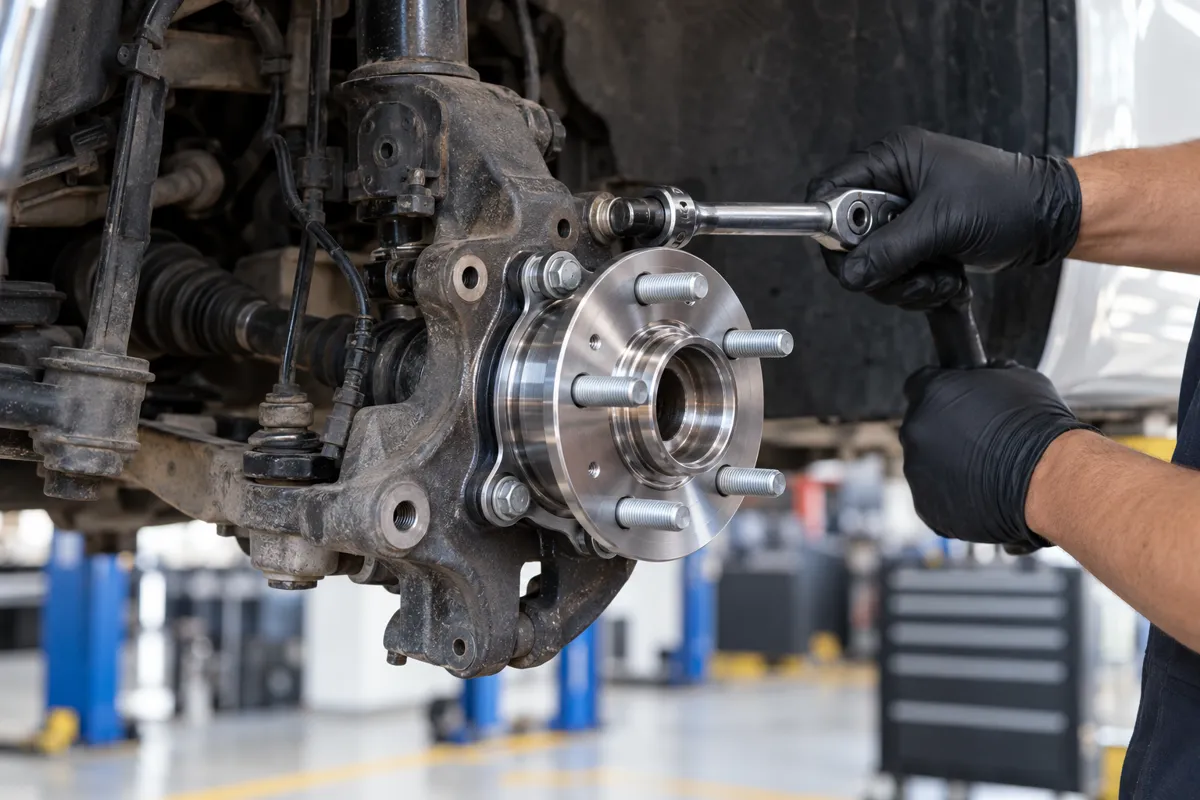
The bearing comes as a complete unit that bolts to the steering knuckle. The old unit is unbolted and the new one fitted, with no pressing needed.
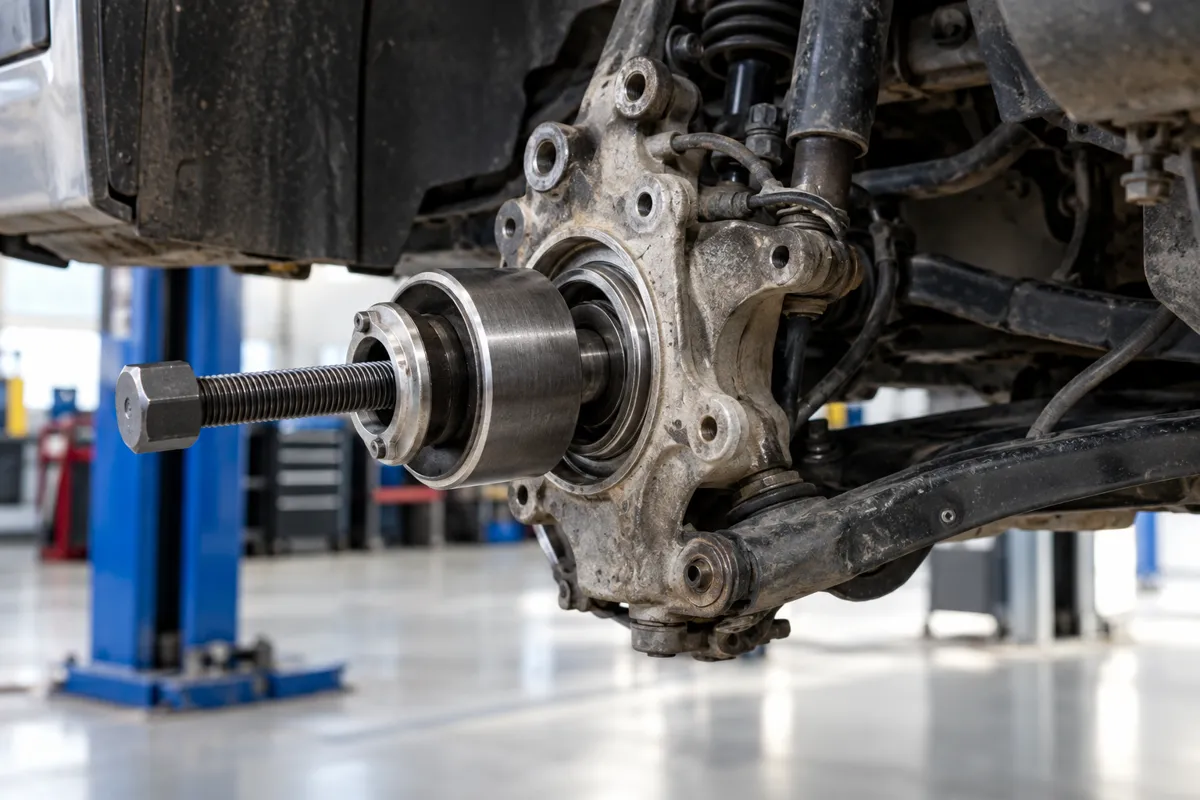
The bearing is pressed into the wheel carrier and the hub is pressed through it. It needs a hydraulic press or special puller tools.
Some models mix both styles, with a bolt on unit at the front and a pressed bearing at the rear. We confirm which type your car uses from the chassis number before quoting, so the price reflects the real job.
Common question
Not automatically. A confirmed fault at one corner can be repaired on its own when the other bearings pass inspection and the applicable repair instructions allow it.
When diagnosis isolates one faulty bearing and checks do not justify replacement elsewhere. A quiet hand-spin test alone is not a complete assessment.
When both bearings are confirmed faulty. Mileage alone does not prove the opposite bearing needs replacement.
The other corners are checked for relevant symptoms and mechanical concerns. Findings determine the recommendation, rather than automatic replacement of all four.
Example costs
These are example repair budgets, not completed customer jobs or fixed offers. All assume new application-matched aftermarket parts and normal access. Actual fitment and condition determine the final quotation.
Example of one front hub assembly on an applicable specification. Parts and standard hardware allowance AED 650, routine fitting and final checks AED 350.
AED 1,000This example excludes additional ABS diagnosis and alignment if other disturbed components make it necessary.
Example of one pressed rear bearing with a reusable hub. Bearing and hardware allowance AED 550, routine removal, pressing and final checks AED 650.
AED 1,200A seized driveshaft, damaged hub or wheel-carrier repair would require a revised quotation.
Example of one bearing and separate hub on an applicable rear assembly. Parts and standard hardware allowance AED 1,100, routine fitting and final checks AED 800.
AED 1,900The opposite bearing, sensor replacement, recovery and additional damage are excluded.
More than a noise
Wheel-speed signals help ABS and stability systems operate. An encoder-equipped bearing can affect that signal, but an ABS or DSC warning does not by itself justify bearing replacement.
Depending on the fitted design, the sensor reads an integrated magnetic encoder or a separate reluctor arrangement.
The sensor reads the ring and reports how fast that wheel is turning.
The stability system compares all four wheels many times a second.
ABS, traction control and the xDrive transfer case act on those readings.
Bearing movement, encoder damage, contamination or incorrect installation can affect the wheel-speed reading on applicable designs. Wiring faults, connector damage and sensor faults can produce similar warnings. The diagnostic result must identify the cause rather than assuming that the warning names the failed part.
Fault codes and live wheel-speed data guide the checks. The sensor, wiring, connector, encoder and mechanical condition are assessed as appropriate. Codes are recorded before repair, then cleared and rechecked after the cause has been addressed. A mechanical bearing fault may exist without a stored fault code.
Front or rear
The position of the bearing changes what has to come apart to reach it. These are typical access steps, not instructions for every model. The fitted bearing design determines whether a hub is unbolted or a bearing is pressed out.
How the job runs
The aim is a quiet car and a bearing that lasts. This is how we get there, step by step.
A clear quote before the repair. Checks after the new bearing is fitted.
We assess whether the car is safe to drive before a road test. Severe looseness, grinding or unstable handling requires inspection and suitable recovery rather than a test drive.
Mechanical checks and, where needed, listening tests compare the corners. Tires, brake drag, CV joints and drivetrain noise are considered before recommending replacement.
You get the bearing type, the parts options and a clear price before anything is ordered.
The bearing or hub is replaced with the correct tools, using a new axle nut and bolts where BMW calls for them.
Relevant fault codes and wheel-speed readings are checked before and after the repair. Clearing codes alone is not proof that the cause has been resolved.
Once safe, a final road test checks the original complaint. Remaining tire, brake or drivetrain noise is explained separately.
Care during fitting
Choosing the right part is only the start. Mounting damage, incorrect tightening or a damaged encoder can cause repeat noise or a wheel-speed warning after replacement.
The hub shaft, bearing seat and wheel-carrier bore need inspection for scoring, corrosion or damage. A new bearing should not be installed into a damaged fit without addressing the cause. Mounting surfaces must be clean and the assembly properly supported.
The tool supports the correct ring for each pressing operation so force is not transmitted through the rolling elements. Where a magnetic encoder is fitted, its orientation must match the sensor. The seal must be protected from impact, contamination and inappropriate tool contact.
Specified single-use nuts, bolts or retaining rings are renewed. Tightening follows the BMW procedure for the actual assembly, including torque-angle steps where specified. Brake operation, wheel fastening and relevant wheel-speed readings are checked before a safe final road test.
These principles follow bearing-manufacturer installation guidance. See NSK wheel hub fitting guidance. The exact procedure and tightening values must come from the vehicle-specific repair instructions.
Your parts options
A brand label alone does not establish suitability. Compare the part number, supplied hardware, application and documented warranty alongside the fitted price.
BMW-branded parts are selected against the vehicle specification. Kit contents vary, so a bearing price should not be assumed to include every required nut, bolt or separate hub.
Brands such as FAG and SKF offer automotive bearing applications. Supplying vehicle manufacturers does not mean every aftermarket product is identical to a BMW-boxed part. Check the exact catalog reference and traceable supply.
Keep the invoice showing the replaced corner, part supplied and agreed warranty terms. Request an explanation of the inspection findings and final checks. Actual workshop records are more useful than a generic promise that every noise will disappear.
Correct fitment
3 and 4 Series, 5 Series, 7 Series, X3, X5, X6 and M vehicles use different bearing and hub applications across their generations. Start with your model and symptom; the workshop handles the technical matching.
A model year can contain production changes. The VIN may be requested privately before ordering to identify the correct catalog application and avoid an unsuitable part.
Front or rear position, driven or non-driven hub, wheel carrier and steering or suspension equipment affect the assembly. Rear-wheel drive and xDrive labels alone are not enough.
The quote should identify the bearing or complete hub, side, quantity and required hardware. Sensor compatibility and the supplied kit contents are checked separately.
The part behind the brake disc
A wheel bearing allows the hub to rotate while carrying radial and cornering loads. Many modern BMW applications use sealed, pre-lubricated bearings. Depending on the design, a wheel-speed encoder may be integrated with the bearing or hub, or the sensor may read a separate reluctor.
Carries wheel loads that vary with vehicle weight, braking, cornering and road conditions.
Takes the side loads every time the car turns.
On encoder-equipped designs, the wheel-speed sensor reads a ring associated with the bearing or hub.
Sealed units are not routinely regreased. Damaged seals and contamination can shorten their service life.
Why they fail
Bearings can run for a very long time, but a few things cut their life short. Knowing the cause also helps stop the new bearing failing early.
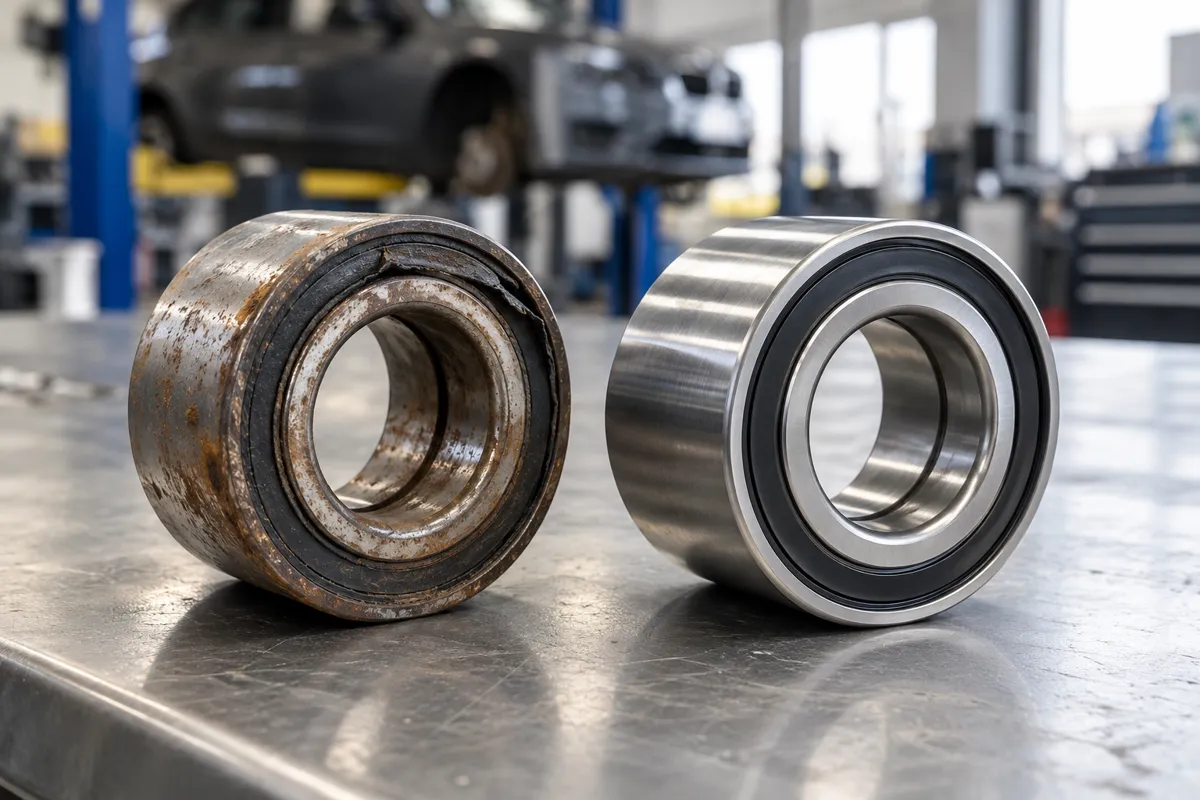
A single heavy hit can dent the bearing races, starting a hum that slowly grows.
Damaged seals can allow moisture and contamination into the bearing. Avoid directing high-pressure jets at wheel-end seals.
Wheel offset, spacers, tire fitment and loading can affect bearing forces. Wheel diameter alone does not establish the cause of failure.
Excessive wheel-end heat can affect lubrication and seals. Brake drag should be investigated when heat is abnormal.
An axle nut or hub bolts tightened incorrectly in past work can overload the bearing.
Bearings are selected for the vehicle application. Overloading and unsuitable modifications can increase stress beyond intended conditions.
Dubai heat, water exposure and road impacts are relevant inspection details, but a road name or model is not evidence of a particular failure. Tell us about any recent impact, wheel change or repair. The old bearing, hub and mounting surfaces can help explain why replacement is needed.
Waiting has a cost
A bearing does not fix itself, and the noise is only the first part of the wear. Once the races are pitted, heat builds and the damage speeds up.
Once the work is done
Final checks address the diagnosed bearing fault. A replacement cannot guarantee silence from unrelated tires, brakes or drivetrain components.
Noise caused by the replaced bearing should be resolved. A remaining noise needs reassessment.
Bearing-related signal faults are checked again. Other warning causes require their own diagnosis.
Reducing impact loads helps protect wheels, tires and suspension as well as bearings.
Keep pressure washer jets away from the hubs.
Related repairs
These jobs often go together with a wheel bearing, or cause symptoms that sound similar.
Your questions
Humming, growling, vibration or wheel movement can justify an inspection, but do not identify a failed bearing on their own. Tire wear, brake drag and drivetrain faults can sound similar. A bearing may be noisy without obvious looseness, so the workshop compares several findings.
The budgeting ranges above allow approximately AED 900 to 1,800 for one bolt-on hub or AED 1,000 to 2,000 for one pressed bearing with a reusable hub. They include routine fitting, standard hardware, final checks and a allowance. They are estimates, not fixed offers; extra diagnosis or damage is quoted separately.
Yes, on applicable encoder-equipped designs, bearing movement or encoder damage can affect the signal. However, sensor, wiring and connector faults can produce the same warning. Fault codes, live data and physical checks are needed before choosing the repair.
The workshop compares noise with speed and road surface, inspects tread and checks the wheel ends. Cornering changes can help but do not reliably identify the side alone. Do not swerve in traffic to test it yourself. Tell us when you hear the sound and whether it changed after tire or wheel work.
Not automatically. One confirmed faulty bearing can be replaced when the others pass inspection and the applicable procedure allows it. Both are recommended when both are faulty, not simply because the car has reached a particular mileage.
Arrange prompt inspection. If grinding is severe, a wheel feels loose or the car is unstable, stop safely and arrange suitable recovery. Do not drive it to the workshop or rely on a driven collection service. Symptoms described over a message cannot establish a safe remaining distance.
A bolt-on unit normally combines the bearing and hub. With a separate pressed bearing, a sound hub may be reusable. Damage to the hub fit or flange can justify replacement too. The quote should make clear whether it includes a bearing, hub assembly or both separate parts.
Timing depends on the fitted design, part availability, access and corrosion or seizure. A routine bolt-on job may involve less work than a pressed bearing or seized driveshaft. Request a completion estimate with the quote rather than assuming every BMW can be finished in the same time.
Not automatically for every hub-only replacement. Alignment may be needed when the knuckle or suspension geometry is disturbed, or when impact damage or handling symptoms justify it. The vehicle-specific procedure and actual work determine the requirement; the quote should identify any separate charge.
The applicable parts and workmanship terms and any inspection charge should be stated in your quotation. No universal warranty duration or free inspection is included in the estimated budgets on this page. Confirm these terms before approving work.
Call or WhatsApp with your BMW model and a short description of the noise. You do not need to identify the faulty corner or part. The Al Quoz workshop is open Monday to Saturday, 9am to 7pm. Ask about collection arrangements and mention any symptoms that require recovery.
Book a noise check
Tell us your model and when you hear the noise. We inspect the possible causes and explain the recommended repair and price before work. Mention severe grinding, wheel looseness or unstable handling so suitable recovery can be discussed.