

When a low X5 needs recovery
Follow the exact warning and your vehicle handbook. A car that briefly rises again is not automatically safe to drive. Tell the recovery provider how low it sits so they can assess suitable loading equipment and charges.
Photograph the stance and warning only while safely parked. Never put yourself under an X5 supported by its air suspension alone or by an unsupported jack. Suspension height can change, including when the vehicle is stationary. Pressurised lines and components belong with a qualified technician following the correct support, pressure-release and electrical-isolation procedure.
If the X5 still looks level, read the full message rather than judging safety by appearance. Do not repeatedly restart it, force height changes or clear codes to make a warning disappear. Keep passengers and cargo within the vehicle limits and arrange an assessment before relying on normal operation.
Confirm which suspension your X5 has
The X5 badge does not identify one air-suspension layout. Generation, market specification and factory options determine which axles use air springs and which controls are fitted. Check the VIN, build information and the actual hardware before ordering parts.
| Generation | What to establish | Why it changes the repair |
|---|---|---|
| E53 | Confirm the original equipment, the air-sprung axle or axles and any later conversion. | An early X5 needs its actual arrangement checked; age or badge alone cannot select a spring or air-supply unit. |
| E70 | Identify fitted rear self-levelling equipment and the correct air springs, supply assembly and controls. | A separate rear air spring is a different job from replacing a damper or an integrated strut. |
| F15 | Check the chassis package and rear-air equipment by VIN. BMW described rear air suspension with particular packages. | Package names and standard equipment vary by market; a model-year-only parts search can mislead. |
| G05 | Confirm whether the vehicle has two-axle air suspension, its build date and chassis options. | Front and rear assemblies, height functions and service procedures differ from a rear-only system. |
BMW's F15 launch information describes rear-air suspension with specific packages. Its G05 launch information describes optional two-axle air suspension in that market. These explain the distinction; they do not establish the specification of an individual UAE or imported X5.
Air springs and dampers do different jobs
An air spring supports the vehicle using compressed air. A damper controls suspension movement. Some applications use separate components; others combine them in an air strut. Electronic damping, self-levelling and driver-selected heights depend on the equipment. Replacing a spring does not automatically repair a damping fault or restore every chassis function.
Some equipped X5s deliberately change height for a loading setting or a driving mode. Check the selected function and handbook before calling every change a failure. A persistent uneven stance, an unexpected drop or a warning still needs investigation. Tell the workshop which mode was selected and whether the car returns to its specified height; do not repeatedly operate it to see how far it can move.
Match the symptom to the right checks
Tell the workshop what changes between parking, starting and driving. A photograph or sound recording can show the complaint, but it cannot prove which part failed. The same low corner can have more than one cause.
| What you notice | Possible explanations | Useful workshop checks |
|---|---|---|
| One corner drops while parked | Air spring, connection, line or valve leakage; height control also needs consideration. | Record height on level ground, compare sensor data and inspect the relevant air paths for leakage. |
| Both rear corners sit low | A shared air-supply/control problem or leakage at more than one point. | Check the fitted layout, supply circuit, valve operation and the two sides. Do not assume both springs failed. |
| Compressor runs repeatedly | Air loss, poor filling performance, electrical supply or control faults. | Assess leaks and permitted commanded operation with supply/current and pressure or filling behaviour. |
| The vehicle will not rise | Supply failure, control inhibition, sensor fault or a leak beyond the system's ability to compensate. | Read relevant chassis faults and live data, then test the circuit indicated by the findings. |
| Ride is harsh but height looks normal | Damping, tyres, suspension joints or restricted travel, as well as a possible levelling issue. | Check ride height and chassis condition. Normal appearance alone does not rule out a fault. |
| Warning follows suspension work | Disturbed wiring, sensor/link position, a leak or a required setup step. | Review the work, inspect affected parts and follow the applicable test and calibration procedure. |
A compressor sound alone cannot establish compressor failure. Likewise, a warning code naming a height signal does not automatically condemn the sensor. The linkage, wiring and actual vehicle position must agree with the data before a part is ordered.
Useful observations before the appointment
- Which corner changesTake a side or rear photograph from outside the parked car. Note whether it is one corner, a whole axle or the entire vehicle.
- How long it was parkedRecord whether the change happens within minutes or after an overnight stop. Avoid treating one sloping parking space as a measurement.
- What happens after startingNote whether it rises, remains low or drops again. Do not repeatedly command height changes to reproduce the fault.
- Recent changesBring details of suspension work, a battery event, an impact, new tyres or unusually heavy loading.
Include the exact dashboard wording and any limits it gives. Avoid reaching under the vehicle to find a leak or disconnecting a line to see whether air comes out. The workshop can reproduce the concern under controlled conditions with proper support.
How the workshop should narrow the fault
A useful assessment connects a test result to the proposed repair. It should establish whether the problem is loss of air, inadequate supply, an incorrect signal or another suspension fault. Ask what the findings support and what remains uncertain.
- Identify equipment and read the relevant modules
- Confirm the fitted system and use a BMW-capable tool that accesses the relevant chassis or level-control modules. Record faults and conditions before clearing anything; a generic engine-code reader may not access the required data.
- Compare physical height with reported height
- Measure using the vehicle procedure and compare readings with live sensor values. Inspect sensor links and connectors for damage or disturbance. Do not apply a universal ride-height figure across all X5 generations and wheel packages.
- Check air loss under the appropriate conditions
- Inspect springs, connections, lines and valves using suitable leak checks. Some leaks depend on height, load or temperature. A single quick observation may need a controlled pressure-holding or parked check before the fault is located.
- Assess electrical supply and air delivery
- Check the relevant fuse/relay, wiring and power supply, then evaluate compressor performance where commanded operation is permitted. Noise, current and filling behaviour need interpretation together.
- Explain the repair and confirmation plan
- Identify the failed component, required parts and any setup. Agree the further test charge or repair scope before work proceeds. The result should explain why that part is needed, rather than simply list codes.
For a warning or persistent sagging, our BMW level-control diagnosis service explains the workshop assessment route. Broader chassis faults belong with BMW suspension inspection and repair.
Repair the leak or replace the air spring
A repairable connection, wiring fault or damaged line requires a different job from a cracked air-spring bellows. The workshop should identify the leaking point and follow the component's approved repair method. A vague promise to patch an airbag is not an adequate repair specification.
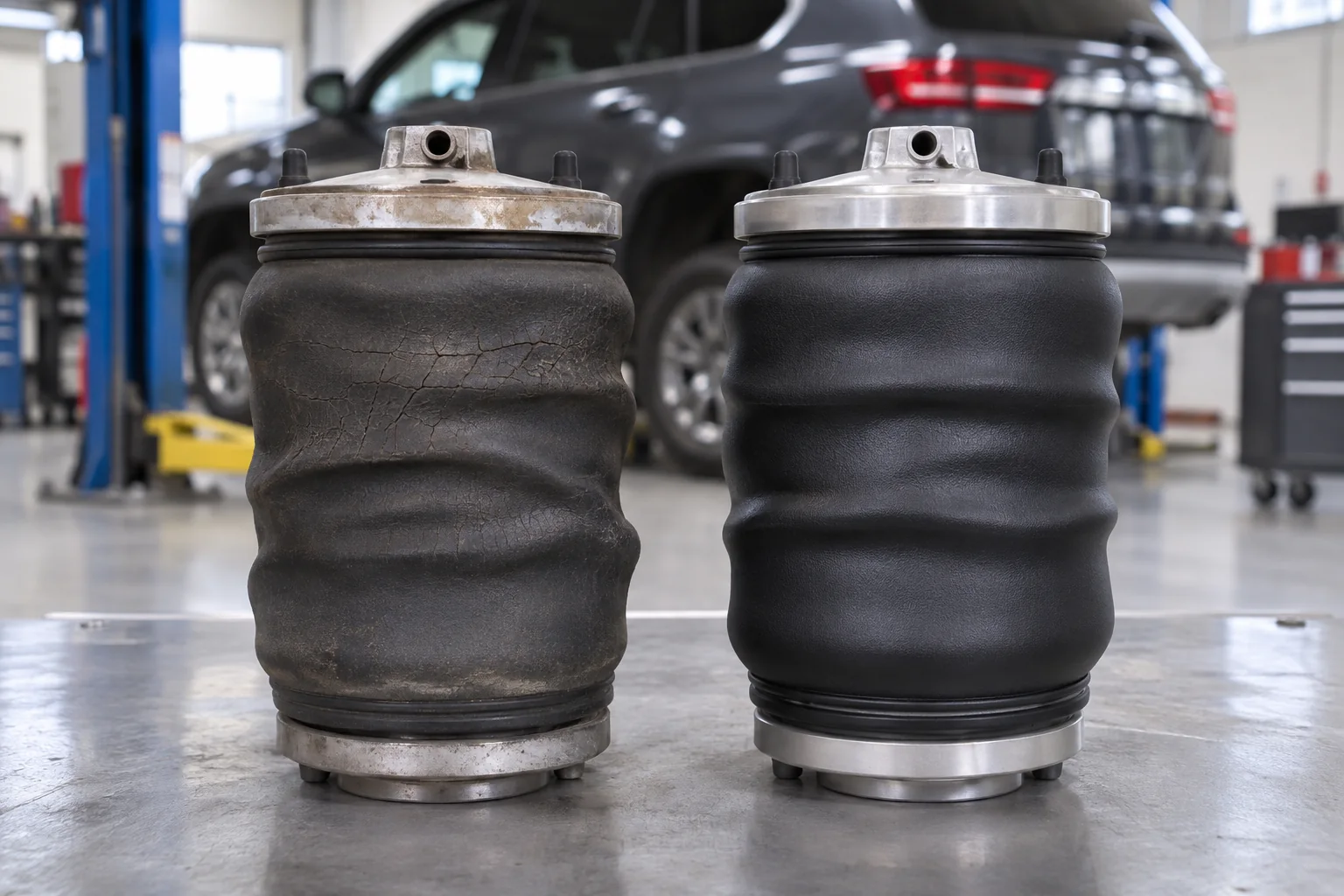
If the bellows is damaged or leaking through deterioration, discuss the correct replacement spring. Confirm the axle, side, part number and whether the quoted assembly includes a damper. The words airbag and air spring often describe the same load-supporting component; two differently labelled prices do not necessarily represent different jobs.
Ask about the other spring's condition and the applicable supplier guidance. Arnott's E70 compressor fitting manual recommends paired rear-spring replacement for the application it specifies. That is useful application-specific guidance, not a rule that every X5 fault requires replacing every spring or the whole system.
Check why the compressor is working too hard
An air leak can keep the compressor compensating and contribute to overheating or wear. Fitting a new compressor without correcting a confirmed leak can leave the cause in place. Equally, a vehicle that will not rise may have a supply, relay or control problem rather than a mechanically failed pump.
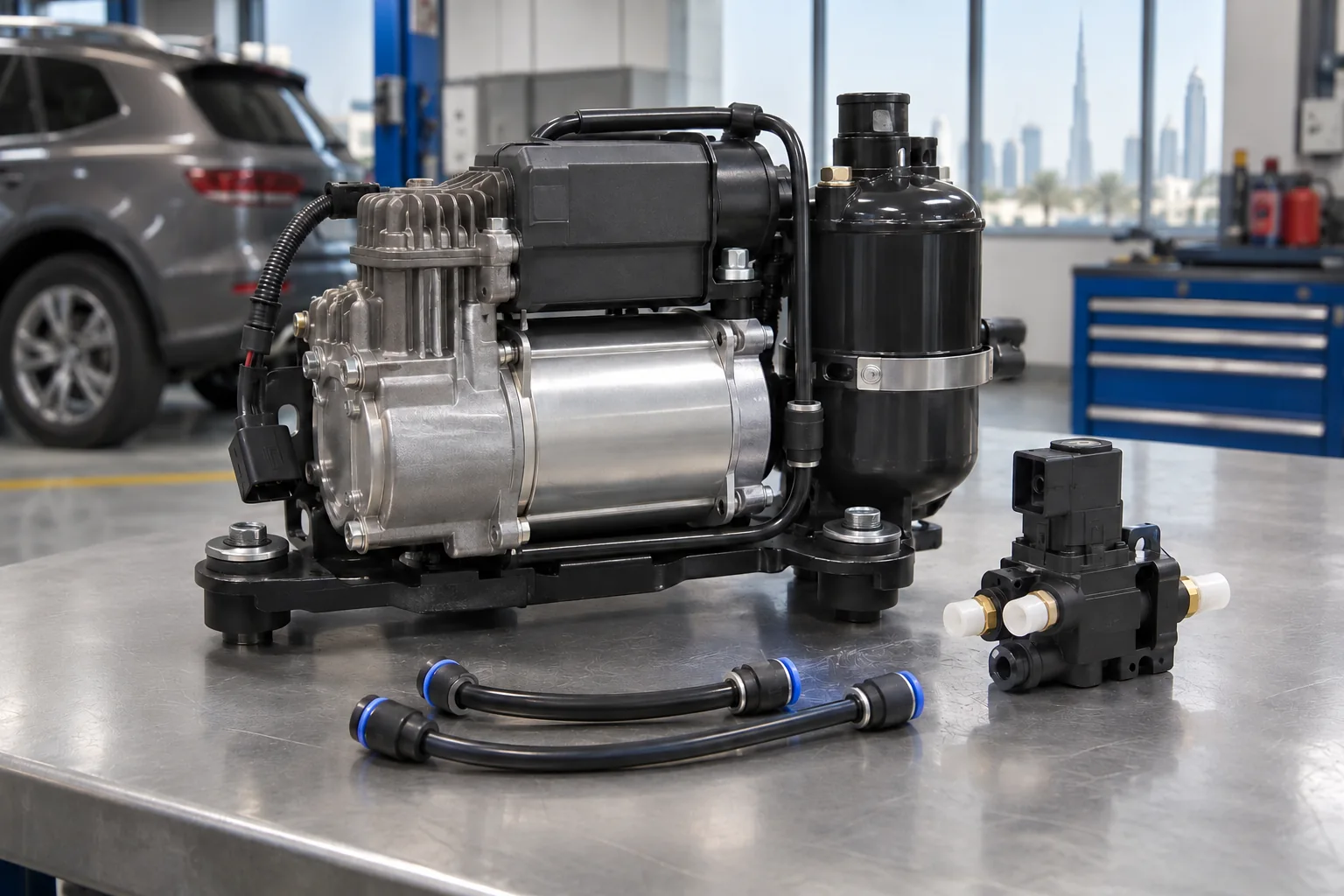
The quote should identify the compressor or supply assembly, its manufacturer and the related work actually needed. A dryer, intake, relay or valve may be separate or supplied within an assembly, depending on the application. Ask which are included and why. A road vibration complaint also needs its own diagnosis; it should not be attributed to the compressor simply because both symptoms occur on the same car.
Height sensors and valves need their own diagnosis
A height sensor reports suspension position through its link and electrical signal. A broken or incorrectly positioned link can affect the reading even when the sensor electronics are intact. Wiring damage or an implausible signal can also prevent normal height control.
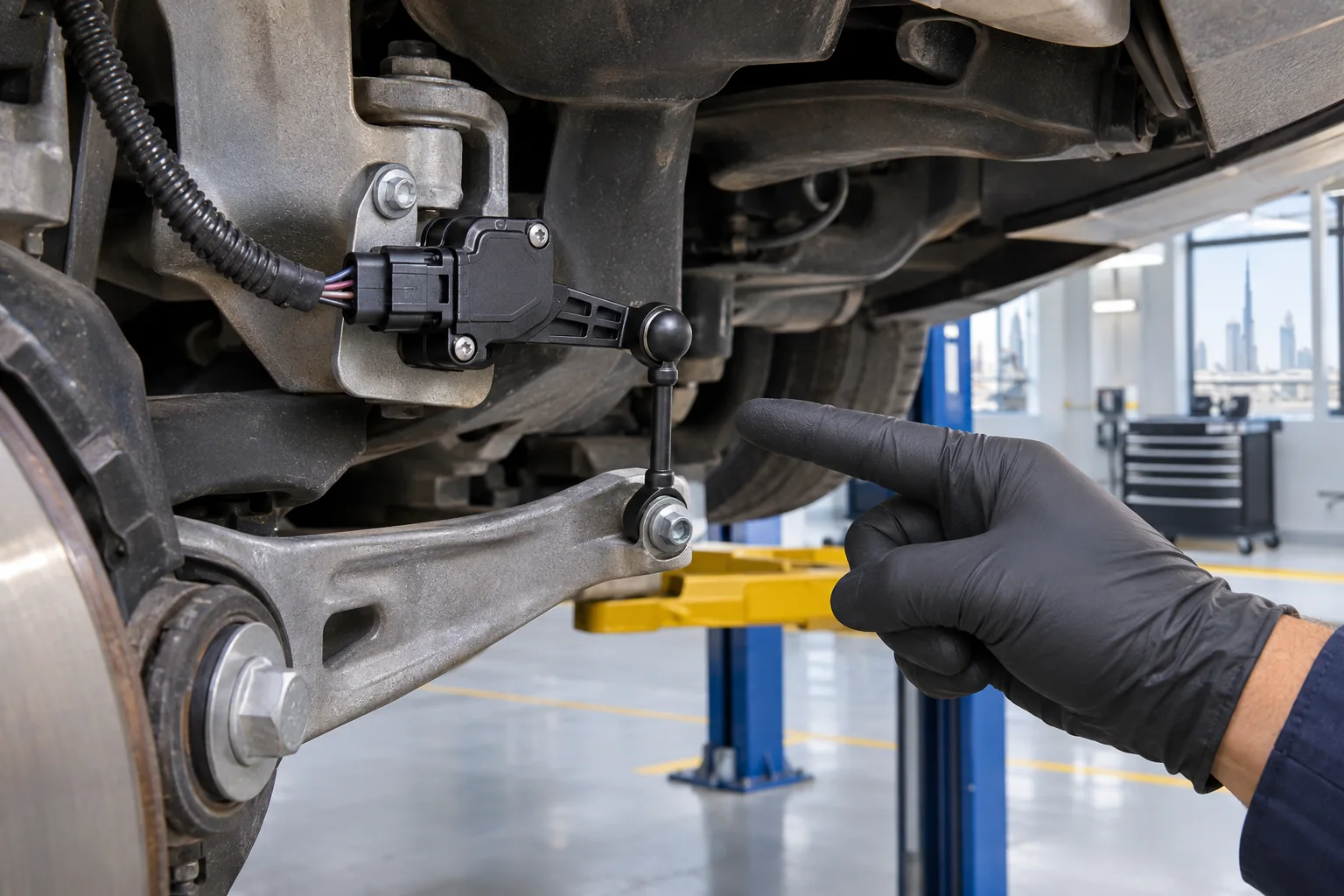
A valve fault can prevent the system holding or distributing air as intended. The workshop needs to separate that behaviour from a leaking spring or line. Testing the actual air path and comparing commanded behaviour with the result is more useful than replacing a sensor or valve because a code mentions the circuit.
Keep fault-code records and the original symptom together. Clearing a warning, replacing a component and seeing the car rise once are different from establishing that the fault has been repaired.
BMW X5 air suspension costs and quote checks
BMW Repair Dubai publishes a fault-code scan and report starting at AED 150 on its BMW X5 repair page. That starting price covers the scan/report stage. Physical leak tracing, electrical tests, calibration, parts, fitting and recovery can require a separate quotation.
Allow AED 2,500 to 5,800 as a planning range for a confirmed compressor replacement with fitting, consistent with the BMW X5 repair page. Ask whether the quote includes the dryer, relay and commissioning where needed. Leak tracing, repairing the leak, a separate valve block and recovery can add cost. The fitted total and any VAT are confirmed in writing.
| Quoted work | Details to request |
|---|---|
| Air spring or complete strut | Request a fitted quote for the affected axle, side and quantity. Confirm the manufacturer and part number and whether the quote covers a separate spring or an integrated strut with a damper. |
| Compressor or supply assembly | Test findings, included dryer/relay/valve work where relevant, and the treatment of any confirmed leak. |
| Sensor, linkage or wiring | The failed item, repair or replacement route, and any setup required by the vehicle procedure. |
| Labour and final checks | Fitting, leak/height checks, required calibration and alignment if applicable. Avoid counting the same labour twice. |
| Total and terms | Diagnostic charges, transport, VAT, exclusions, lead time and the written parts and labour warranty. |
Ask for the findings supporting a wider replacement proposal. A confirmed line repair may restore operation without a new spring; a deteriorated bellows needs its own replacement decision. Comparing component condition and the complete fitted scope gives a better basis for approval than a universal full-system price.
Three quotation differences worth questioning
If one quotation covers a single rear spring and another covers a pair, ask why each quantity is proposed and what condition was found on the opposite side. Compare the same brand, application and fitting scope before deciding that the lower total is better.
A compressor-only price and a supply-assembly price may cover different hardware. Ask whether the dryer, valve block, relay or mounting parts are included, required separately or serviceable. Their presence in a supplier kit does not establish that every item on your car has failed.
A sensor replacement quotation should identify whether the fault lies in the sensor, its mechanical link, the connector or the harness. Request the reason for the selected repair and whether calibration follows from it. A repaired connection and a new electronic sensor are different jobs, even if both clear a height-signal complaint.
Confirm the repair before the car returns
The completion checks depend on the work. They should establish the specified ride height and normal system behaviour, with no relevant unresolved faults. Where the complaint was an overnight drop, ask how the workshop checked that the repaired system holds its height.
Height calibration, fault clearing and wheel alignment are different operations. Calibration follows the applicable procedure and the part or setting changed. Alignment is assessed when the work or chassis findings require it. Neither should be added as an unexplained universal cure for every air-suspension warning.
Parts supply, access, diagnosis and a parked observation can affect the completion window. Ask for a realistic estimate once the equipment and proposed work are known. Obtain the actual warranty coverage, duration or mileage, exclusions and return process in writing; do not assume every part and labour operation has identical terms.
For general principles across BMW models, read the BMW air-suspension owner guide. This X5 guide should be used alongside the handbook and instructions for the equipment actually fitted.
Questions before approving X5 suspension work
Can I identify a leaking spring from a low corner?
A low corner is a useful observation, but a spring, connection, line or valve can be involved. The workshop should locate the loss and compare the height-control data before selecting the repair. Keep yourself outside the car while recording its stance.
Does an X5 have to be converted to coil springs?
A fault does not automatically require a conversion. Diagnose the fitted system and compare a supported repair first. Any conversion proposal needs its own assessment of compatibility, chassis/electronic functions and applicable requirements; it is not interchangeable with replacing one failed air spring.
Why does it rise at startup and sink later?
The system may temporarily restore height while an air loss remains. The rate and location of the drop help direct testing, but they do not prove one component. A controlled leak or height-holding check can assess the complaint.
Will clearing the suspension warning fix it?
Clearing faults does not repair a leak, damaged linkage or supply problem. Save the original fault information and establish the cause. A message that stays off briefly is not enough confirmation of a repair.
Technical references and article responsibility
BMW's generation-specific information above supports the equipment distinctions. Arnott's E70 component instructions explains professional support and pressure precautions; the manual also addresses leaking springs and compressor loading. A vehicle-specific repair must follow the current BMW and component instructions.
Independent BMW workshop in Al Quoz
Send the X5 warning and the corner that drops
Share the model year, VIN or build details, exact warning, which corner changes and how long the X5 was parked. Ask about the assessment charge and fitted quote. If it sits too low or drives abnormally, discuss suitable recovery and charges before moving it.
Independent BMW specialist. Not affiliated with BMW AG.