

Read the warning before deciding to move the car
Stop safely if instructed, if a tyre contacts the body, ground clearance is inadequate or handling changes unexpectedly. Explain the stance and exact message before arranging transport. A car that rises briefly, starts normally or clears its warning once is not automatically safe to drive.
Photograph the stance and warning only while safely parked. Do not crawl underneath, disconnect a pressurised line, use a jack as the only support or operate the height controls repeatedly to force the car up. Automatic height changes can create a risk even while the vehicle is stationary.
Follow the matching handbook rather than a universal speed limit or reset sequence from another model. Tell the recovery provider about low clearance, tyre contact, access restrictions and any braking or steering concern. A Dubai basement may need different loading equipment from an open parking area.
If the BMW looks level but displays a message, report the warning rather than relying on appearance. The system may be unable to make a required adjustment even though the parked stance looks acceptable. Ask about suitable assessment before continuing to use it.
Use the symptom to direct testing rather than select a part
Record what happened during ordinary use and how long the car had been parked. Several faults can produce a similar stance. A symptom helps the workshop decide where to investigate; it does not prove an air spring, compressor or valve has failed.
| What you noticed | What it may involve | What testing should establish |
|---|---|---|
| One corner drops after parking | An air spring, connection, line or valve concern | Where pressure is lost and whether the physical height agrees with the reported height |
| Compressor runs repeatedly or unusually long | Compensation for leakage, supply performance or a control concern | Air tightness, relevant electrical supply and delivery performance under the correct procedure |
| Vehicle does not rise as expected | A supply, air-path, signal or operating-limit concern | Whether adjustment is permitted, commanded and achieved on the fitted system |
| Warning with no obvious lean | Level-control, electrical or other relevant chassis findings | The exact message, fault records, live values and corroborating physical checks |
| Harsh or uncontrolled ride | Loss of travel, damping, tyres or another suspension fault | Whether the air system and damping system each operate correctly |
Note the affected corner or axle, warning wording and any recent tyre, suspension, battery or body work. An existing recording can help, but do not film while driving or provoke a height change for a video. Keep the original fault information before anyone clears it.
Confirm the equipment and the component being discussed
Air springs support the car with compressed air; dampers control suspension movement. A separate air spring is a different component from a complete air strut containing a damper. Electronic damping and air suspension are related features on some vehicles, but one does not automatically establish the other.
Model, generation, axle, factory options and any later conversion affect the arrangement. A broad X5, Touring or 7 Series badge is not enough to order parts. The workshop should identify the actual equipment and compatible component before quoting.
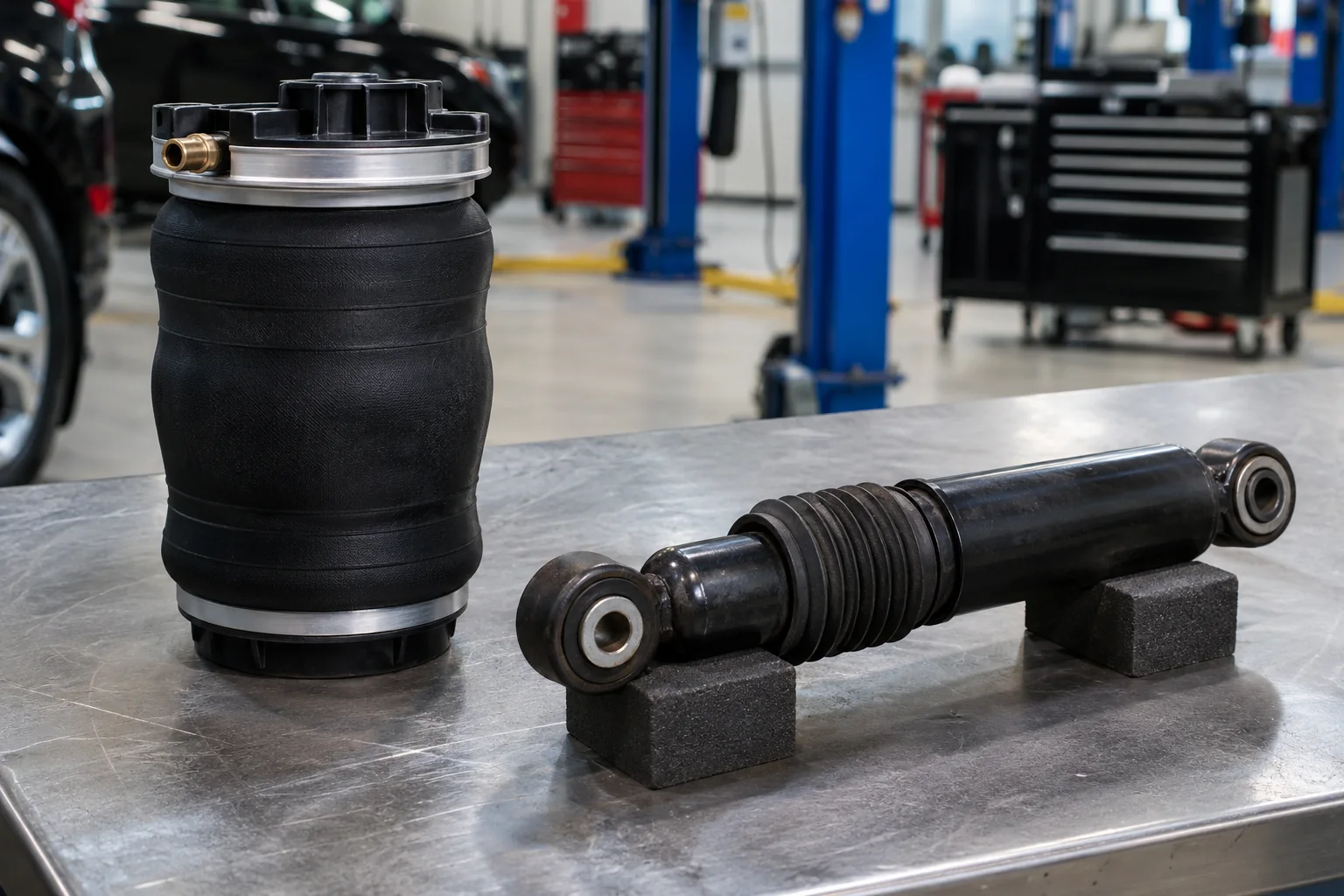
Ask what “airbag”, “air spring”, “strut” or “supply unit” means on the quotation. Two prices with different assembly names may cover different hardware rather than different quality. For X5 generation-specific distinctions, use the BMW X5 air-suspension guide. General assessment and booking details belong on our BMW suspension repair service.
Separate expected height behaviour from a persistent fault
Self-levelling compensates for loading within the vehicle’s limits on equipped systems. Driver-selected heights, loading settings and drive-mode changes depend on the actual vehicle. Do not assume every air-sprung BMW offers the same controls or adjustment range.
BMW’s 2024 i7 and iX suspension guidance describes operating limits and long-stationary behaviour for those models. It shows why the correct handbook matters; it does not establish that a different BMW’s unexpected lean is normal.
Report the selected mode, parking duration, load and whether the car returned to its specified level during ordinary use. A temporary rise can coexist with continuing leakage. Avoid repeated restarts, forced height commands or fault clearing as an experiment; they can obscure the original complaint without repairing it.
What a useful workshop diagnosis should explain
The aim is to distinguish air loss, inadequate supply, an incorrect signal and other suspension faults. A list of codes or a brief look at the car is not the same as connecting a finding to the proposed repair. Confirm the assessment scope and charge before testing proceeds.
- Identify the system and preserve fault information
- Confirm equipment, recent work and warnings. Use diagnostic access to the relevant chassis or level-control modules; a generic engine reader may not provide it.
- Compare measured and reported height
- Record the height at the vehicle’s specified measurement points and compare it with the module reading. A mismatch helps direct checks to the sensor linkage, connector or circuit. Height targets depend on the fitted system.
- Locate any loss of air
- Assess the springs, connections, lines and valves under the appropriate conditions. A brief negative check may need a controlled follow-up if the complaint remains.
- Assess supply and commanded operation
- Check the relevant electrical supply and air delivery before condemning a compressor. Establish whether the system is allowed to adjust and how it responds.
- Connect the evidence to the remedy
- Identify the supported fault, any remaining uncertainty and the confirmation checks. Separate a necessary repair from an unrelated maintenance observation.
HELLA’s F11 520d technical note describes leakage that may need checking in different suspension positions. This is vehicle-specific workshop guidance, not an owner lifting procedure. The useful principle is that test conditions can affect whether a leak is found.
If the problem is intermittent, ask what was checked and what further observation is worthwhile. A parked height-holding assessment may be relevant to an overnight-drop complaint. A warning or persistent levelling concern can also be discussed through our level-control assessment service.
Match the repair to the confirmed fault
Air springs lines and connections
A supported connection or line repair is a different job from replacing a deteriorated bellows. Ask where the leak was located and which approved repair method applies. A vague promise to patch an airbag does not explain the component condition or the proposed work.
For a failed spring, confirm the side, axle, compatible part and required quantity. Inspect related parts and follow the applicable vehicle and supplier instructions on paired replacement. One failed component does not automatically justify replacing the entire system, while the cheapest single-part quote may omit work required by the actual findings.
Compressor and air supply
Repeated running can occur when the system compensates for escaping air. Continuing air loss can increase compressor loading and contribute to wear or overheating. A confirmed leak must be addressed alongside the supported supply repair.
Equally, a car failing to rise does not prove a mechanically failed pump. Supply, control and air-path findings still matter. A compressor-only price and a complete supply-assembly price may include different dryer, valve, relay or mounting items. Ask which parts are included and what evidence supports replacing them.
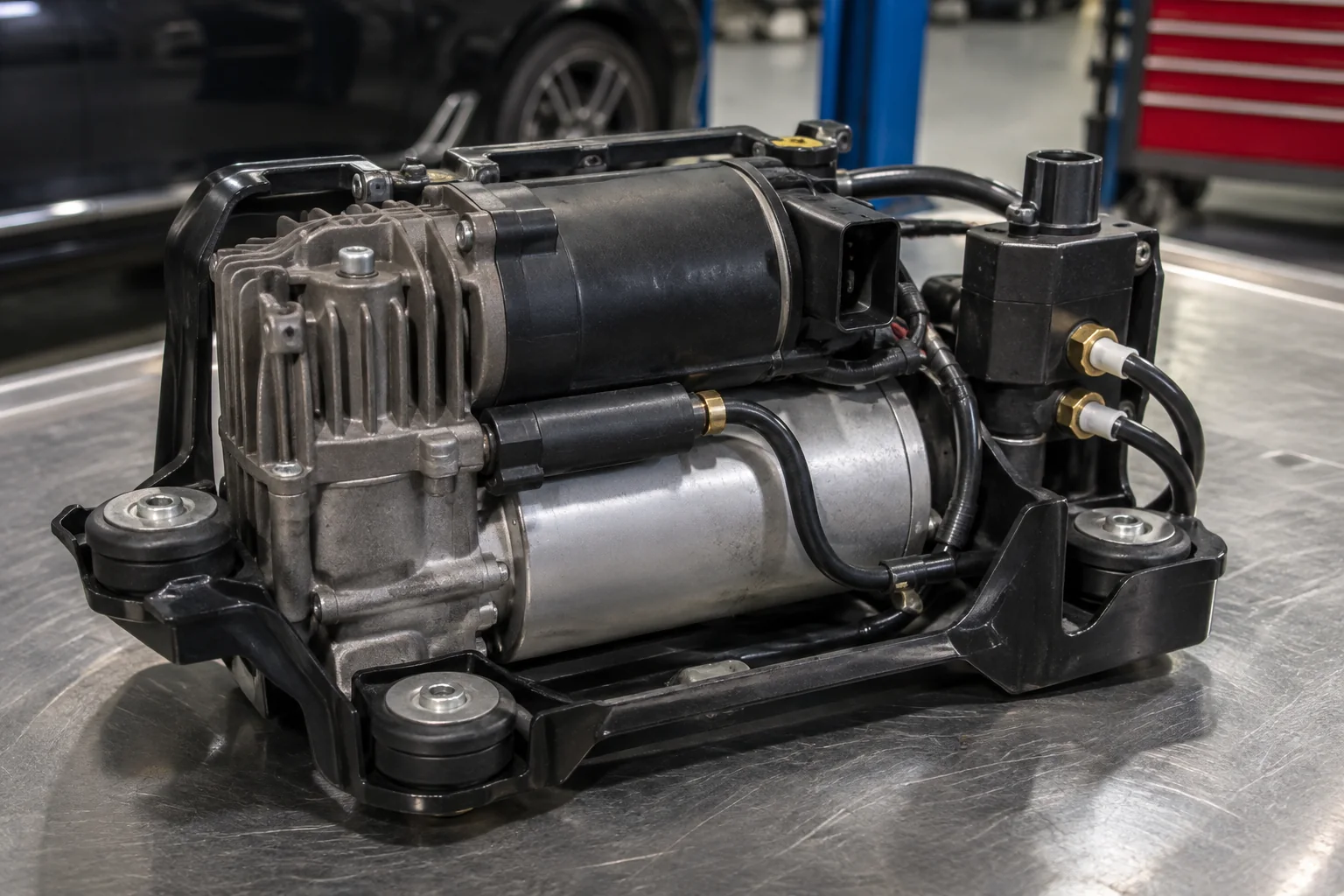
Arnott’s E70 and E71 compressor manual addresses leaking springs and application-specific fitting requirements. It also sets professional support and pressure precautions. Its pairing and warranty wording should not be generalised to every BMW or treated as UAE warranty entitlement.
Height signals valves and damping
A height sensor’s mechanical link matters alongside its electronics. An incorrectly positioned or damaged link, connector or harness can affect the reading. A code mentioning a circuit does not by itself prove that the sensor unit needs replacement.
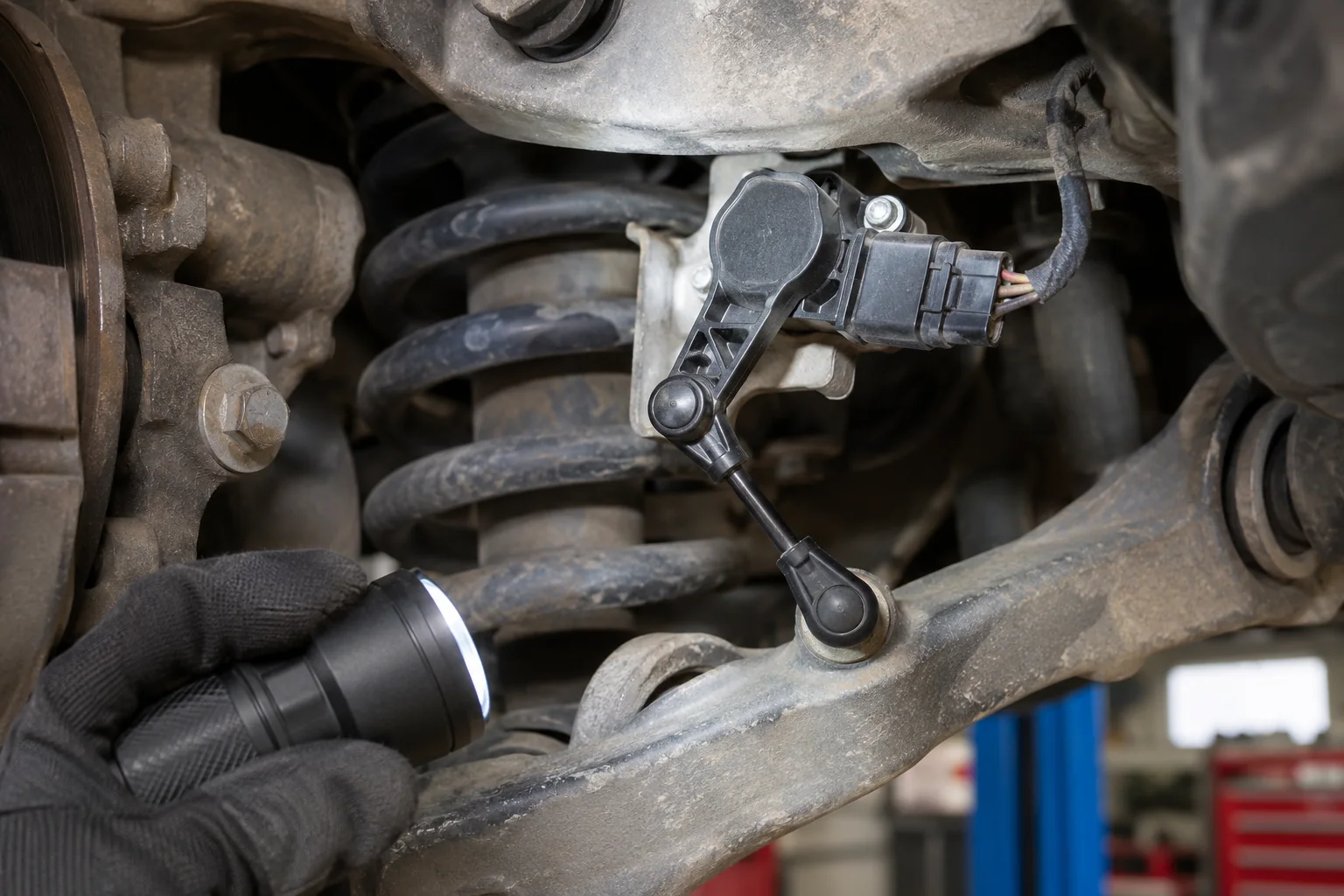
Valve behaviour must be separated from leakage elsewhere. The workshop should explain which air path or command was tested and why the result supports the repair. If damping is also suspect, our shock-absorber service covers that work. Air-system and damping faults can coexist; neither should be inferred solely by excluding the other.
Compare the same work on each quotation
BMW air suspension faults do not have one universal repair price. A line repair, separate spring, complete air strut, compressor and sensor-linkage repair are different jobs. Compare the failed component and fitted scope before comparing totals.
- Identification — vehicle specification, component, side, quantity, manufacturer and part number where available.
- Included work — assessment, fitting, required hardware, confirmed leak repair and applicable setup or alignment.
- Total and approval — labour, parts, diagnostic charges and how additional work is authorised.
- Timing and cover — parts availability, observation time, realistic completion estimate and written parts/labour warranty terms.
A scan price is not a fitted repair price, and an initial code read may not include physical leak tracing. Ask whether an assessment charge is separate or credited under a stated condition. Do not assume the same warranty, turnaround or parts availability applies to every option.
If a quote proposes wider replacement, request the supporting findings and compatible alternatives. A suitable component repair can avoid unnecessary replacement, while an incompatible cheap part can leave the original function unresolved. Keep the comparison tied to the actual vehicle and written scope.
Confirm the original complaint after the repair
Clearing faults, calibrating height and aligning wheels are different operations. Calibration sets applicable height references; alignment concerns wheel geometry. Either may be required by particular work, but neither is a universal cure for leakage or every warning.
Ask whether the system reaches its specified level, whether relevant faults remain and how the original symptom was reassessed. If the complaint was dropping after parking, a momentary rise in the workshop does not answer whether it holds height afterwards. Agree the appropriate confirmation and any unresolved follow-up.
Keep the findings, invoice, part details and written cover. If the stance changes again, report when and under what conditions rather than repeatedly forcing the system to operate. New tyre contact, inadequate clearance or altered handling still takes priority over making a recording.
Ask for the height reference and measured values at the specified points if calibration was needed. Where the work affects wheel geometry, ask for the alignment measurements after the ride height is correct.
For generation and axle differences, see the BMW X5 air suspension guide. For a fitted quote or a suspension problem beyond the level-control system, see BMW suspension repair in Dubai.
Questions before approving air suspension work
Does rising at startup rule out an air leak
No. The system may temporarily restore height while air loss remains. The location and rate of the drop help direct testing but do not prove a failed part. The workshop should assess the original parking complaint under appropriate conditions.
Can a level-control warning appear while the car looks level
Yes. Appearance alone does not establish that the system can make the required adjustments. Follow the actual message and handbook, report changes in handling or clearance and arrange suitable assessment before relying on normal operation.
Does one failed air spring mean replacing the whole system
No automatic whole-system replacement follows from one fault. Confirm the failed component, related condition and applicable instructions. Paired replacement can be appropriate or required for a particular application; the workshop should explain the proposed quantity.
Will clearing the warning or resetting the height fix the fault
Clearing a message does not repair a leak, damaged linkage or supply problem. Preserve fault information and establish the cause. Calibration or another setup operation belongs to the relevant procedure, rather than being a universal reset cure.
Can I identify the failed part from a photograph of the lean
A safely taken photograph helps show the stance, but a spring, line, connection, valve or height-control concern may need investigation. Do not go underneath or disconnect a line to identify the cause. Supply the exact warning and conditions as well.
How long should an air suspension repair take
Diagnosis, parts delivery, fitting and confirmation are separate stages. Intermittent leakage or a parked height-holding check may affect completion. Ask for a realistic estimate after the fitted equipment and proposed work are known rather than assuming same-day return.
Published by BMW Repair Dubai. Manufacturer material supports the stated technical principles and application limits. A vehicle-specific repair follows the current instructions for its fitted equipment.
Independent BMW workshop in Al Quoz
Send the warning and the corner that changes
Share your model, year, exact warning, affected corner or axle, parking duration and recent work. Describe tyre contact, low clearance or handling changes first. Our workshop at Al Quoz, Dubai can discuss the assessment scope and charge and whether suitable recovery should be arranged.
Independent BMW specialist. Not affiliated with BMW AG.