
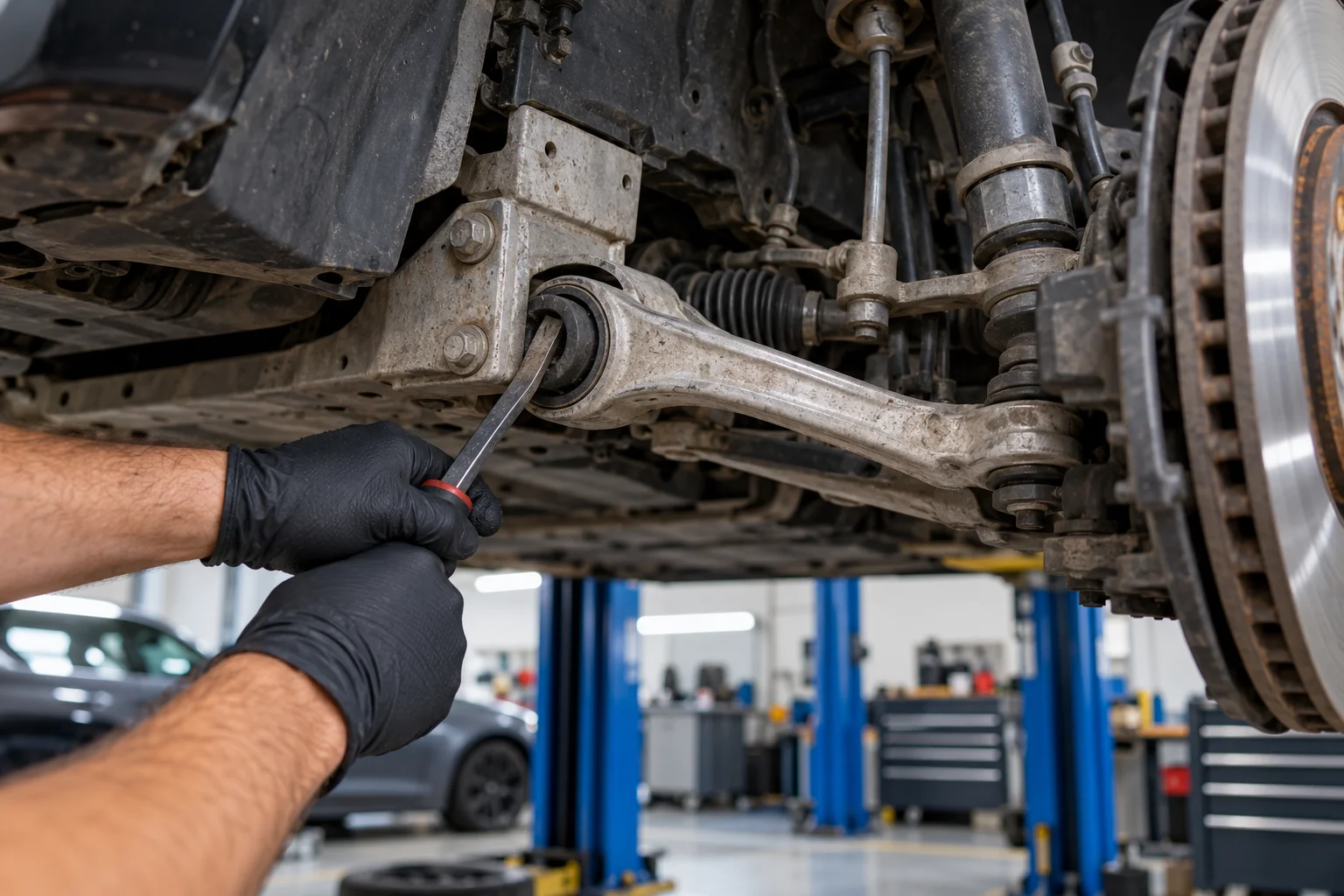
Compare when the suspension noise occurs
The same word can describe several faults. A knock over a speed hump is a different complaint from a continuous hum at road speed or a creak while parking. Note whether the car is moving straight, turning, braking or crossing an uneven surface. That pattern helps the workshop choose its first checks.
| What you notice | Possible areas to inspect | Useful distinction |
|---|---|---|
| Clunk over bumps | Anti-roll bar links, arm bushings, joints and damper mounts | Single impact or repeated rattle, one corner or both sides |
| Creak while turning or parking | Applicable top bearings, joints, bushings and steering components | Whether it follows steering movement, body movement or both |
| Light rattle on broken surfaces | Links, mountings, brake hardware and nearby loose items | Whether it started after wheel, brake or suspension work |
| Hum that rises with road speed | Tyres, wheel bearings and other rotating components | A continuous hum needs different checks from a bump-related knock |
| Noise with a low corner or level warning | The fitted spring or air-level system and related components | Ride height, warning wording and whether the condition changes while parked |
Sound travels through the chassis and cabin. Hearing it near the front passenger footwell does not identify the right front arm as the cause. A useful diagnosis combines the operating pattern with a physical finding, rather than replacing the part most often mentioned in an online discussion.
If the main complaint is a steady rumble, our wheel-bearing noise guide explains that related symptom. A sound linked mainly to steering input may also need the checks described in the guide to noises when steering.
When to stop driving and arrange assessment
New steering looseness, strong vibration, instability, a visibly displaced wheel, a very low corner or tyre contact with the body needs prompt assessment. A loud bang followed by changed ride height or handling also calls for stopping safely. Arrange suitable recovery if the vehicle cannot be driven safely.
A mild creak without an obvious handling change still deserves investigation, but its volume cannot establish a safe driving distance. Describe whether the noise is new, getting worse or accompanied by pulling, uneven ride height or a warning. Follow the vehicle's handbook and any Check Control instruction.
Do not drive repeatedly over a speed hump, make abrupt steering movements or brake hard to demonstrate a fault. The workshop should decide whether a controlled road test is appropriate after an initial safety check. Record observations from journeys already made rather than creating a more severe test.
When requesting recovery from a Dubai basement or car park, mention low clearance, a collapsed corner and access restrictions. Do not attempt to raise an air-suspended vehicle by improvising with its controls. The operator needs the actual vehicle condition to plan safe loading and transport.
What you can record with the BMW parked
Park on level ground, secure the car and keep observations to areas visible without dismantling or getting underneath. Look from outside for an unusual stance, obvious tyre damage or a loose item in the luggage compartment. Photograph an accessible warning or visible concern without reaching behind a wheel.
- Describe the event — Write down clunk, creak, squeak or rattle and the normal action that preceded it.
- Record the conditions — Mention the first journey of the day, a hot parking period, a particular surface or ordinary parking manoeuvre if relevant.
- Preserve the history — Include recent tyre, brake, alignment or suspension work and any impact that coincided with the change.
- Note other changes — Record pulling, steering feel, ride height, tyre wear and the exact warning wording.
Do not crawl underneath a car supported by a jack, put a hand near moving suspension parts or loosen an air line. Springs and pressurised systems require suitable workshop procedures. If recording a sound is useful, a passenger can do so during an otherwise safe normal journey; the driver should not operate a phone.
A stationary push or bounce of the body is not a pass-or-fail test for the whole suspension. It cannot clear a ball joint, identify a top mount reliably or prove that an electronically controlled damper works correctly. Avoid condemning a strut because the car moves more or less than expected during an informal check.
Which suspension components can make noise
Springs dampers and their mountings
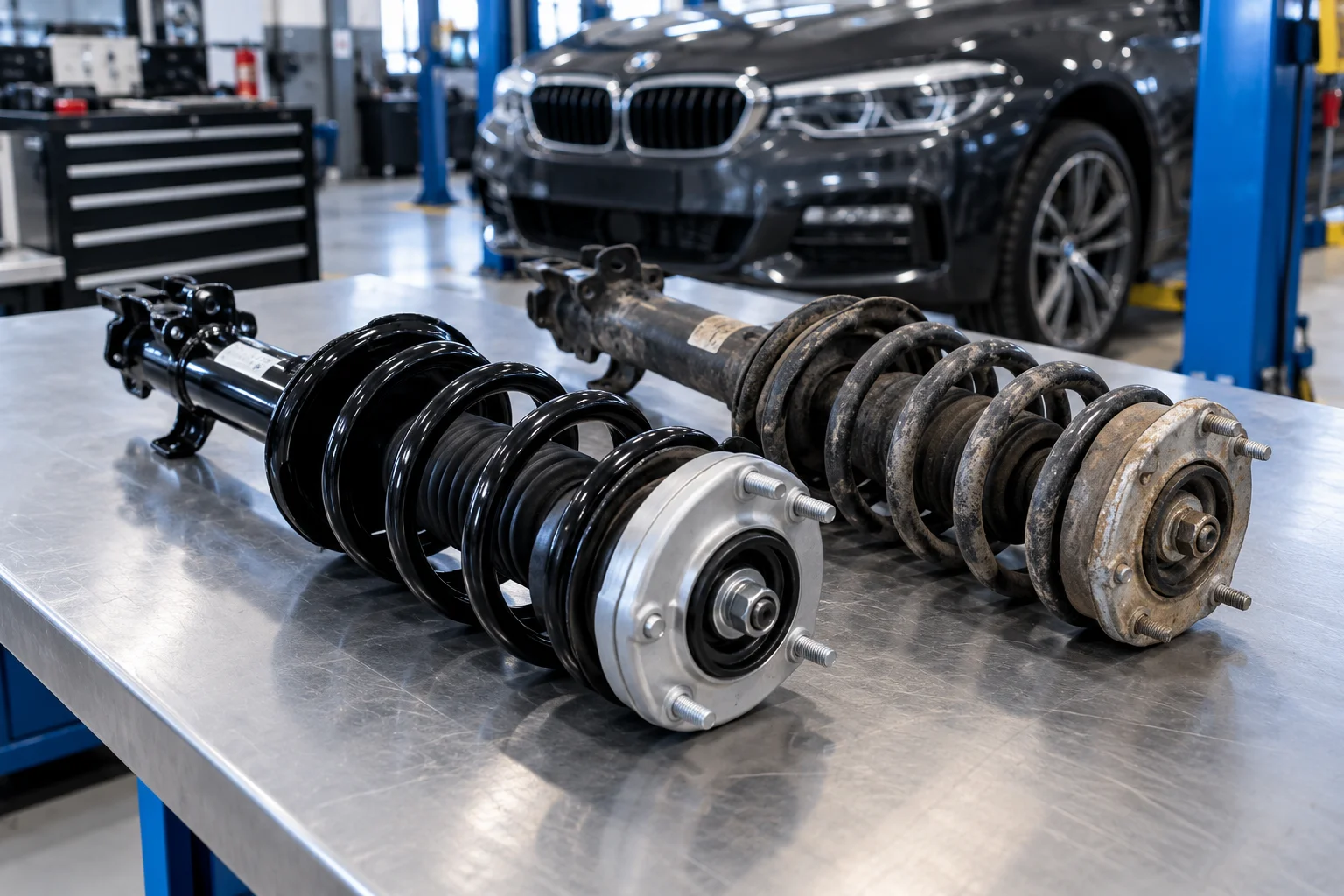
Springs support the vehicle's load. Dampers control suspension movement; they are not interchangeable with the springs. Mounts, seats and isolators connect these parts to the vehicle and manage how movement reaches the body. A noise near a strut therefore does not prove that its internal damping mechanism has failed.
A damaged spring, displaced seat, deteriorated mount or faulty bearing can produce different symptoms. The relevant bearing arrangement varies by axle design. Inspection should establish what is fitted, where abnormal movement or contact occurs and whether the component remains correctly seated. A leak or damaged damper also needs assessment alongside ride behaviour.
Control arms bushings and ball joints
Arms locate the wheel assembly while allowing controlled movement. Their bushings manage movement at mounting points, and ball joints allow articulation where fitted. Rubber separation, abnormal joint clearance or a failed hydraulic bushing can affect noise and wheel control. The exact defect needs identifying rather than labelling every arm-related concern a worn shock absorber.
Anti-roll bar links and bushes
The anti-roll bar connects suspension movement across the axle through its links and supports. Wear or looseness at these connections may contribute to a knock or rattle. However, a similar sound can come from a damper mount or nearby attachment, so location and appropriate movement checks still matter.
These parts work together but do different jobs. A quote should name the affected component, axle and side and explain the finding. Replacing an entire collection of suspension parts merely because the car makes a noise is not the same as establishing which parts are defective.
What cracking leakage and movement actually mean
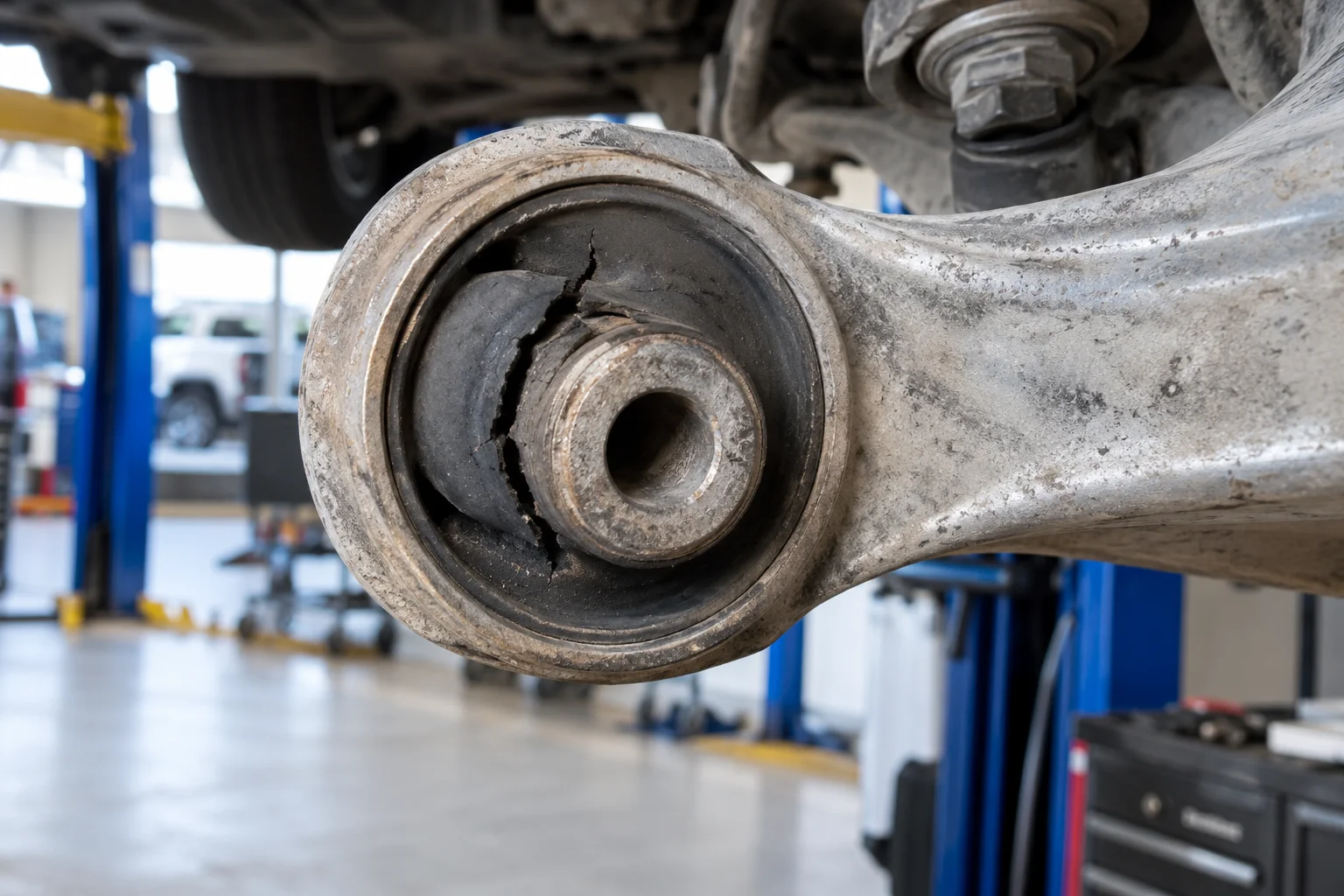
A photograph of rubber cracking can be useful, but surface appearance alone does not quantify how an arm behaves under load. The technician should distinguish minor surface ageing from separation, displacement or excessive movement. Some bushings contain fluid, while others do not; suspected leakage must be traced to the actual component.
Joint boots also matter because they protect the working joint. A split boot, contamination or abnormal clearance needs assessment using the procedure appropriate to the design. The presence or absence of visible grease is not, by itself, a complete joint inspection. ZF's multi-link suspension guidance discusses checks of rubber components and joint protection as part of investigating these systems.
At a damper mounting, the workshop should check the applicable fasteners, support components and fitment. A noise that started after strut work may involve installation or another nearby part. It should be investigated rather than automatically described as normal settling or treated by tightening everything without the specified procedure.
Where the finding supports arm work, ask whether the bushing is separately serviceable and whether the rest of the arm remains suitable for use. The control-arm replacement service is a separate destination for discussing that confirmed repair, rather than a reason to replace an arm before inspection.
Identify the fitted suspension before choosing parts
Model names alone are insufficient for a parts decision. Production date, axle layout and factory options can change the required components. Provide the model, year and vehicle identification number so the workshop can identify the correct arrangement. A part advertised for a 3 Series or X5 is not automatically suitable for every generation.
Coil springs and electronically controlled dampers
A BMW can have coil springs with conventional or electronically controlled dampers, depending on its specification. A selectable driving mode does not, by itself, identify every installed component. Electronic systems may require relevant fault-memory, wiring or control checks in addition to mechanical inspection. A code naming a circuit is not automatic proof that the damper needs replacement.
Air springs and ride-level concerns
Air suspension adds different components and diagnostic questions. A low corner, repeated compressor operation or a level warning can involve leakage, supply or control concerns. Not every BMW uses air springs on both axles, and changing an air spring is different from replacing a shock absorber. The fitted layout must guide the assessment.
If ride height is the main concern, the air-suspension assessment service explains that separate work. This article does not treat a particular generation as universally defective or infer a recall from a noise. Any campaign or technical instruction needs checking against the affected vehicle and current applicable information.
What workshop testing should establish
The aim is to connect the owner's complaint to an observable defect and a suitable remedy. An inspection that simply produces a list of ageing parts may not explain the noise. Equally, a clear engine-code scan does not rule out mechanical suspension wear.
- Confirm the original complaint
- Record the noise conditions and recent work, check for safety concerns and decide whether the vehicle can undergo a controlled road test. Compare the same normal operating pattern where appropriate.
- Localise the sound and movement
- Inspect the relevant links, arms, joints, spring seats, dampers and mountings. Use suitable loaded or unloaded checks for the design rather than assuming a hanging wheel exposes every fault.
- Check neighbouring sources
- Consider brake hardware, steering connections, underbody panels, exhaust attachments and loose cabin or luggage items when the pattern supports them. Noise transmission can make the apparent location misleading.
- Explain the evidence and next step
- Identify the defective part or remaining uncertainty, show the relevant finding where practical and explain why the proposed work should address the complaint. Include electronic testing only where applicable.
Monroe's shock and strut inspection guidance combines customer history, ride evaluation and physical assessment, including damage, leakage and related observations. This supports a broader assessment rather than relying on one informal bounce check. The BMW procedure for the actual vehicle still governs the job.
An intermittent noise may require particular conditions. If it occurs after hot parking in Dubai or only on the first journey, tell the workshop before booking. Heat or dust should not be declared the cause simply because the vehicle is used in the UAE. The appointment may need time to reproduce the reported condition safely.
Match the repair and quote to the findings
A failed link, separated bushing, damaged spring and electronic control fault call for different work. Ask which finding makes each proposed part necessary. If several components are recommended, distinguish the part responsible for the noise from additional wear identified during inspection.
Some bushings can be replaced separately; other designs or component conditions may favour a complete arm. Damper or spring replacement planning also needs the applicable manufacturer guidance and condition across the axle. Ask why paired replacement is recommended rather than assuming either one-sided or two-sided work is always correct.
- Parts — Confirm the side, axle, part number, brand and compatibility with any adaptive equipment.
- Labour and fitting items — Check removal and refitting, required mountings, fasteners and related items rather than comparing a bare component price with a complete job.
- Follow-up procedures — Ask whether alignment, calibration or another vehicle-specific procedure is required and included.
- Charges and approval — Clarify the inspection fee, parts lead time, warranty terms and how additional work will be authorised.
There is no single repair price that follows from the phrase BMW suspension noise. The BMW suspension inspection and repair service covers arranging an assessment and discussing a written scope. This guide helps you understand the symptom and the evidence behind that scope.
Separate alignment balancing and final verification
Wheel alignment measures and adjusts the relevant wheel geometry. Wheel balancing addresses imbalance in the rotating wheel-and-tyre assembly. Neither repairs a loose ball joint, separated bushing or damaged mounting. A wheel-related vibration and a suspension knock can coexist, so the workshop should explain which finding each procedure addresses.

Where alignment is required after work, it should follow correction of relevant mechanical defects and use the specified setup. Ask for the results and an explanation of any remaining adjustment limit. A green display alone does not demonstrate that a previously reported clunk has disappeared.
Final verification should compare the original complaint under suitable conditions, check the repaired area and record what was done. If a noise remains, identify whether it is the same sound or a separate issue. Do not accept an indefinite promise that an unexplained knock will disappear after a few weeks without a supported explanation.
Maintenance that supports the suspension
Keep the approved tyre sizes, pressures and loading requirements for the vehicle, and report new noise, stance changes or uneven tyre wear. Retain repair and alignment records so a later investigation can account for what changed. Inspection timing should reflect the vehicle's guidance, condition and use rather than an invented universal replacement mileage.
Do not spray lubricant into every squeaking joint. Many suspension joints are sealed and maintenance-free, and a spray cannot restore worn material or abnormal clearance. ZF describes maintenance-free ball joints in its LEMFÖRDER steering and chassis information. Use a lubricant only where the applicable component instructions specify it.
Approach ordinary humps and rough surfaces at an appropriate safe speed and avoid overloading the car. These habits do not guarantee a fault-free suspension or reverse existing damage. A performance upgrade is also not a default cure for an unidentified noise; any modification should suit the actual vehicle and intended use.
BMW suspension noise questions
Can I drive with a knocking suspension
A sound description cannot establish a safe distance. Stop safely if steering, stability, ride height or tyre clearance changes, or if there is severe vibration. Describe a milder recurring knock to the workshop promptly and follow its assessment of the affected vehicle.
Does a front or rear noise identify the faulty part
No. Noise travels through the body and can appear away from its source. Links, mounts, joints, brake hardware and other nearby parts may produce similar sounds. The apparent location helps guide testing but does not justify ordering a particular component.
Does a bounce test prove a shock absorber is good
No. An informal body bounce cannot clear the entire suspension or identify every damper, mount or electronic fault. Combine the complaint history with suitable mechanical and, where applicable, electronic checks rather than treating one movement as a pass or fail.
Will wheel alignment stop a suspension clunk
Alignment does not repair loose or damaged suspension components. It may be required after particular repairs, but the source of the clunk still needs diagnosis. Balancing is a separate procedure for wheel-and-tyre imbalance and is not a general cure for knocks.
Why did the noise start after new suspension parts
The original source may remain, another component may be involved, or the recent installation may need checking. Give the workshop the invoice and timing of the change. Ask it to verify compatibility, fitment and the original noise conditions before recommending more parts.
Do all BMW models need the same suspension repair
No. Generation, production date, axle layout and options affect the fitted components. Coil springs, air springs and adaptive dampers require different considerations. Identify the vehicle and confirm the defect rather than transferring a repair from a different BMW model.
Published by BMW Repair Dubai. The linked component-manufacturer resources support general inspection and maintenance principles. They are not a BMW recall notice or a diagnosis of an individual vehicle. Repair decisions require identification, inspection and the applicable vehicle instructions.
Independent BMW workshop in Al Quoz
Get the suspension noise assessed
Share your model and year, the sound and when it happens, any warning or ride-height change, and recent work. Our workshop at 39 Al Quoz 4, Dubai can discuss the assessment scope and charge. Describe severe symptoms before deciding how to bring the car in.
Independent BMW specialist. Not affiliated with BMW AG.