
Buckle replacement
Confirm whether the buckle, switch or associated wiring needs attention and whether a pretensioner is integrated into the assembly.
Belts, buckles and tensioners
Seat belt damaged, stuck or refusing to latch? Our independent Al Quoz workshop inspects the belt and fitted restraint system, explains the required replacement and gives you a vehicle-specific quote before approval. We handle front and rear belt assemblies, buckles and deployed pretensioners.
Do not use a seat with a damaged belt, an insecure buckle or a belt that cannot fit snugly. If the driver’s belt is affected, arrange suitable transport instead of driving to the workshop.
Repair options and fitted quotes
The price depends on the confirmed fault, seating position and exact restraint assembly. Send your model, year and affected seat for assessment. Collision work may require more than one component.
Confirm the assessment fee, any credit towards approved repairs, part numbers, labour, trim access, required fasteners, diagnostic checks and VAT treatment. Ask about transport charges and any additional collision work. A fixed repair tariff is not published here; request an itemised fitted price before approval.
How it is built
Every front belt is a small system of its own. Knowing which part does what is how we avoid replacing a whole belt when only one piece has failed, and how we know when a full assembly really is needed.
When to have it checked
A symptom is a starting point for inspection, not proof of a failed component. Do not use an affected seat if the belt cannot latch, retract to a snug fit or restrain its occupant correctly.
A locked belt after an impact needs collision inspection. Locking alone does not confirm deployment. A fired pyrotechnic pretensioner cannot be reused.
Damaged webbing can tear under load. A belt with a cut or burned strap should not be relied on.
The tongue goes in but does not click, or pops out when pulled. The buckle needs attention before use.
The belt hangs loose or stops halfway back. Check routing, guide friction and retractor operation. Do not use the seat if the belt cannot fit snugly.
Check buckle status, occupancy inputs and wiring. The warning alone does not identify which component has failed.
The restraint system has detected a fault. Protection may be reduced; arrange prompt diagnosis and follow the vehicle warning.
After a collision
A deployed pyrotechnic pretensioner must be replaced. The vehicle-specific BMW collision procedure determines whether the complete belt system and associated components also need replacement.

Tell us which seats were occupied. All belts need assessment after an accident; if occupancy is unknown, every seating position must be accounted for. An apparently intact belt worn in a serious crash must not be assumed reusable.
The specified replacement can include the belt, buckle, lower strap, height adjuster and fasteners. Inspect anchors, seat structure and nearby impact damage. The quote should explain every required component.
Trained handling must follow BMW’s model-specific isolation, waiting-time and repair procedure. Physical inspection and diagnostics determine any control-module work; clearing faults is not collision repair.
Deployment depends on the impact and fitted system. A pretensioner tightens the belt and a force limiter manages belt load; not every collision triggers every device. If airbags also deployed, see our airbag replacement service.
The part you touch every day
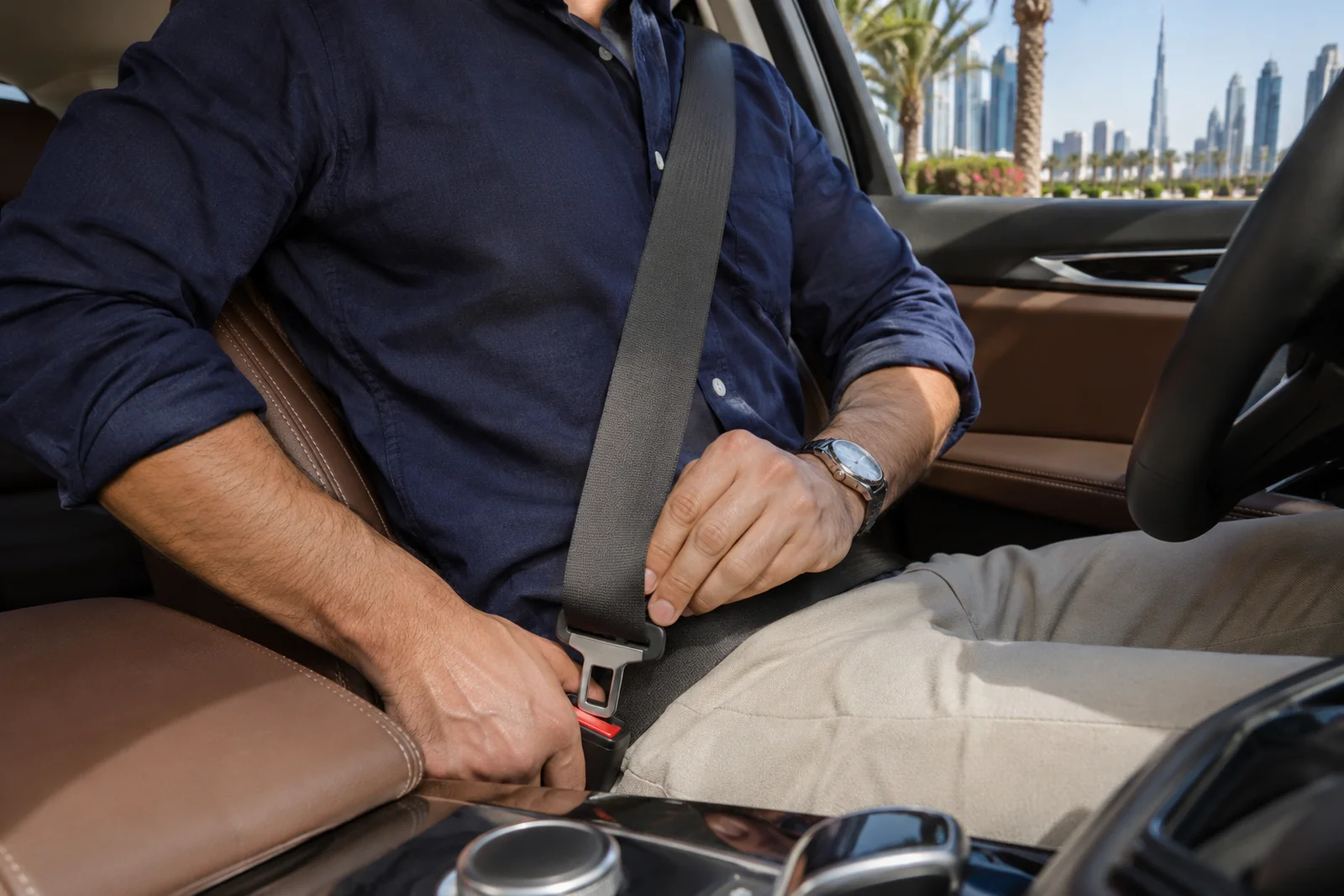
The buckle takes thousands of clicks a year, and in Dubai it also collects sand, coins and the odd spilled drink. Inside is a latch and a small switch that tells the car whether you are belted in.

Debris inside the latch or a worn mechanism. Inspect under the applicable service procedure; a latch that does not hold securely must not be used.
A worn latch can let the tongue go under load. This is a stop using fault and the buckle is replaced.
A sticky release button or bent tongue. We check both parts, since a damaged tongue means the belt side needs work too.
A buckle switch or wiring fault is one possibility. Check the relevant inputs and circuit before deciding whether a buckle assembly is needed.
Retractor and strap
Most belts that misbehave without a crash have a retractor or webbing problem. Some are simple to sort, others mean the whole belt assembly has to be changed.
Dirt and sun cream build up on the webbing and the pillar guide, adding friction. Use only the cleaning method allowed by the vehicle handbook. Inspect routing and retraction; persistent weakness may require the correct assembly.
Inspect for obstruction, routing and mounting-angle problems as well as retractor faults. A symptom alone cannot establish the cause.
A twist at the guide stops smooth travel and wears the webbing. It can usually be worked out without parts.
Sharp edges, pets and years of strong sun weaken the strap. Webbing is part of the belt assembly and is replaced with it.
On many BMW coupe and convertible models a powered arm pushes the belt forward when you sit down. A failed motor or arm stops it moving.
Every rear seating position matters
Rear belt routing and components vary by model and seat position. We check the strap, buckle, retractor and mounting before confirming which repair is needed.
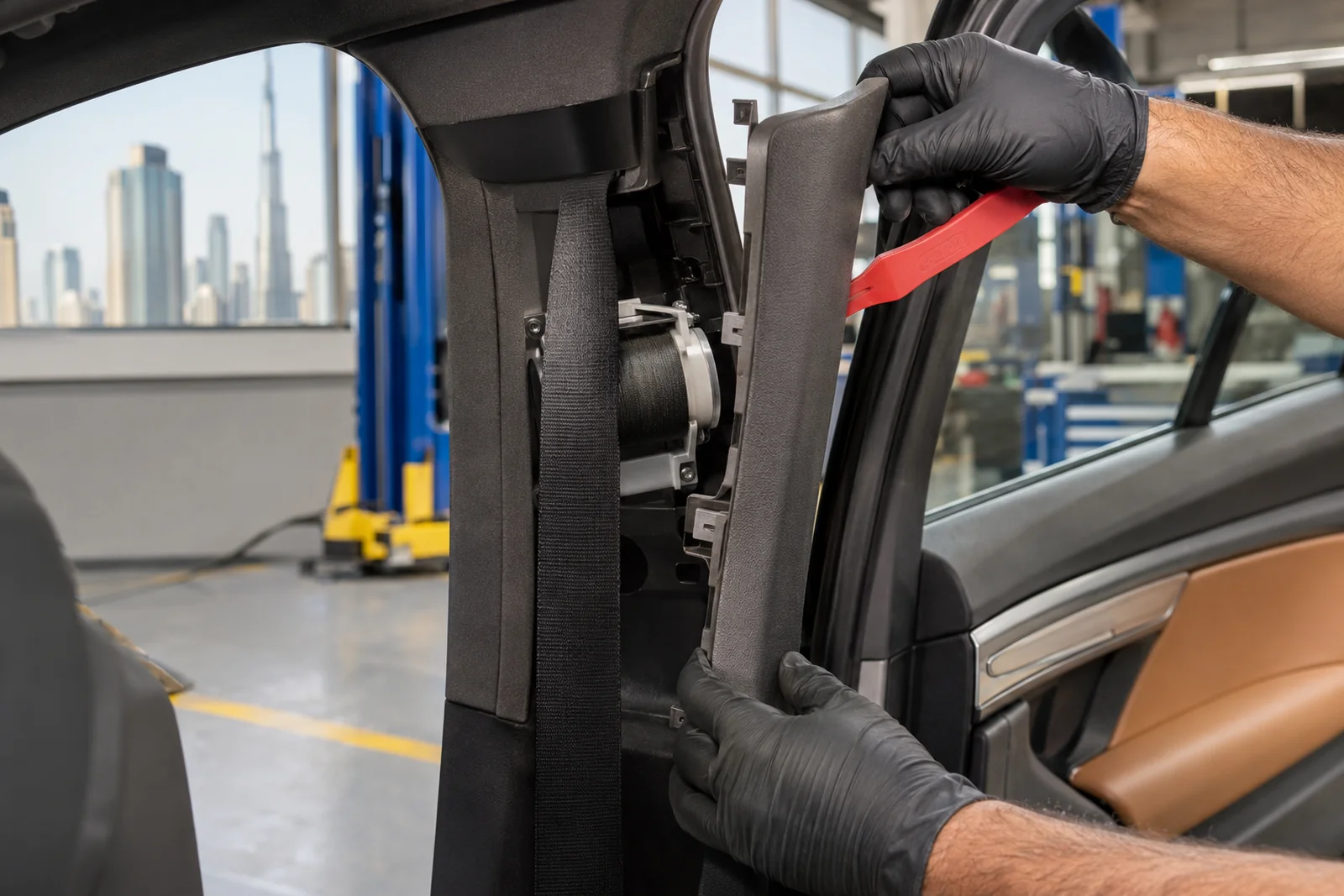
Inspect the retractor, guide and belt route behind the trim. Slow travel or locking needs assessment of routing, obstruction and the mechanism before replacing parts.
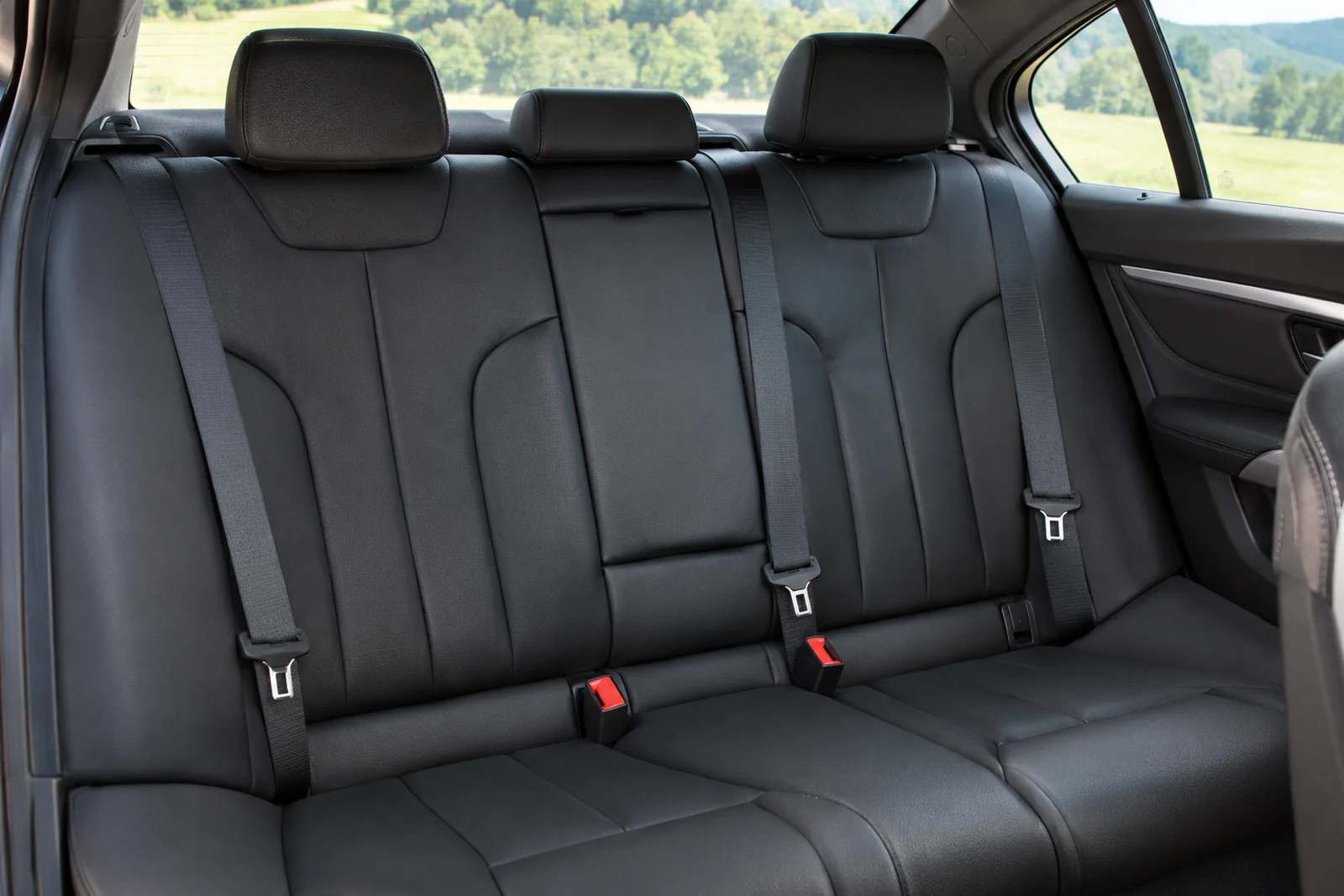
Check the seat-back or roof-mounted belt arrangement where fitted. Folding seats can trap buckles or twist webbing. A warning that stays on also requires input and wiring checks where applicable.
Follow both the BMW handbook and child-seat instructions. Belt-locking features vary by model and market; do not assume every rear belt uses the same locking mode. Never secure a child seat with a faulty belt.
Repositioning a trapped buckle, repairing a confirmed wiring fault and replacing an assembly are different jobs. The inspection establishes the parts, access and completion time required.
Lights and chimes
A warning identifies a problem to investigate. Buckle status, occupancy inputs and wiring can all be involved; the fitted system and diagnostic findings determine the checks.
Buckle engagement, reported buckle status and the relevant wiring or connectors.
Before replacing a partCompare the symptom with diagnostic inputs and the specified tests. The warning alone does not prove a buckle has failed.
Objects on the seat, occupancy inputs and related wiring, depending on the model.
Useful informationTell us whether the warning began after seat removal, cleaning or interior work.
Read the restraint-system faults and inspect the circuits identified by the diagnostic procedure.
What to doProtection may be reduced. Arrange prompt assessment and follow the vehicle’s warning instructions.
Do not fit chime-silencing clips or bypass a buckle switch. These hide the symptom and can give the restraint system incorrect information. For broader warnings, see BMW restraint system malfunction diagnosis.
Doing it properly
A seat belt is only as good as the way it is fitted. These are the checks that make the difference between a belt that looks right and one that works in a crash.
Belts are ordered by chassis number, seat position and colour, because tensioner type and length differ between models.
Anchor bolts hold the belt to the body. They are tightened to the specified torque and new bolts are used where required.
Trained technicians follow the specified isolation, waiting time and pyrotechnic handling instructions for the vehicle.
After the required repair, check belt operation, installation and the restraint-system self-test. Clear repair-related faults only as specified and investigate any remaining warning.
How we work
The repair plan depends on the fault, collision history and fitted restraint system. Inspection and evidence come before parts approval.
Free pickup or drop offWe collect your BMW in Dubai, or you bring it to our Al Quoz workshop.
Belt and buckle checkEach belt is pulled, latched, released and checked for locking and retraction.
Airbag module scanStored faults guide the relevant physical inspections and specified tests; codes alone do not establish the replacement list.
Clear quoteYou get the findings and a fixed price before any parts are ordered.
Follow the specified repair procedureUse the vehicle-specific isolation and handling procedure, fit the correct components and fasteners, and tighten anchors to specification.
Verify the completed repairThe airbag module is checked again and the belt tested before the car is returned.
Know what you are approving
Ask to see the relevant damage or diagnostic findings and why replacement is recommended. Confirm VIN, seating position, body style, market specification and restraint equipment. Colour alone does not establish compatibility.
Confirm parts availability and estimated completion after assessment. Ask for the applicable parts and workmanship warranty, duration, exclusions and claim process in writing before approving the work.
Review the replaced components and invoice. Confirm routing, latching, retraction, mounting and the required restraint-system checks. A scan without faults does not establish the condition of every mechanical component.
Our independent workshop is in Al Quoz, Dubai. Free pickup is available for workshop repairs; confirm scheduling and suitable transport where the driver’s belt is unusable or collision damage affects the vehicle.
Check before paying for related work
An open campaign may change where your repair should be carried out. Use BMW’s official tool to check your individual vehicle before authorising paid work that could relate to a recall.
Applicable recall work is free through authorised BMW partners
Eligibility depends on the individual vehicle. An inquiry to our independent workshop does not confirm campaign coverage.
FAQ
Short answers to what owners ask about belts, buckles and tensioners. Message us on WhatsApp for anything else.
A fired pyrotechnic pretensioner cannot be reset for reuse. A locked belt needs inspection to establish the cause and, after a collision, the full replacement scope required for that vehicle.
No. Stitching or patching weakens the strap. The belt assembly is replaced.
Have belts assessed after every accident. Deployed components must be replaced, and belts worn in a serious collision must not be assumed reusable. Follow the vehicle-specific BMW collision instructions, which may require the complete belt system and associated components.
Possible causes include buckle status, occupancy inputs and wiring. A diagnostic scan guides inspection and specified tests; it does not by itself prove which part needs replacement.
Routing, guide friction, contamination or a retractor fault may cause slow movement. Use only handbook-approved cleaning methods. Do not use the seat if the belt cannot return to a snug fit.
Yes, on many models the buckle is a separate part. If it carries a tensioner, it is handled with the airbag system rules.
We do not recommend it. You cannot know its history, and a belt from another car may not match your seat or tensioner type.
The completed repair must include the specified diagnostic and warning-lamp self-test checks. A remaining or returning warning requires further investigation; clearing a code alone is not proof of repair.
Not necessarily. Cost depends on the exact assembly, fitted tensioner, access and collision damage. Compare an itemised fitted quote for the correct seating position.
Yes. We offer free pickup in Dubai, and the work is done at our Al Quoz workshop, open Monday to Saturday, 9am to 7pm.
Timing depends on diagnosis, trim or seat access, part availability and any collision-related work. Ask for an estimated completion time once the repair scope and parts supply are confirmed.
Do not use a seat with a damaged belt, insecure buckle or a belt that cannot fit snugly. If the driver’s belt is affected, arrange suitable transport. A restraint warning also needs prompt assessment; follow the vehicle’s warning instructions.
There is no single price for every BMW or seat position. Request an itemised quote covering the specified parts, labour, diagnostic work, VAT treatment and any transport or additional collision repairs.
Book a seat belt check
Tell us your model and year, affected seat, warning message and whether the car has been in a collision. Send a photo only if it can be taken safely. We will confirm assessment and transport arrangements, then explain the repair quote before approval.