
xDrive transfer cases, actuators and fluid
BMW Transfer Case Replacement in Dubai
Binding on tight turns, a shudder in car parks, a clunk when pulling away or an xDrive warning usually point to the transfer case or its actuator. We test the whole four wheel drive system first, so you only replace the transfer case when it really has failed.
How xDrive splits the power
What the Transfer Case Does in Your xDrive BMW
The transfer case sits behind the gearbox and decides how much drive goes to the front wheels. The rear axle is always driven, and the front gets a share when the car needs it.
Inside is a multi plate clutch pack. An electric actuator motor squeezes those plates together through a lever and a gear, and a control unit decides how hard, many times a second, using wheel speed, steering angle and throttle signals. Under gentle cruising most power goes to the rear. When you pull away hard, turn in or lose grip, more goes to the front.
BMW calls this transfer case the ATC, and different versions are used across the X3, X4, X5, X6 and X7 and the xDrive versions of the 3, 4, 5 and 7 Series. The X1 and X2 on the front wheel drive platform use a different setup, with a power take off at the front and a coupling at the rear, so the checks for those cars are different.
Owners who drive on sand or gravel outside the city lean on the system far more than those who stay on tarmac. Deep sand keeps the clutch pack working hard and heats the fluid quickly, so a car that spends weekends in the desert usually needs its transfer case checked sooner than one used only for the school run.
The full drive enters the transfer case from the automatic gearbox.
Power passes straight through to the rear prop shaft and differential.
The clutch pack sends a varying share to the front prop shaft.
A motor and control unit set the clutch pressure moment to moment.
What drivers notice
Symptoms of a Failing BMW Transfer Case
Transfer case problems show up most at low speed, on full lock and when pulling away, which makes Dubai car parks and roundabouts the place most owners first notice them.
The car feels like it is braking or skipping when you turn on full lock at walking pace.
A judder through the floor, often worse when the car is hot.
A thump from under the centre of the car when moving off or changing direction.
Messages such as four wheel drive failure, xDrive fault or drivetrain warnings, often with DSC and ABS lights.
A noise that changes with road speed, coming from below the gearbox.
Oil on the transfer case casing or dripping near the rear of the gearbox.
Several of these can also come from the differentials, the prop shafts or the gearbox, so the first job is always finding the source. Binding on tight turns that goes away when driving straight is the classic transfer case sign, but a worn front differential or mismatched tyres can cause the same feeling. Our BMW drivetrain malfunction repair page covers the wider set of warnings these cars can show.
What it costs
BMW Transfer Case Replacement Cost in Dubai
The cost depends on whether the fault is the fluid, the actuator or the transfer case itself. These figures are published by other Dubai businesses and a UAE parts seller, so you can see the range before calling anyone.
These prices are published by other businesses, not by us. They were checked in November 2026 and can change at any time. Starting prices usually cover the simplest version of the job.
The gap between a fluid change and a new transfer case is large, which is why diagnosis matters so much on this job. Plenty of cars that arrive with binding or a shudder need fluid or an actuator, not a complete unit. When the casing, the chain or the clutch pack is worn, the options are a used unit, a rebuilt unit or a new one from BMW, and we price each so you can choose. Labour for removing and refitting the unit is similar whichever option you pick, so the real difference in the final bill comes from the part itself, the fluid and the calibration time.
The part that fails most
The Transfer Case Actuator Motor and Its Gear
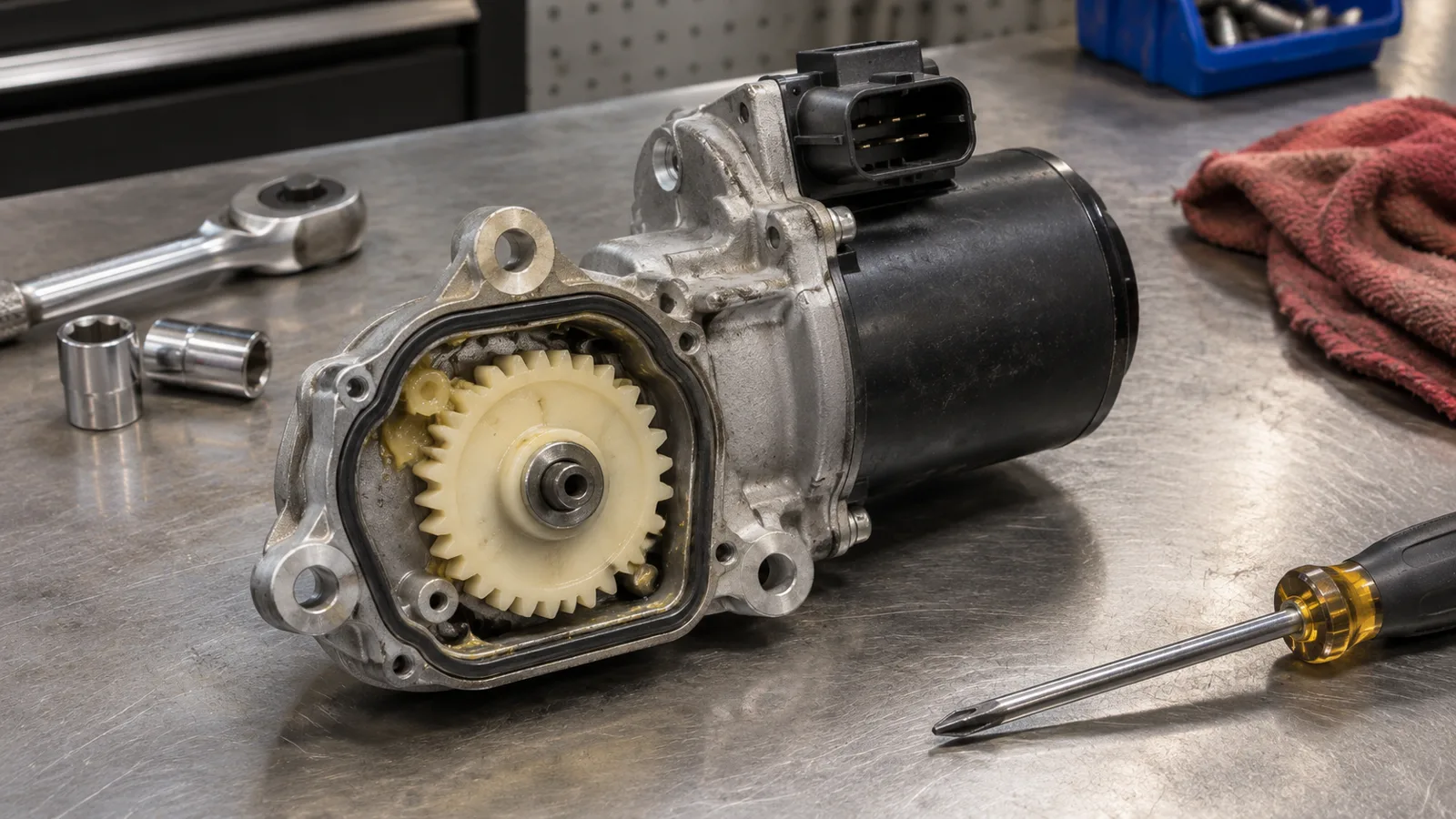
The actuator, often called the transfer case shift motor or servo, bolts to the outside of the transfer case and moves the lever that loads the clutch pack.
On many versions the motor drives the lever through a plastic gear. Over time that gear wears or loses teeth, and the actuator can no longer set the clutch pressure. The car then shows an xDrive warning, the front wheels may get no drive at all, or the system reacts late and the car shudders.
Because the actuator sits on the outside, it can be removed and tested without opening the transfer case. Where the motor itself is healthy and only the gear has worn, a gear repair kit is an option on some versions. Where the motor has failed, a new actuator is fitted and the system is calibrated.
Aftermarket actuators cost far less than the BMW part, and many work well, but quality varies between brands. We tell you which option we would choose for your model and why, and we fit the part you decide on.
- Fault memory shows actuator or motor position errors
- Front drive missing or late on hard acceleration
- Warnings that come and go with heat

Lifetime is not forever
Transfer Case Fluid Service for xDrive Models
BMW lists the transfer case fluid as lifetime fill on many models, but the clutch plates wear into that fluid and it breaks down with heat.
Old, worn fluid changes how the clutch pack grips. The most common result is a shudder or binding on tight turns, especially in hot weather. Replacing the fluid with the correct BMW specification often reduces or removes the symptom, and on a car that has done high mileage it is a sensible step before deciding on bigger repairs.
In Dubai heat, with lots of short trips and slow traffic, the fluid works harder than it would in a cooler climate. We suggest checking it with every major service on older xDrive cars, and changing it when it is dark or the car has started to bind.
A fluid change is also a useful test. If the binding improves clearly afterwards, the clutch pack is still in reasonable shape. If nothing changes, the fault is more likely in the actuator or inside the unit, and the next step is clearer.
The hidden cause
Why Tyre Mismatch Damages the Transfer Case
An xDrive car expects the front and rear wheels to turn at almost exactly the same speed. Tyres that do not match break that rule all the time.
If the front tyres are worn more than the rear, or one axle has a different brand or size, the front and rear prop shafts turn at slightly different speeds. The clutch pack in the transfer case then slips constantly to make up the difference, which heats the fluid and wears the plates. Over months, this is one of the most common reasons a transfer case fails early.
Staggered sizes from the factory are designed for this, but they still need the correct rolling circumference. Run flat and non run flat tyres mixed on one car, or a single replaced tyre on a worn set, can cause the same strain.
Before you replace one or two tyres, send us the sizes and tread depths of all four. We can tell you whether the new pair will match closely enough or whether replacing all four will save the transfer case from extra wear. It is a quick message that can avoid a very expensive repair later.
Choosing the fix
Repair, Rebuild or Replace the Transfer Case
Once we know the cause, there are usually several ways to fix it. Each one suits a different fault and budget.
For binding or shudder with no internal wear. The lowest cost fix and often the first step.
Suits early symptomsFor warnings and missing front drive where the transfer case itself is sound.
Outside the casingFor leaks and some noises, with the unit removed and resealed.
Unit removedFor a worn chain, clutch pack or damaged casing. We price each so you can compare.
Full replacementA used transfer case must match the exact version and ratio for your car. The wrong unit can fit physically but cause constant strain and warnings. We confirm the part number against your chassis number before ordering, and we explain the condition and history of any used unit we offer.

After the work is done
Calibration and Coding After Transfer Case Work
The transfer case control unit needs to learn the actuator position and the clutch pack behaviour after almost any job.
The control unit learns the end positions of a new or refitted actuator.
Some models store a value for fluid age that is reset after a fluid change.
A replacement transfer case may need coding so the car recognises it.
Stored drivetrain, DSC and ABS faults are cleared and checked again.
Skipping these steps is a common reason a new part still gives warnings or a shudder. We run them with the correct diagnostic software, then road test the car on tight turns and full throttle starts to confirm the system responds as it should.
The rest of the drivetrain
Parts Checked Around the Transfer Case
The transfer case connects to several parts that can fail in similar ways. Checking them together avoids replacing the wrong one.
Runs from the transfer case to the front differential. Worn joints cause clunks and vibration. See our BMW drive shaft repair page.
Low or worn oil can cause noises and binding that feel like a transfer case fault. See our BMW differential repair page.

The front drive passes through CV axles that wear and click on full lock. See our BMW axle replacement page.
Where the gearbox meets the transfer case, a leaking seal can mix fluids. See our BMW transmission leak page.
A clunk when moving off, for example, can come from the transfer case, a prop shaft joint, a differential mount or an engine mount. We lift the car and load each part by hand, then drive it with the noise in mind, so the repair goes where the fault actually is.
How the job is done
How We Replace a BMW Transfer Case in Al Quoz
You see the finding and agree the cost before any part is ordered.
Removing a transfer case means supporting the gearbox, disconnecting both prop shafts and the actuator, and lowering the unit from under the car. We inspect the prop shaft joints, the gearbox output seal and the mounts while everything is apart, because this is the easiest moment to deal with them.
The old transfer case or actuator is kept for you to see when you collect the car. If the cause was fluid or tyres rather than a worn part, we explain that too, so you know what to watch for in future.
- Road test and scanSymptoms recreated, fault memories read.
- Tyre and fluid checkTread, sizes and fluid condition checked.
- Actuator testMotor and gear tested on and off the car.
- Finding and costYou receive the cause and each option priced.
- Repair or replacePart fitted, fluid filled to specification.
- Calibrate and testTeach in, faults cleared, road tested.
Owners ask us
BMW Transfer Case Questions
Quick answers before you book.
What does a BMW transfer case do?
It splits drive between the front and rear axles on xDrive models.
Why does my BMW bind on tight turns?
Usually old transfer case fluid, a worn actuator or mismatched tyres.
Can I drive with a transfer case warning?
Often the car drives in rear wheel drive, but get it checked soon to avoid more damage.
Is the actuator motor part of the transfer case?
It bolts to the outside and can be replaced separately.
Does transfer case fluid need changing?
BMW calls it lifetime fill, but fresh fluid often cures shudder on older cars.
Can different tyres damage the transfer case?
Yes. Uneven wear or mixed sizes make the clutch pack slip constantly.
Do the X1 and X2 have a transfer case?
Front wheel drive based X1 and X2 models use a different coupling system.
Will a used transfer case work in my BMW?
Only if it is the exact version and ratio for your car. We check first.
Does the car need coding after the repair?
Yes. The actuator and control unit need calibration after most jobs.
Do you collect the car in Dubai?
Yes. Pickup is free anywhere in Dubai. Our workshop is in Al Quoz and we are open Monday to Saturday, 9am to 7pm.

Binding, shudder or an xDrive warning?
Book Your BMW Transfer Case Check
Tell us your model, year and what the car is doing. We collect it for free anywhere in Dubai, find the cause and send the cost before any work begins.
- Free pickupAnywhere in Dubai
- Cost firstBefore any work
- OpenMonday to Saturday, 9am to 7pm