
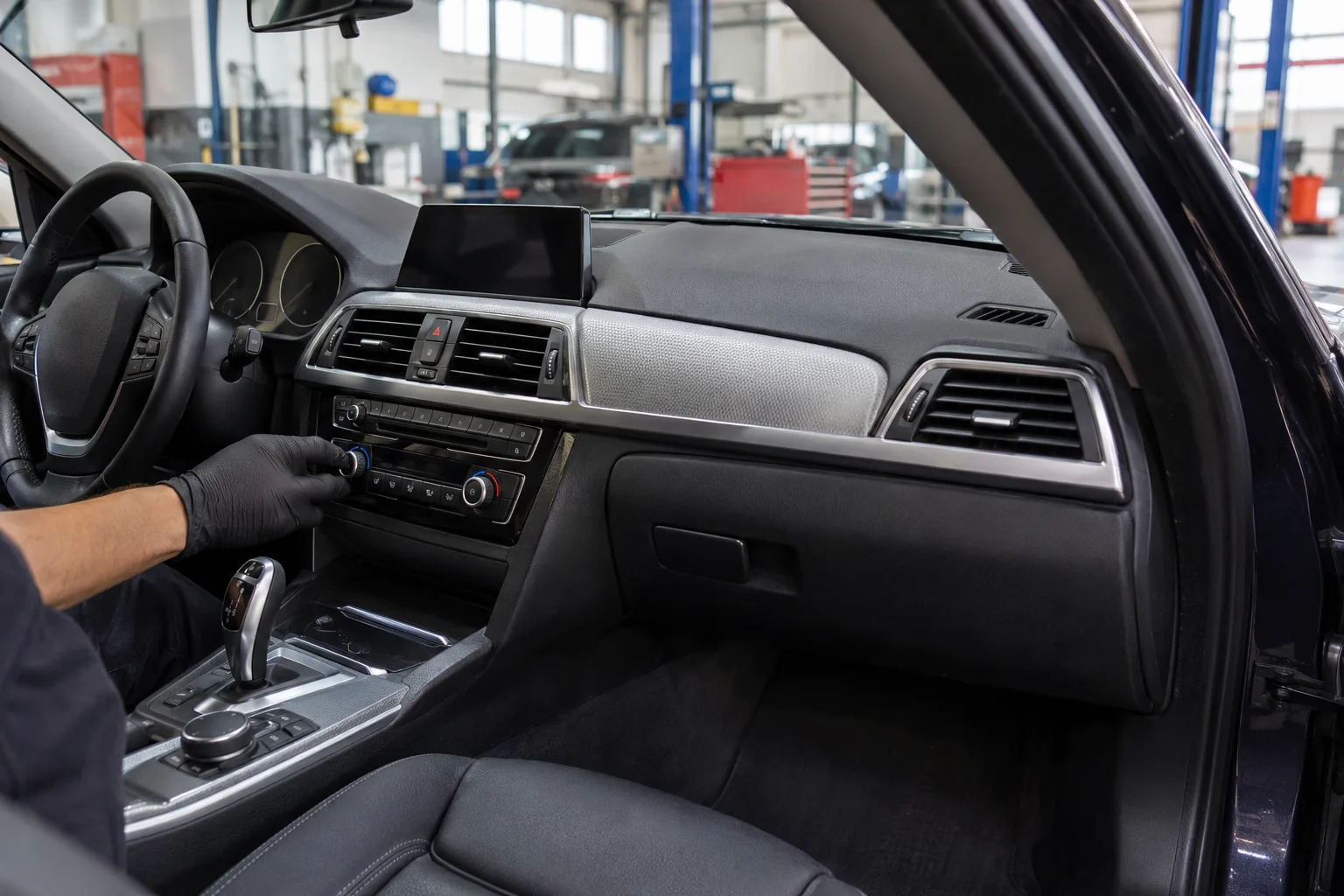
Match the noise to what the climate system is doing
A sound that follows cabin fan speed points to a different investigation from one that appears only with a cooling request. Neither observation proves a failed part. Describe the condition and let the workshop check whether the source is air movement, a moving component or vibration transmitted from elsewhere.
| What you notice | Useful distinction | Area to investigate |
|---|---|---|
| Rustling, ticking or vibration that changes with fan speed | Does it follow the cabin blower rather than engine speed? | Blower wheel, debris, motor, housing and filter installation |
| Whistle or rushing air near a vent | Does normal adjustment of that outlet change it? | Vent opening, duct sealing, airflow restriction and filter fit |
| Repeated clicking when airflow direction or recirculation changes | Does the air reach the selected outlets? | Flap movement, actuator, linkage, controls and sensor inputs |
| Drone or rattle associated with cooling | Where is vibration felt, and is cooling also affected? | Pipe contact, brackets, mounts, compressor and applicable drive components |
| Grinding, burning smell, smoke or a warning | Severity changes the response | Stop testing and obtain appropriate assistance |
Stop adjusting the controls if there is smoke, a burning smell, severe grinding or a vehicle warning. Stop safely and follow the warning instructions. Do not keep the engine running or repeatedly switch the AC on to demonstrate a severe sound. If demisting cannot maintain a clear windscreen, stop safely until visibility can be restored.
Cooling performance is a separate clue. If the main complaint is warm air, use our BMW AC diagnosis guide. For weak airflow, smells, uneven temperatures or water concerns alongside the sound, the air conditioning problems guide explains those symptoms without assuming that they share one cause.
The cabin blower can be noisy while cooling still works
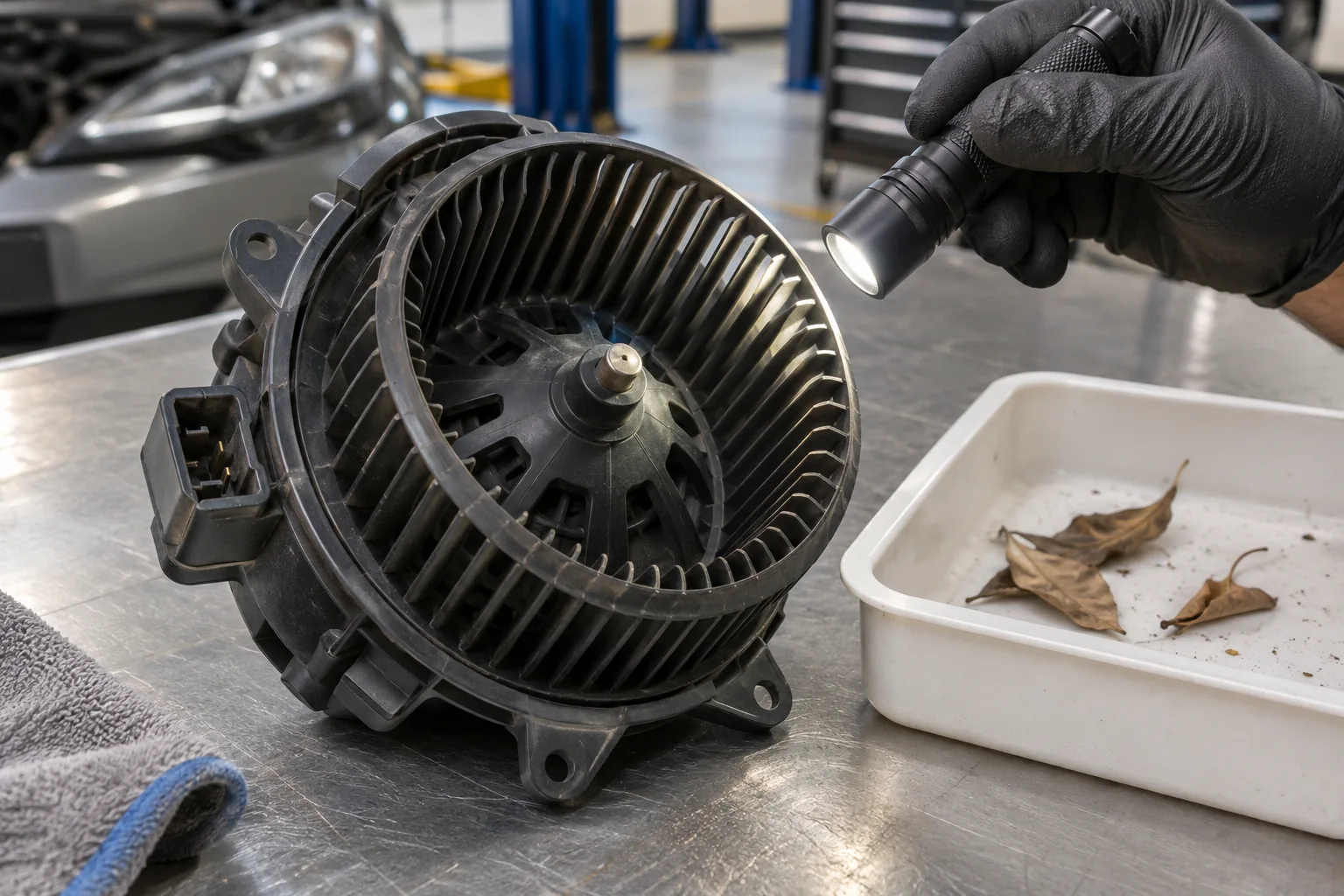
The blower moves air through the cabin ventilation system. It can run without the compressor actively cooling, so fan noise and cooling-circuit noise need to be separated.
Debris in its housing, contact at the fan wheel or a motor problem can create a cabin-side sound. Hearing it near the glovebox does not by itself identify which part needs attention.
If rustling or vibration rises and falls with the selected fan speed, report that relationship. A technician can inspect the blower, housing, electrical supply and filter area as appropriate. Cleaning out an obstruction may solve the complaint without replacing the motor; damaged or worn components require a different decision.
BMW's February 2015 SI B64 04 12 describes a howling or vibrating blower complaint on F30 3 Series sedans produced from 31 May 2011 to 13 February 2013. Its procedure includes checking for debris in the housing and microfilter. This is a historical, limited application example, not evidence that every noisy BMW blower has the same fault.
A fan that operates at only some settings or stops intermittently also needs its control and power supply checked. Do not order a motor solely because the airflow is weak. Our blower motor service page explains the assessment and replacement destination when that area is confirmed.
A whistle does not confirm a refrigerant leak
Air passing through a restricted opening or an imperfectly sealed duct can make a whistle. The useful question is whether the sound responds to the cabin fan or an ordinary vent adjustment. A leak in the cooling circuit is a separate finding that requires an appropriate leak test.
With the vehicle safely parked and no urgent symptom, note whether the outlet was partly closed or aimed into a narrow position. Return it to a normal open setting and describe any change. This can provide a simple explanation for an airflow sound, although it does not clear a persistent new noise elsewhere.
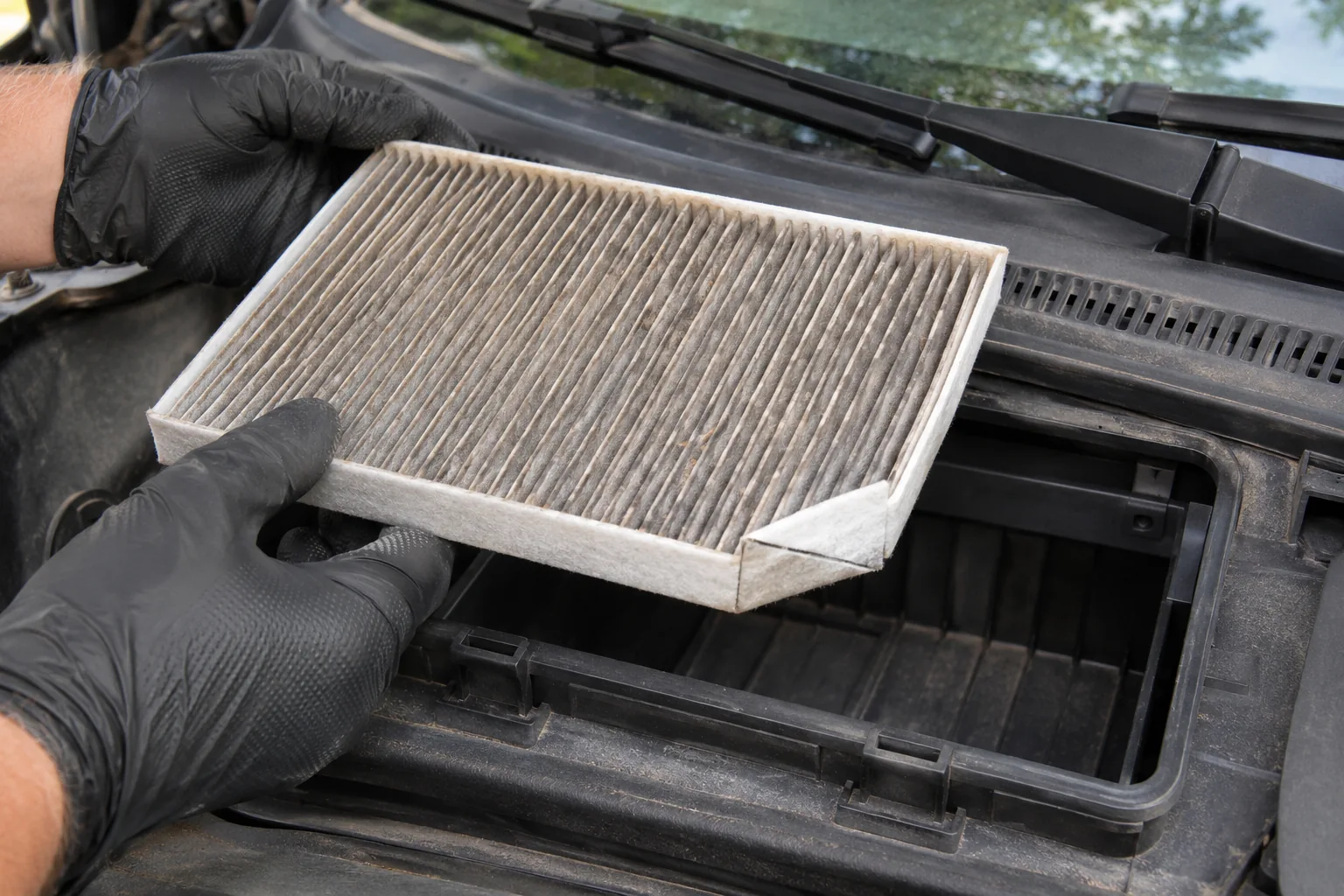
Filter condition and installation also deserve attention when noise begins after a cabin-filter change. Mention the timing rather than assuming the new filter is defective.
The correct filter, its seating, housing closure and any disturbed seals should be checked. A dirty-looking filter alone cannot prove the origin of every whistle.
Do not push tools through the vents, spray cleaners into them or try to seal a duct from the outside with improvised material. Those approaches can leave the actual source untouched. A technician should distinguish a vent or housing noise from refrigerant-flow noise and other sounds transmitted through the dashboard.
A different historical example is BMW SI B64 09 15 from February 2016. It describes a centre-vent whistle with the AC/compressor off, associated with refrigerant flow at particular temperature differences on listed F22, F23, F30, F31, F32, F33 and F36 vehicles. It required the specific complaint to be confirmed before repair. A whistle can therefore involve airflow or a cooling-circuit condition without being proof of a leak.
A brief hiss and a persistent sharp whistle are worth describing separately. Include duration and whether cooling changes. Neither the loudness nor a phone recording tells the technician how much refrigerant is present.
Repeated clicking can involve air flaps and their controls
The climate system uses flaps to route and mix air. Repeated clicking or cycling when you select footwell, windscreen, face-level airflow or recirculation can lead the investigation towards that mechanism and its controls.
An actuator or linkage may be involved, but the motor is not the only possibility. A control input can cause repeated movement even when replacing the actuator would not address the reason it was commanded to move. Tell the workshop whether the selected airflow actually changes.
BMW SIB 64 02 22, dated 18 May 2022, is an example of recirculation-flap cycling linked to implausible automatic air recirculation sensor readings on the vehicles listed in that document. The sensor input matters as well as the moving flap.
This bulletin is BMW North American service information, not a Dubai recall notice or a diagnosis for your vehicle. A workshop must confirm the fitted system and applicable current information. The same clicking description on a different model can need different checks.
A short adjustment sound and repeated clicking with failed air distribution are different complaints. Record whether it happens once, repeats continuously or occurs only after a particular selection. The actuator assessment service is the relevant destination if the flap mechanism is implicated, rather than replacing a compressor because the noise comes from the dashboard.
A cooling-related drone may be vibration from pipes or mounts
A rattle heard inside the car can originate outside the cabin and travel through a pipe, bracket or body contact. The place you hear it is useful, but it is not always the location of the faulty component.
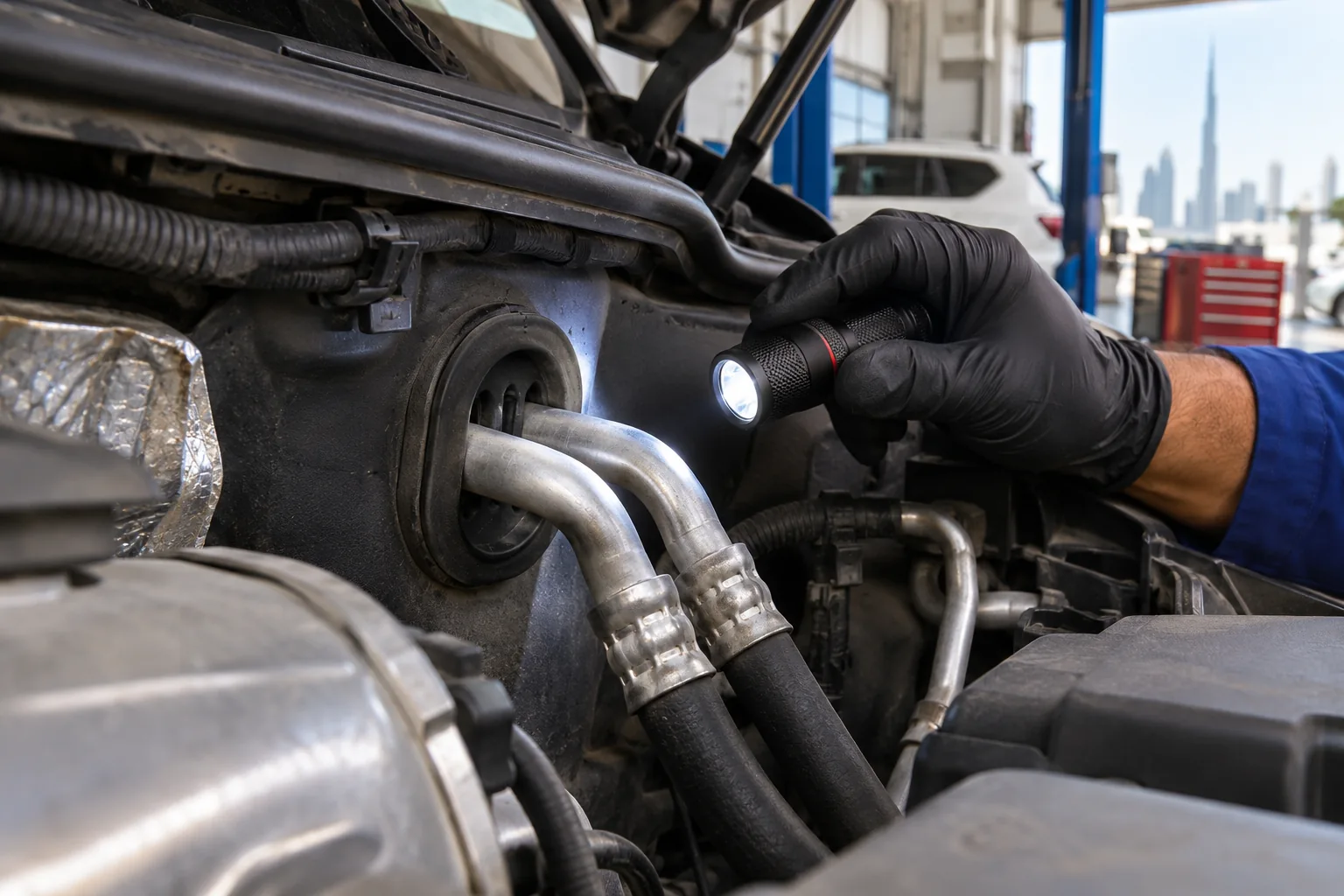
BMW's June 2024 revision of SIB 64 05 21 addresses an AC-related rattle or drone on its listed applications, including the G20 3 Series. It describes contact and vibration paths involving lines and hoses. This shows why the compressor should not automatically be condemned when cooling activation brings on a cabin rattle.
The vibration path can involve coolant hoses as well as refrigerant lines. The technician should locate the contact or movement and follow the applicable repair method. Do not bend aluminum pipes, loosen their connections or add a clamp because another car's bulletin mentions one. The line arrangement and repair instructions must match the vehicle.
For an under-bonnet squeal on a belt-driven installation, the auxiliary drive also needs distinguishing from the compressor internals. The pulley-noise guide covers that separate complaint. An electric compressor has a different drive arrangement, so advice based on an engagement clutch or belt does not apply to every BMW.
DENSO's abnormal-noise guidance similarly separates compressor faults from piping, condenser mounts, brackets and drive components. Its generic chart is a diagnostic reference; the fitted BMW system determines which possibilities apply.
Give the workshop a useful description without dismantling anything
Only make normal control observations while safely parked, in suitable ventilation and without warnings or severe symptoms. Do not run an engine in an enclosed space. One clear description is enough; prolonged testing is unnecessary.
- Location and sound
- Glovebox, centre vents, footwell, front of the car or another area. Describe a rustle, repeated click, whistle, drone or grind in your own words.
- Controls already in use
- Fan level, automatic or manual mode, cooling selection, airflow direction and recirculation setting.
- Timing and duration
- At startup, during a journey, after parking, only when warm, or after a recent filter change or repair.
- Accompanying symptoms
- Warm air, weak airflow, a failed outlet selection, misting, warning text or an unusual smell.
If a quiet, non-severe sound changes during an ordinary fan adjustment, note the setting. If it changes when the cooling request changes, report that too. Keep the rest of the conditions as similar as practical so the observation is meaningful.
The cooling button is a request to the control system, not proof that every related component instantly starts or stops. Automatic modes and demisting can also influence operation. Use the BMW Driver's Guide for your vehicle identification number (VIN) to identify the controls on your vehicle instead of assuming another model's panel works the same way.
An existing short audio clip can help explain an intermittent event. State where the phone was held and what setting was selected. Keep hands and devices out of engine bays and moving fans; a recording cannot establish refrigerant charge, bearing condition or the need for a compressor.
A parked hybrid or electric BMW needs its operating state recorded
On an equipped plug-in hybrid or electric BMW, cabin preconditioning can operate before departure. Hearing climate equipment with the combustion engine stopped therefore does not automatically establish a fault.
BMW's preconditioning guidance makes availability dependent on the country, model and equipment. Note whether preconditioning was selected, a departure timer was active or the vehicle was charging when the sound occurred. These conditions help the workshop reproduce the right event.
A new grind, severe vibration, warning or loss of cooling still needs assessment. Do not label it normal because an electric vehicle makes operating sounds. Leave high-voltage compressor connections and refrigerant work to appropriately trained personnel using the correct procedures and materials.
Workshop checks should identify the source before a parts quote
The initial assessment should reproduce the reported condition where safe and establish which system produces the sound. Agree the investigation scope and charge before authorising dismantling or refrigerant work.
- Confirm the complaint under matching conditions
- Compare blower operation, cooling demand, flap commands and the noise location. Separate an acoustic complaint from a cooling-performance problem.
- Inspect the relevant physical area
- Check the fan housing, filter fit, ducting, pipe clearances, brackets or drive components indicated by the observation.
- Use applicable diagnostic information
- Climate-control faults, sensor values, commanded positions and component tests can support the investigation. No fault code does not rule out a mechanical rattle.
- Test the cooling circuit when the evidence calls for it
- Identify the refrigerant and vehicle specification, then assess performance, pressures, leaks or recovered charge as appropriate. Interpret measurements under recorded operating conditions.
A pressure reading alone cannot specify how much refrigerant to add or prove why a pipe resonates. Likewise, a low vent temperature does not show that a repeated flap click is harmless. The finding should explain the complaint the car was booked for.
Ask the technician to state what has been confirmed, what remains uncertain and what further test would change the repair decision. This is especially helpful for intermittent noise that cannot be reproduced during the visit.
Choose the repair from the finding
The smallest appropriate repair is the one that addresses the confirmed cause. Debris removal, correct filter seating or a verified contact-point correction may be sufficient. A damaged blower, failed flap mechanism or internally faulty compressor calls for a different scope.
| Confirmed finding | Repair discussion | Completion check |
|---|---|---|
| Obstruction or incorrect filter fit | Removal or correct installation, with damage assessed separately | Original fan setting is quiet and airflow is restored |
| Blower or flap fault | Identified component, controls and any required setup | Noise and the affected airflow function are checked |
| Pipe or bracket contact | Applicable clearance and support correction | Original cooling condition no longer creates the contact noise |
| Cooling-circuit or compressor fault | Confirmed cause, correct materials and any contamination work | Cooling performance and noise checked after the agreed repair |
Do not use a recharge can or add oil as a noise treatment. Refrigerant type, charge mass and compressor-oil requirements are specific to the system. DENSO's compressor-oil guidance explains why the correct oil matters; an unspecified lubricant is not a universal fix.
For a compressor proposal, ask why external vibration, mounting or drive faults have been excluded and whether contamination changes the scope. Obtain the parts specification, labour, required fluids, applicable tax and warranty terms in the estimate. No single price can describe every AC-noise repair.
Prevent avoidable noise without adding routine lubricants
Follow the vehicle's cabin-filter and maintenance instructions, keep accessible intake areas clear as directed and report a sound that appears immediately after work. Correct fit and housing closure matter as well as filter cleanliness.
Do not pour liquids through vents, lubricate the blower through an opening or spray a belt to make a squeal disappear. Compressor oil belongs within a specified service procedure, not a recurring owner top-up. A persistent sound needs its cause identified.
Keep repair records and describe a change early. Maintenance can reduce avoidable obstructions and installation problems, but it cannot promise a silent system or prevent every component failure.
Describe sound and cooling as two separate results
After repair, check the condition that originally produced the noise as well as the cooling and airflow functions involved in the work. Cold air alone is not a complete answer to a noise complaint, and a quieter system should still direct air where selected.
For intermittent events, agree how a return of the symptom will be documented. Keep the previous report so the next assessment can build on the findings instead of beginning with another guessed part.
Questions about BMW AC noise
Can the AC still cool normally with a noisy blower?
Yes. Cabin airflow and refrigerant cooling are different functions. The workshop should investigate the fan-side sound even if the delivered air is cold.
Should I replace the compressor if the noise stops when I switch cooling off?
That observation narrows the conditions but does not confirm internal compressor damage. Cooling operation can also change vibration in pipes, mounts or drive components. The source needs confirming.
What if the workshop cannot reproduce the noise?
Provide the settings, operating state and an existing recording if available. Ask what was checked and whether another assessment under matching conditions is needed before approving parts.
Technical references
The linked BMW bulletins are historical North American service examples with limited vehicle applicability. Use current VIN-specific workshop information and owner instructions for your car. They do not establish a UAE recall or current warranty entitlement.
The BMW Driver's Guide, manufacturer bulletins and DENSO references above support the distinctions between blower, control, mounting and cooling-circuit complaints.
The right check for the sound you hear
Discuss your BMW AC noise
Send the model, year, noise location and the setting that changes it. Include any cooling problem or warning. Our independent Al Quoz workshop can discuss an appropriate first assessment through the BMW AC repair service.
Independent BMW specialist. Not affiliated with BMW AG.