
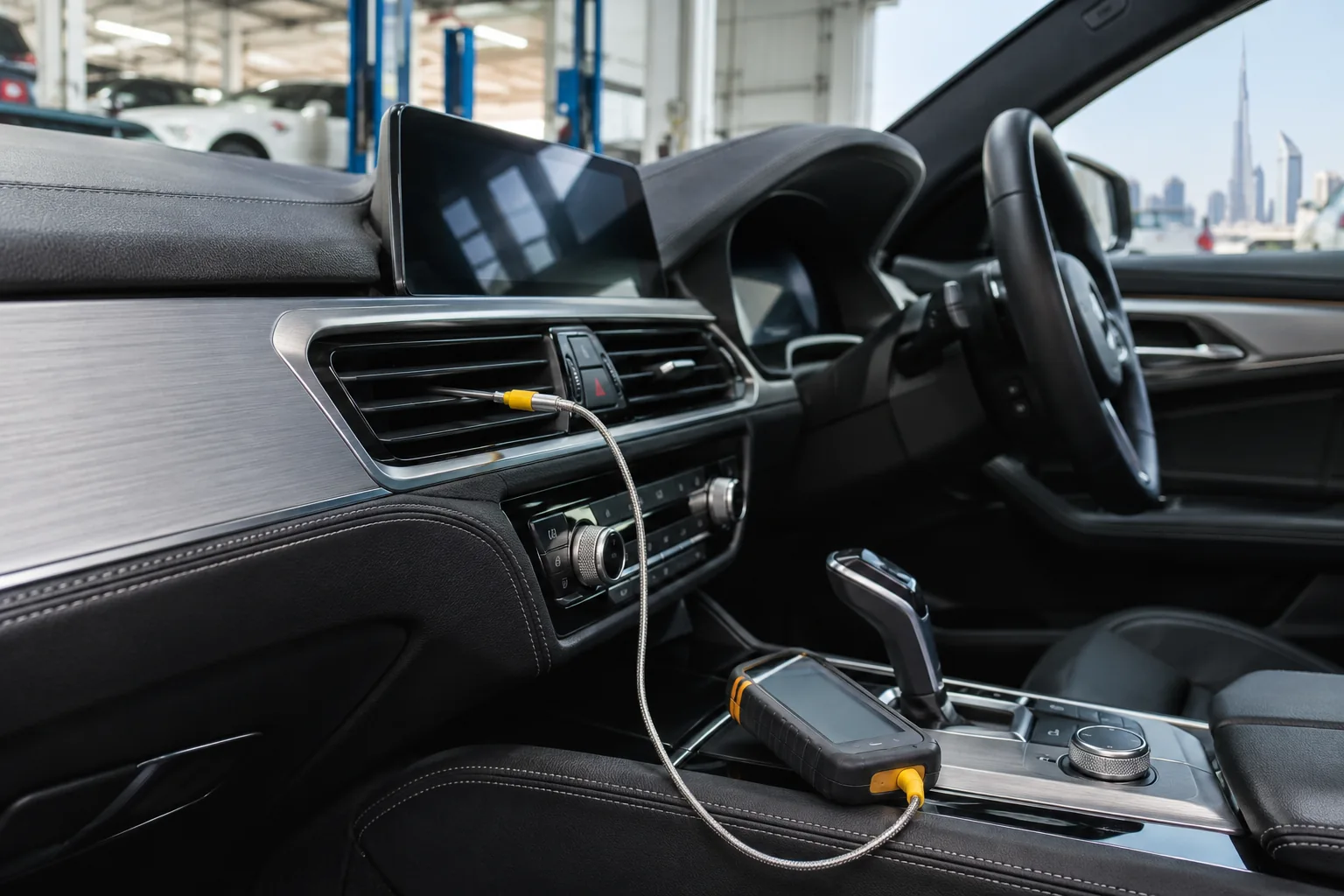
Check the settings before booking diagnosis
Park safely and compare the system under consistent conditions. Open the face-level vents, enable cooling and select the same temperature for both front zones. If your car has SYNC, use it for the comparison. Check any separate centre-vent temperature adjustment using your vehicle's manual.
- Make sure cooling is requested Ventilation alone can move air without cooling it. The available A/C, AUTO and MAX A/C controls depend on your BMW's equipment.
- Compare a manual fan setting Try a low and then a higher fan speed while stationary. AUTO can adjust airflow itself, so a changing fan speed in AUTO is not proof of a fault.
- Compare like-for-like outlets Check the two centre vents with equal settings. A closed vent or different zone temperature can create a misleading comparison.
- Allow the parked cabin to lose its stored heat Note the outside conditions and whether the car was parked in sunlight. Judge the trend after cooling has stabilised, rather than the first breath of air.
BMW explains that its AUTO climate program adjusts airflow and air distribution according to operating conditions and selected settings. That general explanation does not give every model the same menu or controls. Use the BMW Driver's Guide for your VIN for the fitted functions.
If cooling loss comes with an overheating warning, smoke, a burning smell or loss of visibility through misted glass, stop safely and arrange assistance. Follow the vehicle warning. Keep clear of belts and electric fans, and leave pressurised refrigerant connections and high-voltage components to trained technicians.
Match the symptom to the next useful test
A symptom suggests a direction for testing. It does not identify a failed component on its own. Tell the workshop which pattern you can reproduce.
| What you notice | What needs separating | Useful confirmation |
|---|---|---|
| Weak air at every outlet | Restricted air path, blower operation or its electrical control | Filter and intake inspection, then fan command, supply and output checks |
| Strong air stays warm on both sides | Cooling request, refrigerant circuit performance or compressor control | Climate data, measured temperatures and pressures under defined conditions |
| Cool on the road, warm in traffic | Condenser heat rejection and fan operation, alongside refrigerant performance | Fan command versus response and stationary cooling test |
| One side warmer with matching settings | Zone settings, air-mixing flap operation or uneven cooling | Paired vent temperatures, actuator tests and refrigerant checks if indicated |
| Cold at first, then fades | Airflow loss versus loss of cooling with airflow unchanged | Reproduce the fault while recording evaporator temperature and control data |
Noise without a cooling change has a different starting point. Use our BMW AC noise guide to describe where and when the sound occurs. For a broader overview including odours, see common BMW air conditioning problems.
When the blower runs but the airflow is weak
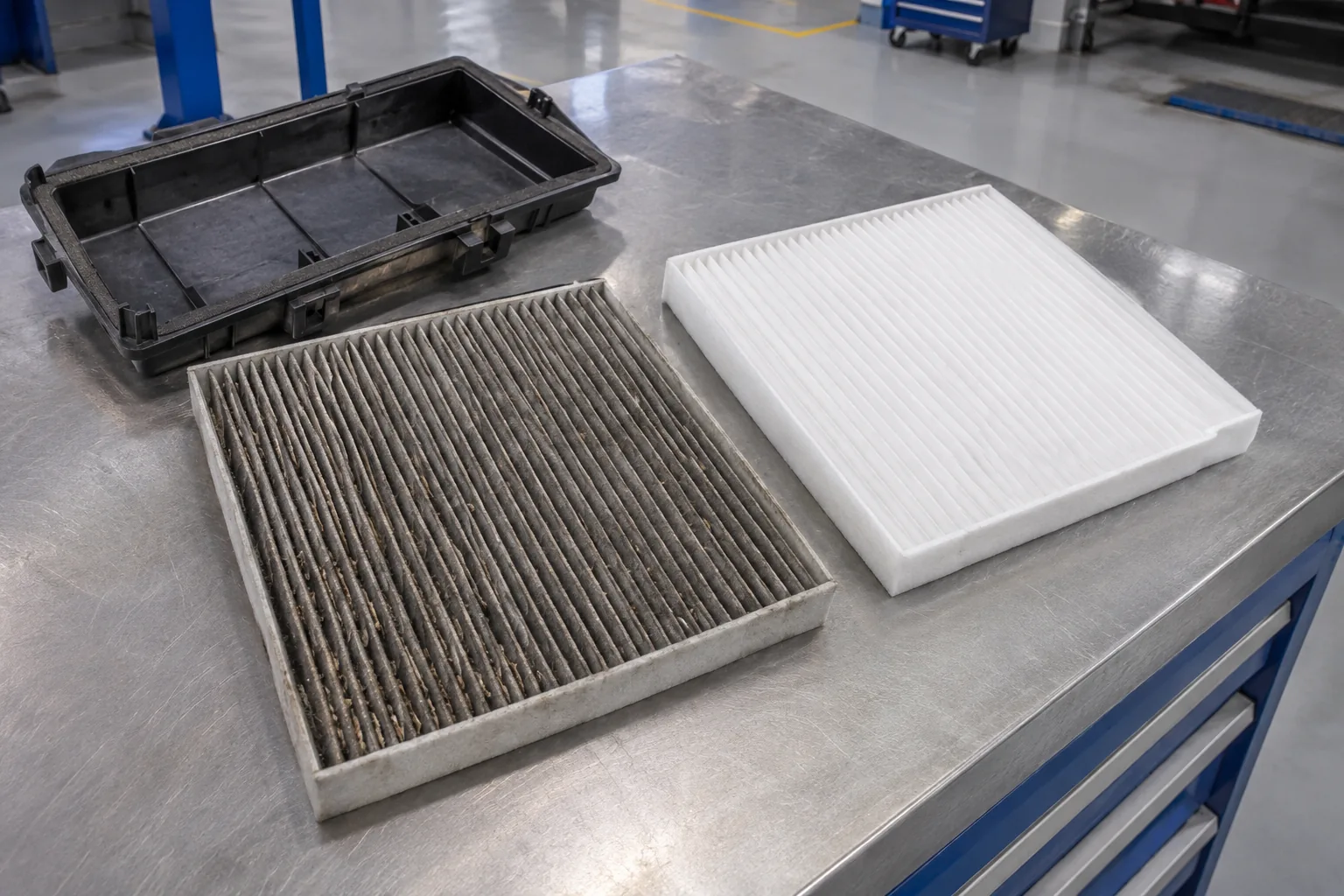
A restricted cabin microfilter can reduce the air reaching the cabin. Its condition matters more than assuming one replacement interval applies to every BMW and every driving environment.
Filter position and access vary by generation. Follow the maintenance instructions for your vehicle or ask for an inspection. A new filter helps when restriction is present; it cannot repair a refrigerant leak.
If fan sound changes but air barely reaches the selected outlets, the workshop should inspect the air path and distribution flaps. If the fan does not respond properly, the motor, blower regulator or final-stage unit, supply and control signal need checking. Replacing the motor first can leave a wiring or regulator fault unresolved.
The blower regulator controls fan speed. A fault scan can assist, but checking electrical supply and the requested versus actual operation makes the repair decision more useful. No airflow is not, by itself, evidence that the AC needs more gas.
When cooling gets worse in traffic
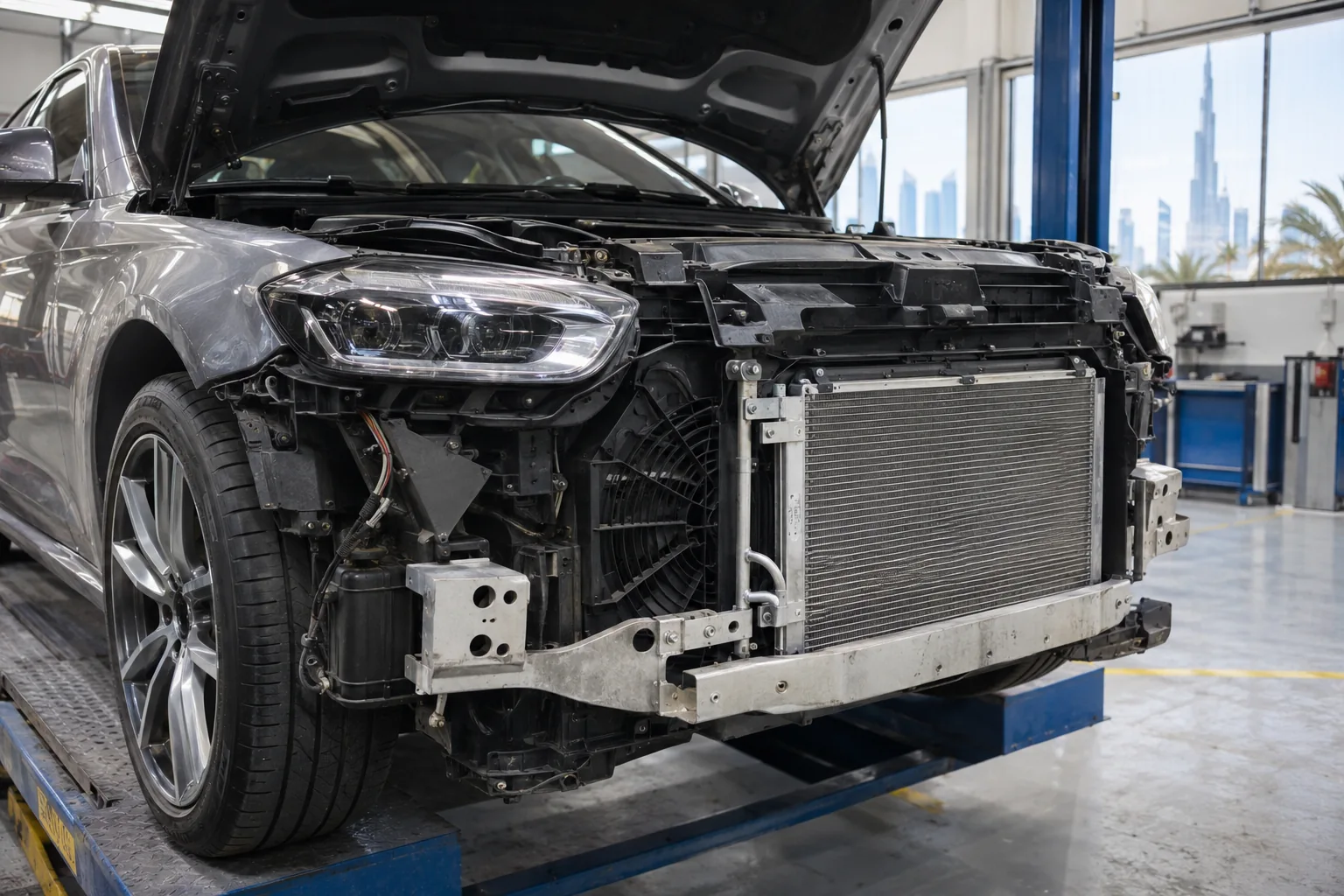
The condenser releases heat outside the car. With less road airflow while stationary, fan operation becomes an important check. A blocked heat-exchanger face or a fan that does not respond correctly can affect cooling, but the symptom alone does not prove which part is faulty.
Ask for a stationary comparison of cooling performance, fan command and actual response. The technician should consider pressure and temperature together and check the relevant electrical circuit before condemning the fan. Do not reach through the grille, try to stop a fan by hand or bend condenser fins while attempting a home repair.
Hot weather is a test condition to record, not a diagnosis. A system that repeatedly loses useful cooling after stabilising needs investigation rather than a claim that all BMWs behave that way in Dubai.
When cooling comes and goes
The most useful detail is whether air delivery falls as cooling fades. A blower that still sounds busy while outlet flow drops needs a different investigation from strong air that simply becomes warm. Describe both the temperature and the air volume.
Record how long the fault takes to appear, whether it affects all zones, and whether switching cooling off briefly changes it. A workshop may need a longer test to capture sensor readings, evaporator temperature, compressor request and shut-off conditions while the fault is present. A short successful test cannot rule out a fault that only occurs after an extended drive.
A useful note for your appointment
“Both front zones start cold. After about 20 minutes, the air still blows strongly but becomes warm. It happened in slow traffic. No warning appeared. The last AC service was three months ago.”
This is an example of how to describe a symptom, not a diagnosis or a documented customer repair.
Do not erase stored faults or disconnect the battery as a generic reset before diagnosis. There is no single AUTO-button reset procedure that should be applied to every BMW climate system.
What a useful workshop diagnosis should establish
Ask what each proposed test is intended to confirm and agree a diagnostic spending limit. BMW's integrated automatic heating and air conditioning system is often referred to as IHKA. A suitable diagnostic tool should communicate with the fitted climate system, rather than checking only generic engine codes.
- Reproduce and measure the complaint
- Record ambient conditions, climate settings, fan speed and comparable outlet temperatures. Check the model-specific performance procedure rather than quoting one universal vent temperature.
- Read the relevant controls
- Review stored faults and live values, then compare sensor readings, cooling requests and component responses. A code identifies an investigation route; it is not a parts order.
- Test the suspected circuit or component
- Choose leak detection, electrical measurements, actuator testing or refrigerant performance checks according to the evidence. Record what passed as well as what failed.
- Explain the repair and verify it
- Link the finding to the proposed work, then repeat the original test after repair. For an intermittent fault, ask what test duration and conditions were achieved.
A quiet compressor is not automatically a failed compressor. Electrically controlled variable-displacement designs cannot all be judged by listening for a clutch click. DENSO explains why temperature and live data checks matter alongside AC pressures. Controls and compressor type must be identified for the vehicle.
Why a gauge reading cannot tell you how much gas to add
Pressure changes with temperature and operating conditions. A single reading cannot establish the refrigerant mass inside the system or distinguish every reason for poor cooling. The vehicle label and current repair data identify the required refrigerant, charge quantity and compatible oil.
If a charge check is justified, the workshop uses suitable recovery and charging equipment and the specified quantity. R134a and R1234yf are different refrigerants. Do not select one by model badge alone or mix them.
If refrigerant loss is established, ask how the leak will be located. Dye can help in suitable circumstances, but a clean-looking connection or a short vacuum hold does not exclude every leak.
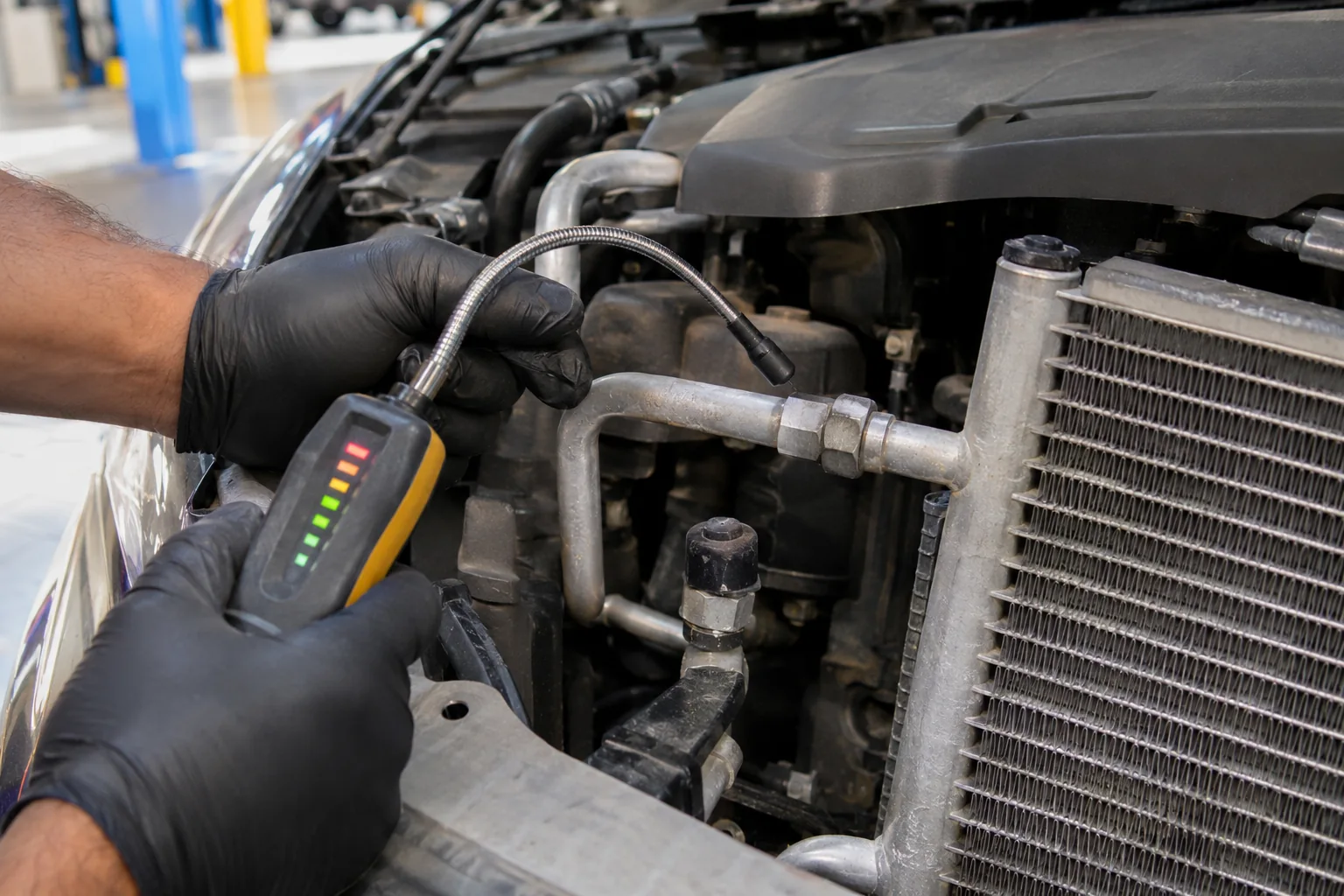
DENSO's AC service equipment guidance explains the limits of relying only on UV dye. The appropriate additional leak test depends on the system and the suspected leak. Leave adding dye, opening service valves and charging refrigerant to an equipped workshop.
If the AC has already been regassed, bring the invoice and any recorded recovered and charged quantities. That service history helps the technician decide what has actually been checked. Repeated filling without an explanation for the loss leaves the underlying question unanswered.
Choose the repair from the finding
The useful outcome of diagnosis is a defined job. A restricted filter may need replacement; an electrical fault may need a connection, regulator or motor repair; a confirmed leak needs its source addressed. Compressor replacement needs supporting performance and control tests, plus the applicable checks for contamination and the cause of failure.
Ask the workshop to separate the diagnostic fee, parts, labour, refrigerant and any additional procedures. Confirm the refrigerant type and charge allowance, whether further leak investigation is included, warranty terms and the final payable total. Do not compare a gas-only offer with a diagnosed component repair.
Our BMW AC repair service page covers workshop scope and current starting prices. This guide helps you describe the complaint and understand the tests before approving that work.
An E90 3 Series, F10 5 Series and G30 5 Series need their own equipment and repair information checked. A chassis code helps identify the vehicle; it is not proof that the same fault applies to every example. Hybrid and electric BMWs may involve high-voltage AC components, requiring appropriately trained personnel and vehicle-specific procedures.
BMW AC diagnosis questions
Does a colder passenger vent prove the driver's flap has failed?
No. Match the zone settings and vent adjustments first. The workshop can compare outlet temperatures and test flap operation, then investigate refrigerant performance if the evidence points there. A side-to-side difference is an observation, not a confirmed actuator failure.
Should the AC always reach one fixed vent temperature?
There is no useful universal pass number for every BMW in every condition. Ambient temperature, humidity, fan setting and the manufacturer's test procedure affect the comparison. Ask for the conditions and specification used for your vehicle.
Why might the rear climate controls appear not to work?
Check that rear climate operation is enabled in the fitted system. For Operating System 7 vehicles, BMW notes that rear climate operation can be unavailable when the main system is off or window defrosting is active. Check your own manual before assuming a rear blower fault.
Can a scan alone confirm an AC leak?
No. A scan may record implausible pressure or related control faults. Locating a leak requires an appropriate physical leak test. Ask for the identified leak location and test evidence before approving a component replacement.
Technical reading for your BMW
Use vehicle-specific BMW instructions for settings and repair specifications. The general supplier references explain test principles, not a diagnosis for an individual car.
Bring the symptom and service history
Get the right AC check for your BMW
Tell us your model, year, when cooling changes and whether airflow changes too. Bring any previous AC invoice so we can discuss the first diagnostic step at our independent workshop in Al Quoz, Dubai.
Independent BMW specialist. Not affiliated with BMW AG.