
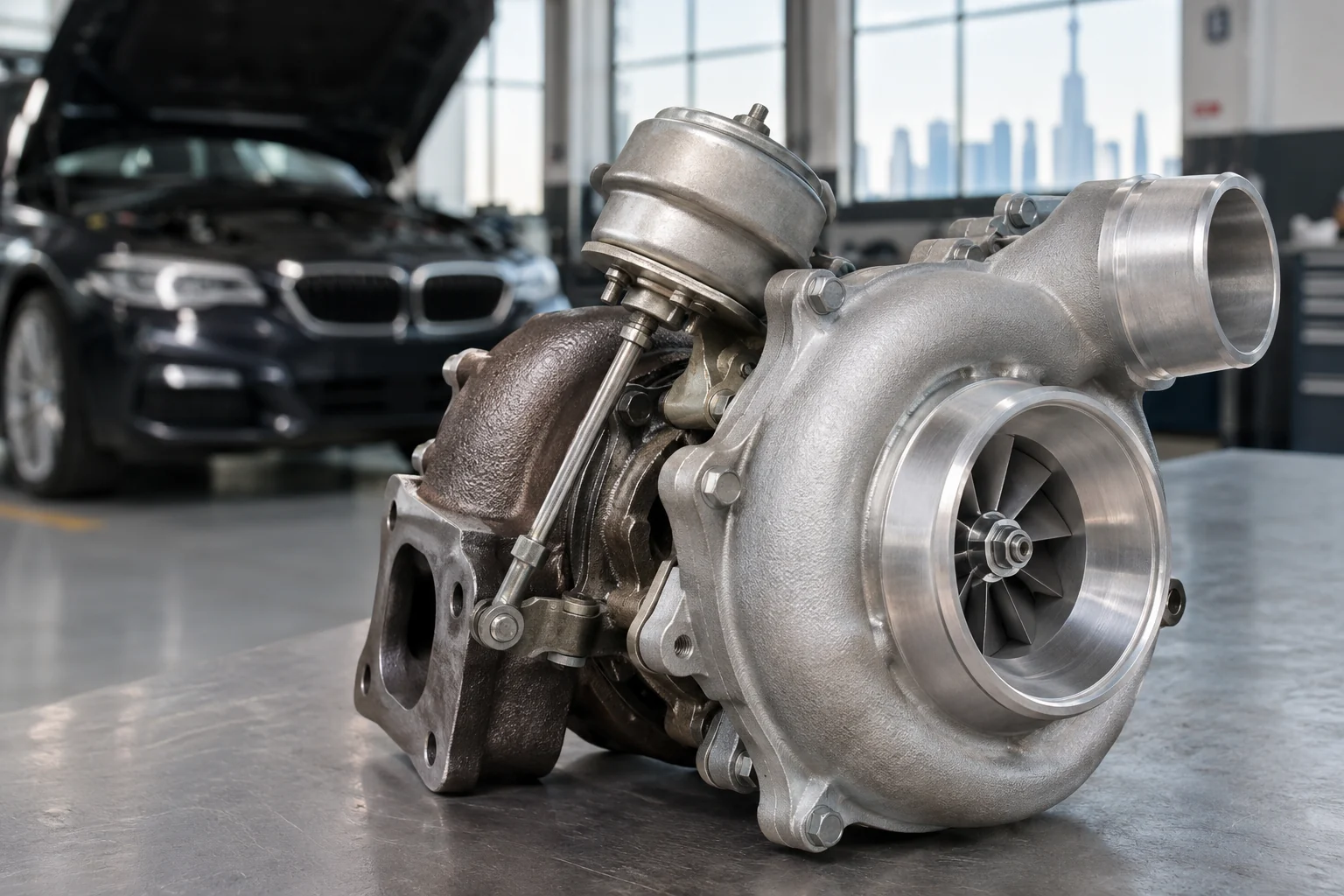
When to stop driving with a suspected turbo fault
Stop safely and switch off
Heavy persistent smoke, a red oil-pressure warning, severe new grinding or siren-like noise, or power loss that makes driving unsafe calls for a safe stop. Arrange recovery and explain the symptoms. Do not keep restarting the engine to see whether the problem has cleared.
Reduced power still needs assessment
If the car remains controllable and the handbook permits continued travel, avoid hard acceleration and arrange prompt diagnosis. A drivetrain warning can have several causes. Read its exact instructions rather than treating every amber message as permission to finish a long journey.
A restart does not establish a repair
Power may return after an ignition cycle while the underlying fault remains. Record what happened before the stop and tell the workshop if the warning disappeared. Do not deliberately reproduce a severe fault on the road or use full throttle to test boost.

BMW turbocharger issues and their possible lookalikes
A symptom identifies the next useful check. Its severity, when it happens and the accompanying warnings matter more than the name of a part suggested by an online search.
| What you notice | Other possible explanations | Useful workshop evidence |
|---|---|---|
| Weak acceleration or late boost | A charge-air leak, control fault or engine torque limitation. | Requested and actual boost alongside the reason for reduced torque. |
| Hiss under acceleration | Escaping air at a pipe, seal or charge-cooler connection. | A located leak under an appropriate controlled test. |
| New whistle or siren noise | An intake or exhaust leak, or turbo mechanical damage. | The noise source and physical condition of the affected components. |
| Blue-grey exhaust smoke | Oil entering combustion or exhaust from the turbo or engine. | Oil-use history, ventilation, oil drain and engine checks. |
| Metallic rattle | A heat shield, exhaust mounting or wastegate mechanism. | The exact noise location and model-specific operating assessment. |
| Drivetrain message or boost code | An air, actuator, sensor, fuelling or engine-management fault. | The full BMW fault report and relevant test-plan findings. |
A brief change in response is different from a new, repeatable loss of power. Rough idle or a misfire also needs wider engine diagnosis. Tell the workshop whether the engine shakes, the warning lamp flashes, or the symptom follows recent maintenance.
Three systems to check before condemning the turbo
Exhaust energy drives the turbine, which turns the compressor to supply pressurised intake air. The engine controls that pressure and relies on the correct lubrication. A problem anywhere along those paths can change how the BMW accelerates.
01Charge air and intake connections
A split pipe or leaking joint can release air after it has been compressed. Inspect the charge-air route, seals and fitted cooler before blaming the rotating assembly. A leak may open under load even when the engine bay looks tidy at idle.
Replacing a confirmed leaking connector can resolve the pressure loss when the turbo itself is healthy. The replacement must fit and seal correctly. An aftermarket material alone does not establish quality or compatibility.
02Wastegate and boost control
The wastegate regulates exhaust flow through the turbocharger. Depending on the installation, diagnosis may involve vacuum supply and control valves, or an electronic actuator, wiring and position feedback. These systems do not share one universal adjustment procedure.
A sticking linkage, control issue or implausible sensor signal can interfere with boost regulation. Ask whether the fault is in the actuator, the valve mechanism, its supply or the command reaching it.
03Lubrication and mechanical condition
Restricted oil supply, contamination and foreign-object damage can harm the turbo. Inspection should consider why damage developed, as well as whether the wheel, bearings or housing have failed.
A replacement installed without correcting an oil-supply or contamination problem can be damaged again. Ask which underlying cause has been identified and what will be corrected before the new assembly runs.
Garrett's turbocharger diagnostic guidance also considers intake restrictions, fuel and exhaust faults, lubrication and engine condition before replacement.
Oil near a turbo does not identify the leak source
Separate an external leak from oil passing into the air or exhaust path. Oil reaching a hot exterior surface may create a smell or smoke under the bonnet. Tailpipe smoke is a different observation and needs its own investigation.
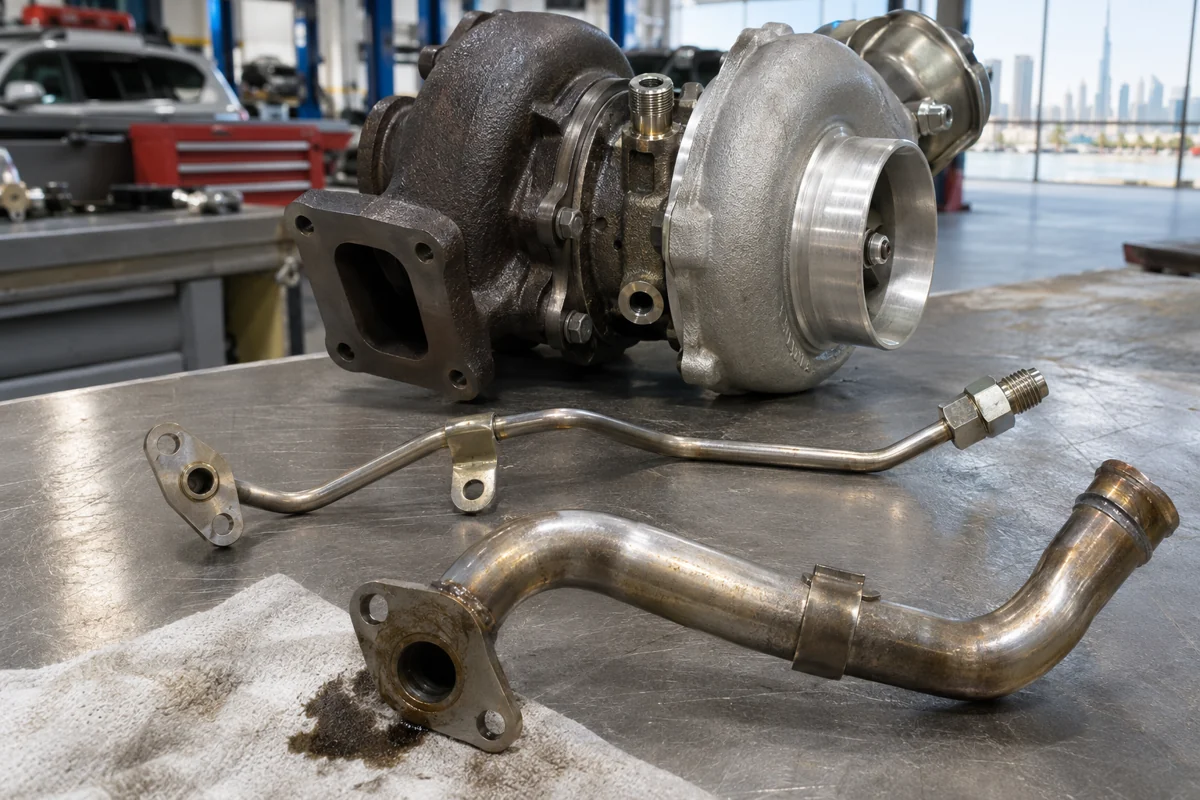
Check the return path and crankcase pressure
Oil needs to drain correctly from the turbo. Restrictions or abnormal crankcase pressure can affect that process. The crankcase ventilation system belongs in the assessment, particularly when oil use or breather symptoms accompany the complaint. Read more about BMW crankcase ventilation faults if these symptoms overlap.
Distinguish a film from accumulating oil
A trace of oil in intake pipework, by itself, is insufficient evidence to order a turbo. The amount, location, rate of accumulation, oil consumption and other test results matter. Ask what finding connects the oil to the proposed failed component.
Investigate the engine as well
Exhaust colour is a clue rather than a complete diagnosis. Engine wear, ventilation and other faults may need checking. A cold-start vapour cloud and persistent smoke after warm-up are different patterns. For an external leak, our turbo oil leak service information explains the related repair scope.
Garrett explains why oil leakage can have a cause outside the turbo in its guide to turbocharger oil sealing. Replacing an assembly without checking the surrounding system may leave the original problem unresolved.
Why the engine code changes the diagnosis
A badge such as 320i, 335i or X5 does not identify every turbo component fitted across generations. Give the workshop the VIN and any modification history. Confirm the engine and production information before selecting parts or following a repair bulletin.
N54 and N55
BMW describes the N54's twin-turbo arrangement and the N55's single twin-scroll arrangement in its X5 engine introduction. Twin-scroll does not mean two separate turbochargers. The number of units, control hardware and access requirements affect the inspection.
Wastegate noise
BMW's N54 noise bulletin distinguishes a specified slight mechanical rattle from a particular clanking complaint on listed early vehicles. This is why a recording should lead to an operating assessment. Do not tighten an actuator rod simply to quieten a sound.
Later petrol and diesel systems
B-series petrol engines and diesel installations need their own applicable test plans. Some diesel systems use different turbine-control arrangements, and exhaust-system condition can enter the investigation. The correct questions are which system is fitted and what test confirms its fault.
For example, BMW's B58D wastegate bulletin covers specified xDrive models built before June 2024 and a binding mechanism associated with corrosion. It does not apply to every B58. These North American documents provide technical context. Current instructions and any UAE campaign or warranty eligibility must be checked for the individual VIN.
What a useful turbo diagnosis should establish
The assessment should connect the complaint to a measured or observed fault. Ask for the fault report, test findings and explanation of the proposed repair. A parts recommendation should be specific enough to check at handover.
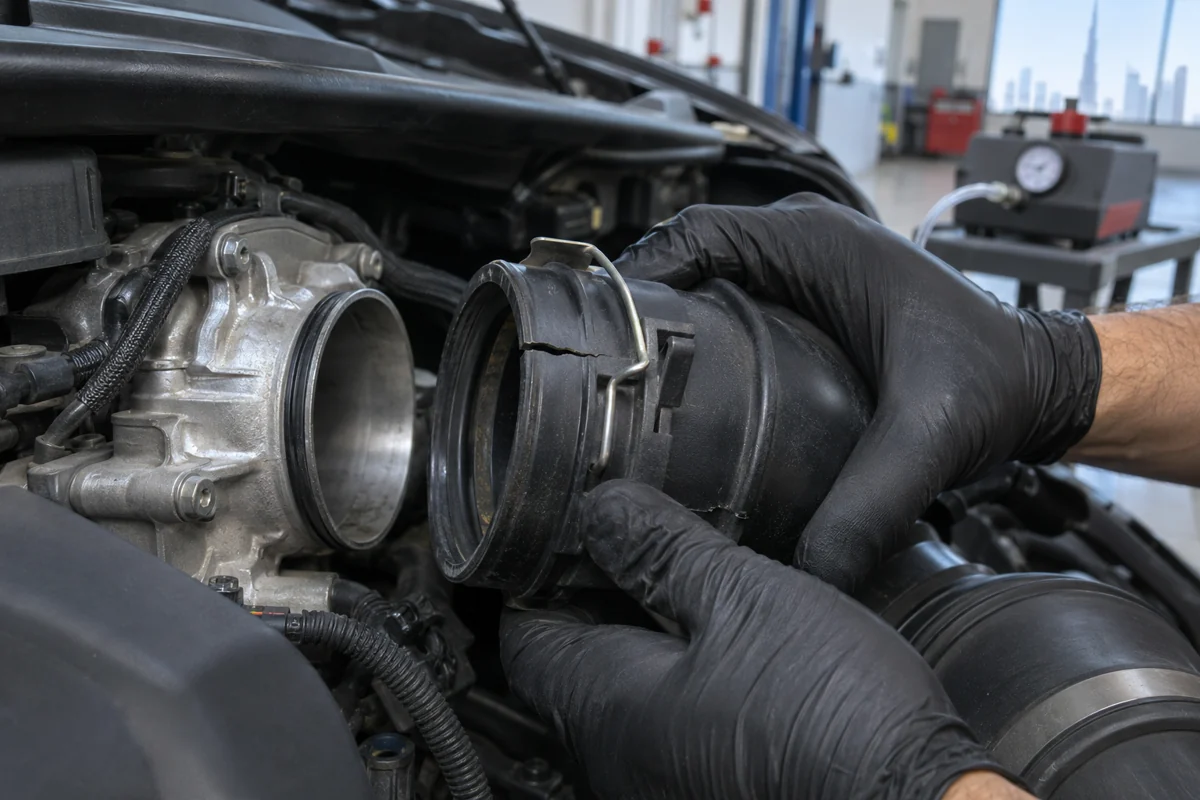
- Read the complete fault context
Retain BMW-specific descriptions and associated engine faults before clearing memory. A generic P0299 underboost description reports a pressure condition. It does not prove which component caused it. Record stored operating conditions where available.
- Inspect and test the air path
Check connections, seals and the fitted charge-air cooler. Use a controlled leak test appropriate to that system, following the vehicle's pressure limits and procedure. A generic pressure figure from a video is not a safe specification for every BMW.
- Compare control and response
Review requested and actual boost together with relevant actuator and sensor information. Confirm whether another fault is limiting engine torque. Vacuum and electronic systems need different checks. Any loaded test must be conducted safely by the technician.
- Assess mechanical damage and its cause
If damage is suspected, inspect accessible wheels and housings and assess bearing condition against the applicable specification. Do not diagnose a turbo by hand-feeling shaft movement alone. Check oil supply, drainage and possible debris before choosing the repair.
Ask what happened first in the fault sequence. The DME, BMW's petrol-engine control unit, may reduce boost because another engine condition requires a torque limit. The technician should distinguish that commanded reduction from an air leak or an actuator that cannot follow its command. Pressure readings also need consistent units and context. Absolute pressure and pressure above atmosphere are different measurements, so two numbers from different tools may not be directly comparable.
For example, if the engine requests more boost but measured pressure remains low, that difference identifies a problem to investigate. A test that locates air escaping at a damaged pipe supports repairing that leak and retesting. If the engine is requesting reduced output because of a separate fault, replacing a turbo may leave the original complaint unchanged. Ask which of these patterns the evidence supports, rather than treating a low pressure reading as a complete diagnosis.
BMW's intermittent power-loss bulletin for specified N20, N26 and N55 vehicles shows the importance of context. Listed pressure and air-mass faults can accompany Valvetronic, tank-ventilation or software issues. The document calls for appropriate test plans and charge-air checks.
Repair options after the cause is confirmed
A leaking pipe, an electrical fault and a damaged rotating assembly call for different work. Agree the diagnosed cause, exact parts and completion checks before approving a quote.
Repair the surrounding system
Confirmed pipe, seal, vacuum, wiring or ventilation faults may be repaired while retaining a sound turbo. The workshop should then repeat the relevant tests. Replacing a sensor is justified by its test result, rather than simply because it costs less than a turbo.
Assess actuator or specialist repair
Separate actuator replacement depends on the fitted unit and repair procedure. A rebuild requires a suitable assembly, proper inspection, balancing and the required control setup. Ask what the specialist will restore, how it will be tested and what written coverage applies.
Replace a confirmed damaged assembly
Wheel damage, housing defects or a non-serviceable mechanism can justify replacement. Match the part to the VIN and configuration. Agree related oil-line work, cleaning, seals, fluids and setup as applicable so the replacement addresses the cause as well as the damage.
For fitted scope, parts choices and current quote information, use the BMW turbo replacement service page. Clarify whether the charge covers a scan or a wider diagnostic investigation, and how further work will be approved. Do not compare a loose turbo price with a complete fitted job.
At handover, ask how the original complaint was checked, whether the relevant boost and control tests passed, and whether leaks remain. Get the supplied part description and repair warranty in writing. An unexplained cleared warning light alone gives you little evidence of the result.
Looking after a turbocharged BMW in the UAE
Record hot-weather patterns, but do not assume Dubai's temperature has identified a failed turbo. Maintenance should match the engine specification, service condition and how the car is actually used.
- Use the specified engine oilCheck the BMW approval required for the exact engine. Viscosity alone does not establish suitability. Follow the vehicle's servicing guidance and investigate unexpected oil use instead of relying on repeated top-ups.
- Keep the intake properly sealedHave damaged filters, loose housings and disturbed intake connections checked. Report recent air-filter or engine work if the symptom started afterwards. Unfiltered air and foreign objects are different concerns from an external dusty engine bay.
- Allow for engine warm-upAvoid demanding high load immediately after a cold start. Follow the handbook for operating and shutdown advice. There is no single idling duration that should be prescribed across every BMW turbo installation.
- Report cooling and oil warningsInvestigate a warning or leak promptly. Do not open a hot cooling system or reach around a running turbocharger. Record any recent overheating incident because it may change what the workshop needs to inspect.
- Disclose tuning and hardware changesTell the technician about remapping, boost-control changes and aftermarket intake or exhaust parts. The calibration and hardware need to be considered together. A “heat-rated” description alone does not demonstrate a suitable replacement.
BMW turbocharger questions
Use these answers to prepare for an assessment and understand what still needs to be proved on your vehicle.
Does turbo lag mean the turbocharger is failing
No. Response depends on engine speed, load, gear selection and the fitted system. A new or worsening hesitation needs investigation, particularly with warnings, smoke or noise. Compare it with the car's previous behaviour and describe the conditions to the technician.
Can a boost leak cause a drivetrain warning
Yes, a leaking charge-air path can interfere with pressure control and produce reduced power or a warning. Other engine faults can produce a similar message. The full fault report and a confirmed leak are more useful than the warning label alone.
Does every wastegate rattle need a replacement turbo
No. Noise needs to be located and assessed for the particular unit. A heat shield or exhaust part can rattle too, and some documented mechanical wastegate sounds are operating characteristics. The remedy should follow the applicable test plan.
Will clearing the codes restore normal boost permanently
Clearing codes does not repair a leak, damaged mechanism or wiring fault. It may also remove useful diagnostic information. Save the report and let the workshop establish why the warning appeared before using its disappearance as evidence of success.
How long should a BMW turbocharger last
There is no single mileage that proves one is due for replacement. Service history, lubrication, operating conditions and mechanical findings matter. Ask for the evidence of failure rather than accepting an age-based recommendation alone.
Should both turbochargers be replaced together
Only an engine fitted with multiple units raises that question. Ask which unit has failed, how the other was assessed and whether a shared cause affects both. Replacement quantity should follow the configuration, condition and applicable repair instructions.
Can an additive or thicker oil fix turbo smoke
Do not substitute an additive or an unapproved oil grade for diagnosis. Smoke can come from the oil-drain path, ventilation, turbo or engine. Identify the cause and retain the required lubricant specification before approving a remedy.
What should I send the workshop before booking
Send the model, year, warning text and a description of smoke, noise or power loss. Include recent repairs, oil use and modifications. Take photos only while safely parked. Mention severe symptoms before arranging travel so recovery can be discussed.
Find the cause of the boost problem
Describe what changed, when it happens and which warning appeared. The assessment should identify whether the next step concerns pipework, boost control, lubrication or the turbocharger itself.
Call 056 464 6081 Discuss your turbo symptomsConfirm the diagnostic scope and charge before approving work. If the symptoms make driving unsafe, discuss recovery first.