
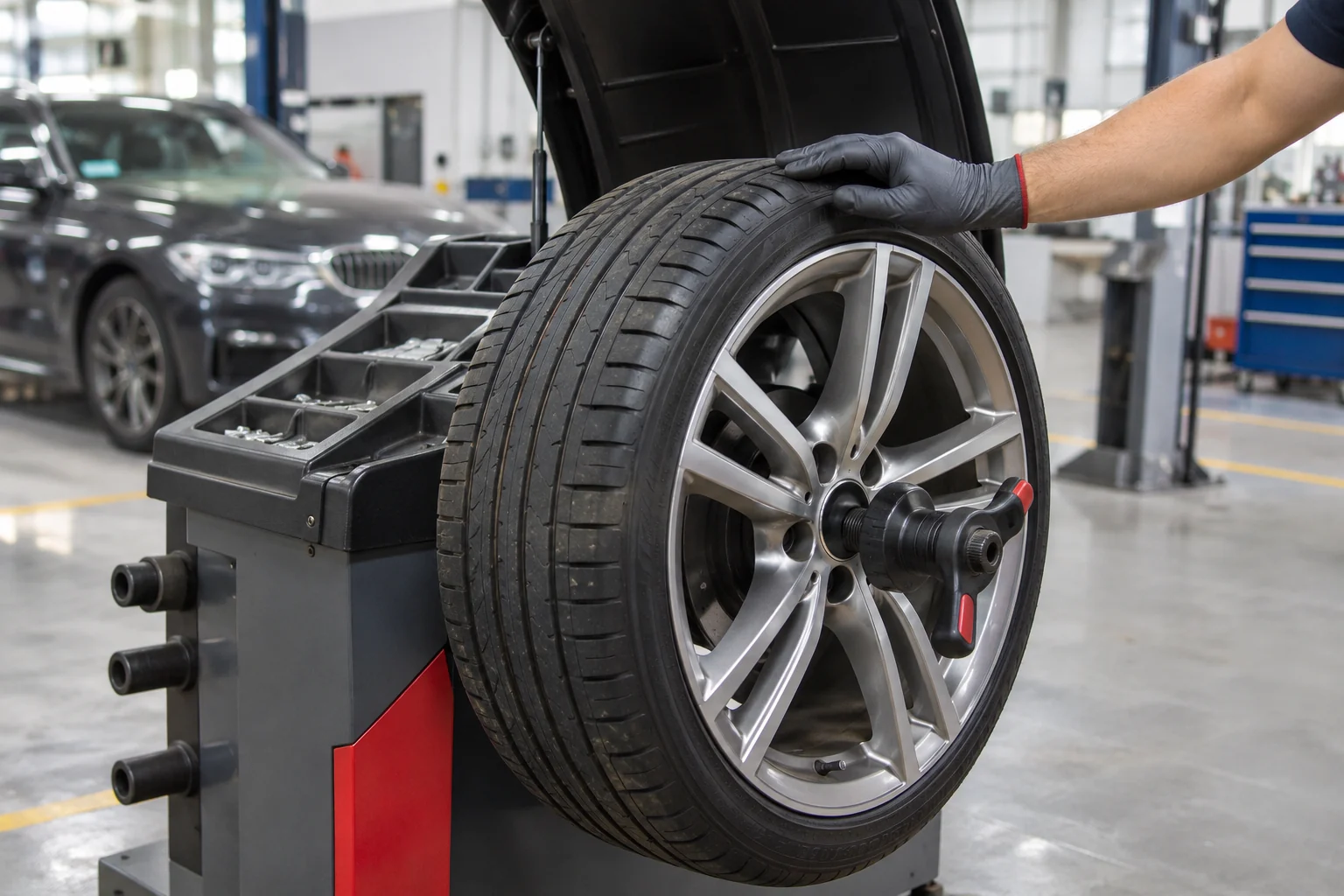
When vibration needs immediate attention
A new shake deserves attention even if the car still moves normally. A sudden, severe or rapidly worsening vibration is more urgent, especially after an impact or when steering or braking feels different.
Do this if the car becomes difficult to control, braking performance changes, a tire has a bulge or visible damage, or shaking comes with a serious warning, smoke or burning smell. Do not continue a journey to see whether the problem clears.
Do not make motorway runs, brake hard, coast in neutral or accelerate repeatedly to reproduce the fault. Do not crawl under a car supported by its emergency jack or touch hot brakes. A technician can decide whether a controlled road test is appropriate after an initial safety inspection.
If the vibration is mild and recurring, describe it when arranging an inspection. A remote conversation cannot confirm that the vehicle is safe to drive. Tell the workshop about any warning or change in control so suitable recovery can be discussed.
Match the driving condition to the first checks
Where you feel a vibration helps describe it, but does not identify the failed part. Movement travels through mounts, suspension and the body. A shake in the steering wheel can have more than one source, and a vibration through the seat does not prove the rear wheels are responsible.
| When it happens | What it can suggest | What needs checking |
|---|---|---|
| Stationary at idle | Uneven engine operation or vibration transmitted through mounts | Running quality, relevant fault data, mounts and contact with surrounding parts |
| Within one road-speed range | A rotating wheel or tire source, among other possibilities | Condition, fitment, centering, balance and runout |
| Only while braking | Brake judder or movement in associated components | Disc measurements, hub condition, calipers and relevant suspension play |
| During normal acceleration | An engine fault under load or a driveline-related concern | Whether the symptom follows engine speed, road speed or load, then targeted tests |
| After recent work or an impact | A useful clue about where to begin | The work performed, wheel installation, damage and changes in fitment |
This table guides inspection rather than prescribing replacement. Several faults can coexist. For example, correcting imbalance may reduce a shake while a damaged tire or worn component still needs separate attention.
What you can check safely before the appointment
Useful information often comes from a parked inspection and a short description. You do not need to diagnose the car yourself or carry out a test drive.
- Record the circumstancesWas the car stationary, moving steadily, accelerating normally or braking? Note whether it was cold or warm and any warnings already displayed.
- Look at accessible tiresFrom a safe position, look for visible damage, unusual wear or an obviously deflated tire. A normal-looking outer sidewall does not rule out hidden damage.
- Check pressure as directedUse the vehicle's specified cold pressures and instructions for its fitted tires and load. Do not use the tire sidewall maximum as the target or bleed hot tires down to a cold setting.
- List recent changesInclude tire fitting, wheel removal, brake work, a pothole or kerb strike, a long parked period, and any change in wheels, spacers or tire sizes.
Give the workshop the model, year and engine or VIN details. Mention whether the shake began immediately after work or appeared gradually. If a passenger has safely recorded a warning, that may help; the driver should not film while moving.
A useful booking description
The car shakes through the steering wheel within a road-speed range I noticed on my usual journey. It started after tire fitting. I have not tried to reproduce it, and there is no warning message.
That description gives a more useful starting point than naming a part to replace. If the symptoms change before the appointment, update the workshop rather than assuming the original explanation still applies.
Why a road-speed shake can remain after balancing
Balancing corrects uneven mass distribution in a wheel and tire assembly. It does not repair a bent rim, damaged tire, incorrect mounting or every variation in how a tire rolls under load. Repeated balancing without understanding the remaining symptom can therefore miss the actual problem.
Balance and alignment answer different questions
Alignment adjusts wheel angles. Pulling, an off-centre steering wheel and uneven wear can justify an alignment assessment, but alignment is not a universal cure for vibration. Michelin explains the distinction between alignment and balancing. Ask which finding supports the proposed service.
Condition and fitment come before another adjustment
The workshop should consider the tire's condition, its seating on the rim, wheel damage and correct centering on the vehicle and machine. Aftermarket wheels, spacers or changes in size make the fitment history particularly useful. A pressure warning reset does not correct a physical tire or wheel problem.
Runout describes how far a rotating assembly departs from running true. Radial force variation concerns changing force as a loaded tire rolls. They are related diagnostic considerations, but are not interchangeable with imbalance. If initial checks do not explain the complaint, ask whether more detailed runout or loaded tire testing is relevant and available.
BMW's brake-vibration diagnostic flowchart hosted by NHTSA includes wheel and tire assessment rather than assuming every braking complaint starts with the discs. It is a workshop reference for the relevant applications, not a repair procedure for every BMW. Your fitted wheel/tire combination and current vehicle repair information determine the appropriate checks.
Use tire replacement when condition and fitment justify it. If the evidence points to geometry, discuss BMW wheel alignment. Neither job should be selected solely because the steering wheel shakes.
What needs checking with brake-only vibration
A judder that appears when you apply the brakes needs a brake-focused assessment. Calling it warped discs immediately skips important checks and may lead to a recurring complaint after replacement.
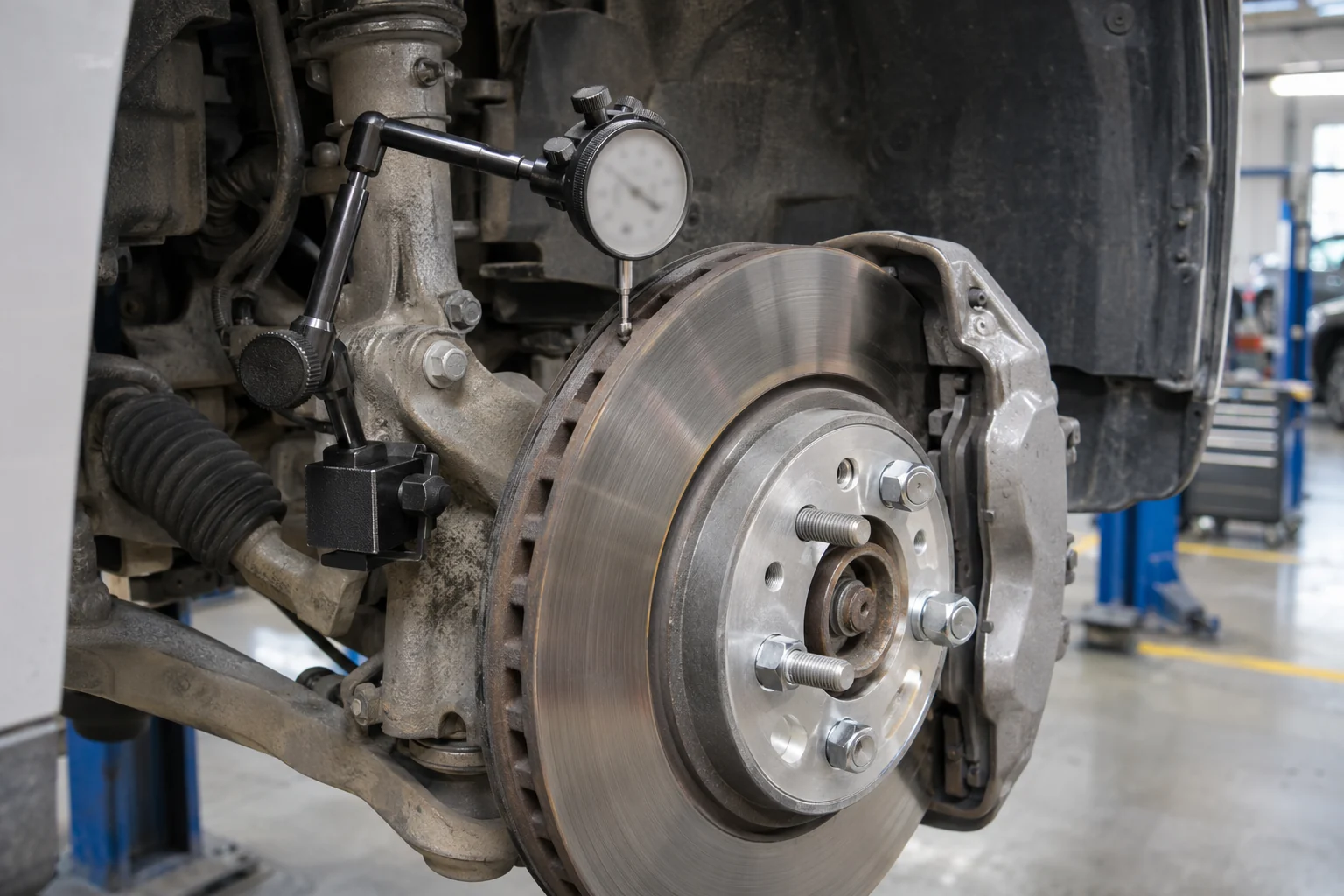
Disc thickness variation means the friction disc is not the same thickness around its circumference. Lateral runout is its side-to-side movement as it rotates. Hub condition, the mounting surface and other brake components can influence the result. Bilstein group's brake judder guidance describes these checks and the need to follow vehicle-specific limits.
Ask for the measured finding rather than a diagnosis from pedal feel alone. The technician may need to inspect caliper operation and relevant suspension components as well. Replacing discs will not correct unrelated looseness or an installation problem.
Repair choices depend on the disc type, condition, minimum thickness and applicable procedure. Resurfacing is not suitable for every disc or fault. If replacement is needed, the quote should identify the axle, pads, discs and any additional components justified by inspection. The BMW brake repair page covers professional repair enquiries.
Tell the workshop if the judder appeared after brake work, alongside pulling, or with reduced braking performance. Do not perform repeated hard stops to demonstrate it. A change in braking effectiveness belongs in the urgent assessment described above.
Separate rough running from mount vibration at idle
If the car vibrates while stationary, wheel imbalance cannot explain that stationary symptom. The next question is whether the engine is running unevenly or its normal movement is reaching the cabin through a mount or another contact point.
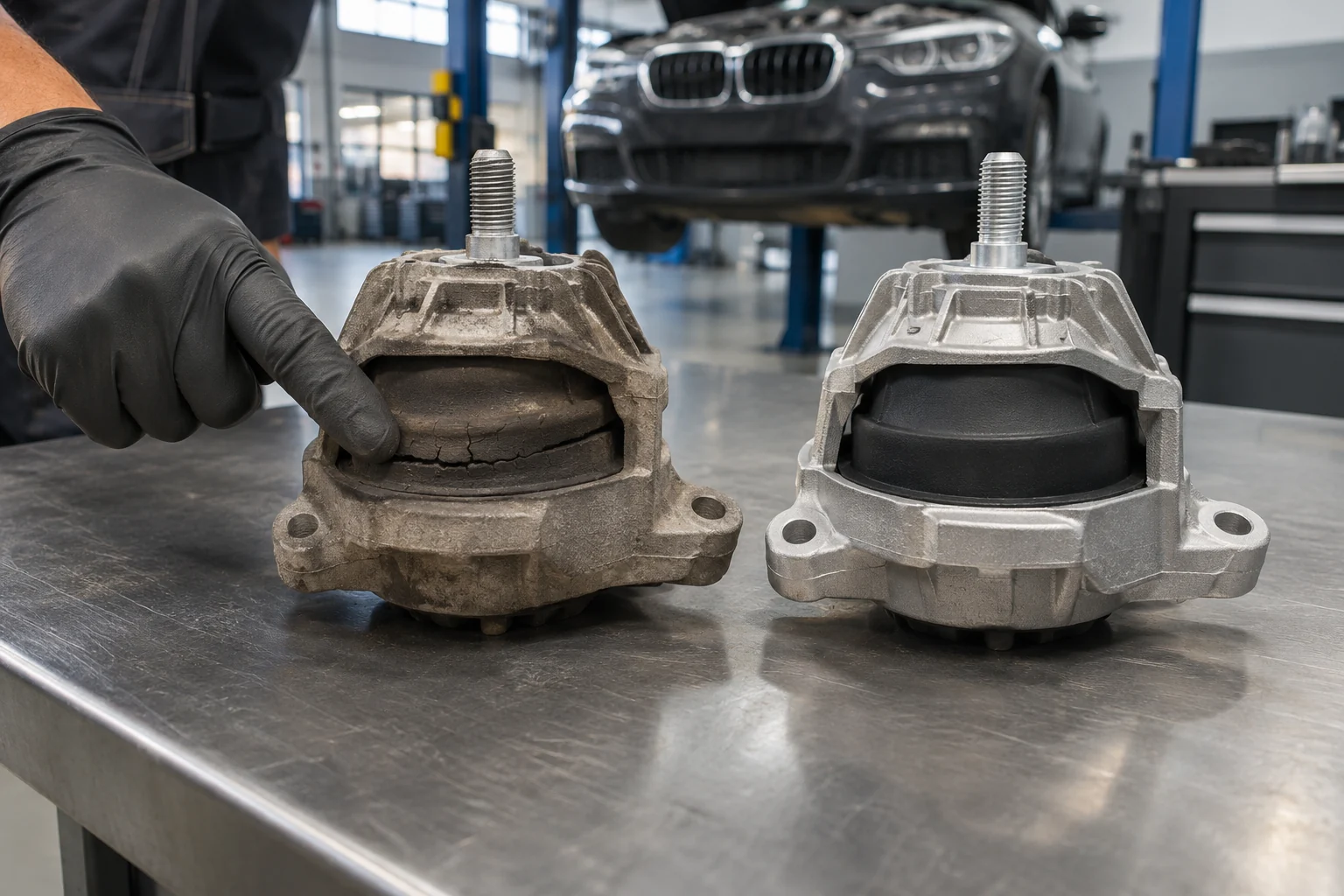
Unstable engine speed, warnings or uneven running may call for fault-memory and live-data checks appropriate to the engine. A steady tachometer does not prove that combustion is perfect, and a fault code identifies an area to investigate rather than automatically authorising replacement.
Mounts can transmit vibration even when the engine itself runs normally. Their design varies; inspection may involve rubber condition, fluid leakage where applicable, installation and surrounding clearance. The relevant mounting system must be identified before discussing engine mount replacement.
Mention whether you already notice a change with the AC on or while stopped in Drive, but do not carry out brake-loading or revving tests yourself. A change with load is a clue, not proof of a mount failure or an AC fault.
Petrol and diesel diagnostic paths differ. Spark plugs and ignition coils are not universal explanations for diesel roughness. For plug-in hybrids, whether the combustion engine was actually running matters. Fully electric BMWs need a different driveline assessment; combustion-engine advice does not apply to them.
Investigate acceleration and propshaft vibration carefully
A shake during acceleration can come from uneven engine operation under load, mounts or rotating driveline components. Its location does not prove that the gearbox, driveshaft or rear axle has failed.
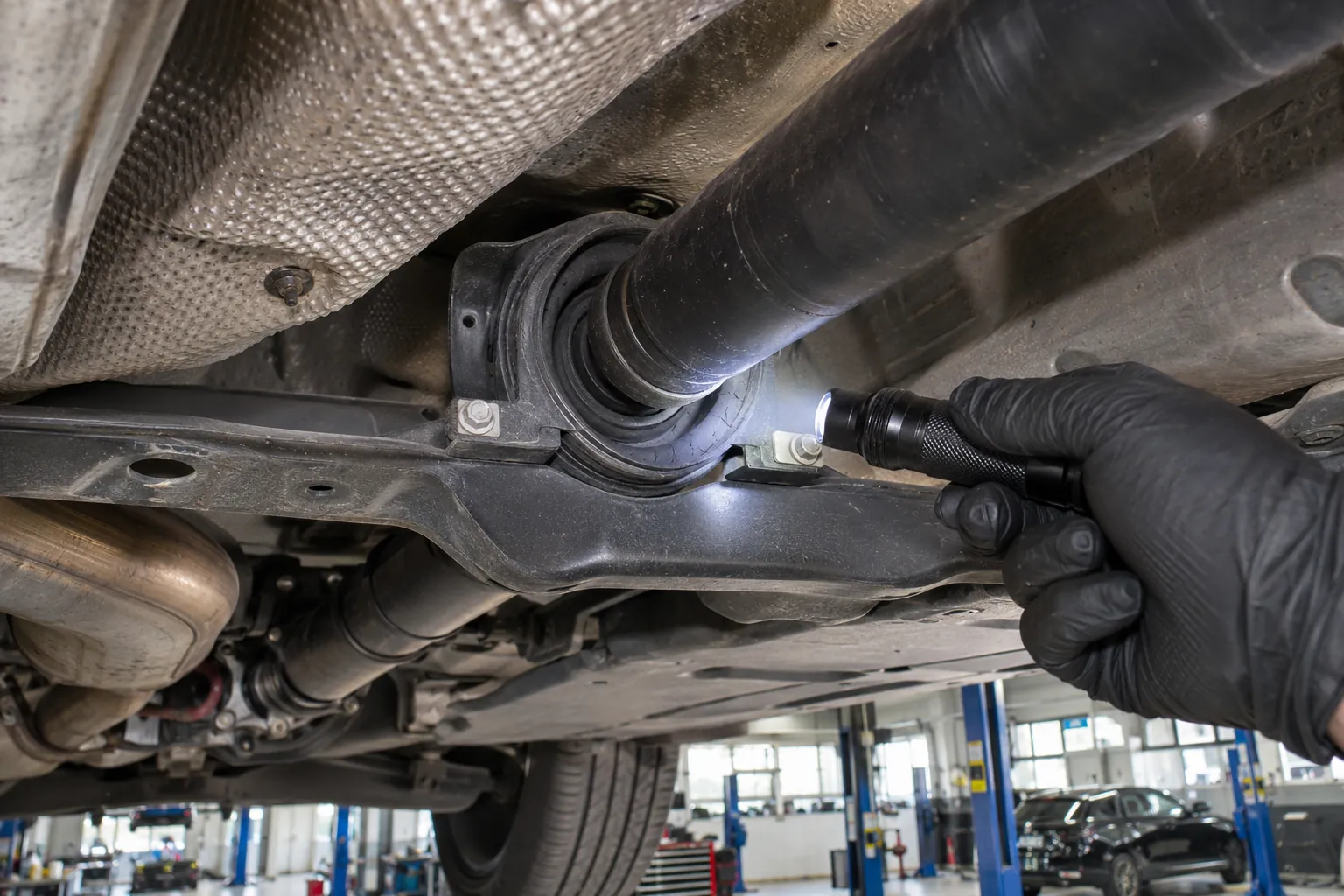
A technician compares the complaint with road speed, engine speed and load when a controlled test is safe. These distinctions help choose the next inspection instead of treating all acceleration shudder as the same fault. Diagnostic work may involve relevant fault data and physical checks rather than a scan alone.
Depending on the vehicle, the inspection may include propshaft supports, couplings, joints, mounts and surrounding clearance. Joint design and serviceability vary. A worn support on one generation does not establish the same cause on another. xDrive also adds components and makes correct tire fitment important; four-wheel drive does not mean every shudder is a transfer case fault.
Movement felt through a gear lever can be transmitted from elsewhere. Manual and electronic selector designs differ, so lever vibration is not enough evidence for gearbox replacement. Explain any accompanying gear-change problem separately.
If impact damage, severe clunks or worsening vibration appears, stop and seek advice about recovery. Do not put a car on improvised stands or run its wheels in the air to locate the sound. Physical driveline inspection belongs in a properly equipped workshop.
Why the model and recent history change the checks
A 520d diesel, a petrol 325i and an xDrive X5 do not share every engine, suspension or driveline arrangement. Even within the same badge, generation and specification matter. Supply the year and vehicle details rather than relying on a model-name symptom list.
Tell the workshop about run-flat or conventional tires, staggered wheel sizes, suspension changes and aftermarket wheels. Do not rotate tires front to rear unless the fitted sizes, direction and vehicle instructions permit it. An air-suspension explanation only applies where that equipment is fitted.
In Dubai, distinguish a cold start after parking from a warm idle in traffic, and note whether the AC was operating. These circumstances help reproduce a complaint safely; heat alone is not a diagnosis. Tire pressure also needs the correct cold reference, rather than an adjustment based only on a hot reading.
After a kerb or pothole impact, condition checks come before an assumption that alignment will solve everything. After wheel or brake work, installation and the changed parts provide a sensible starting point without proving that the previous work caused the fault.
What to ask before approving a vibration repair
A useful assessment connects the reported symptom with an observed finding, a proposed repair and a way to confirm the result. Ask what was found, which checks were completed and whether any uncertainty remains.
- Ask for the evidence. A damaged tire, a measured disc condition, relevant diagnostic data or a demonstrated mounting issue is more useful than a list of possible parts.
- Separate diagnosis from repair. Confirm the initial assessment charge and included checks. Extra diagnostic time, dismantling and repair should have a clear scope before approval.
- Understand the proposed parts. Ask which components and axle are included, the parts brand and any fitment or calibration requirements. Do not assume every quote includes the same work.
- Agree how the result will be checked. When safe, the workshop should compare the original complaint after the work. If another symptom remains, ask what it suggests before authorising more parts.
Costs follow the confirmed cause and vehicle specification. Wheel work, a mount repair and brake replacement are different jobs. The BMW vibration assessment and repair page explains the commercial scope and budget considerations. This guide helps you describe and understand the diagnosis before deciding on that work.
If worn arms, bushes or other suspension parts are implicated, ask how the finding relates to the shake and whether wheel geometry needs checking after repair. BMW suspension repair is a relevant next step only when inspection supports it.
If the workshop cannot reproduce the shake
An intermittent complaint may not appear during the first visit. Ask the workshop to record which conditions were checked and what the safety inspection found. A visit without the symptom does not automatically mean there is no fault, but it also does not justify replacing several possible parts without evidence.
Agree on the next step. This may be a further appointment under the conditions already described, more detailed testing or monitoring with clear instructions about changes that require stopping. Keep a parked note of when the symptom occurred, how long the vehicle had been parked and any work completed since the previous visit. Do not change your driving to collect more examples.
After a repair, distinguish the original shake from a different remaining symptom. Tell the workshop what improved and what did not. A written record of the complaint, findings and work makes a follow-up more useful than starting again with another list of possible causes. Keep tire, wheel and brake invoices with that record so specifications and recent changes can be checked.
Common questions about BMW vibration diagnosis
Can I keep driving with a mild vibration
A mild symptom still needs assessment. Its description alone cannot establish safety. Stop safely and arrange assistance if it becomes severe, affects control or braking, follows serious damage, or accompanies a concerning warning.
Why does the steering wheel shake at one speed
A road-speed pattern can direct attention to wheels and tires, but does not prove imbalance. Condition, mounting, runout and other components may need checking. Do not speed up to reproduce the shake.
Why is the vibration still there after balancing
Balance adjustment addresses mass distribution. It does not correct every tire defect, bent wheel, fitment problem or loaded tire variation. The remaining symptom should guide the next checks instead of another adjustment without a finding.
Does brake judder always mean warped discs
No. Disc thickness variation, installed runout, hub or mounting condition and related components can contribute. Measurements against the applicable limits help determine the repair.
Can an engine mount cause vibration without an engine fault code
Yes, a mechanical mounting problem may not produce an engine fault code. Equally, no stored code does not rule out every engine problem. Running quality and physical inspection need to be considered together.
What should I send the workshop when booking
Send the model, year, engine or VIN details, conditions already noticed, warnings, recent work and any impact history. Mention changes in steering or braking first. Ask about the assessment scope and charge.
Independent BMW workshop in Al Quoz
Describe your BMW vibration before booking
Tell us when the shake happens and what has changed. Ask about the assessment scope and charge before approving work. If control or braking is affected, discuss suitable recovery first.
Independent BMW specialist. Not affiliated with BMW AG.