
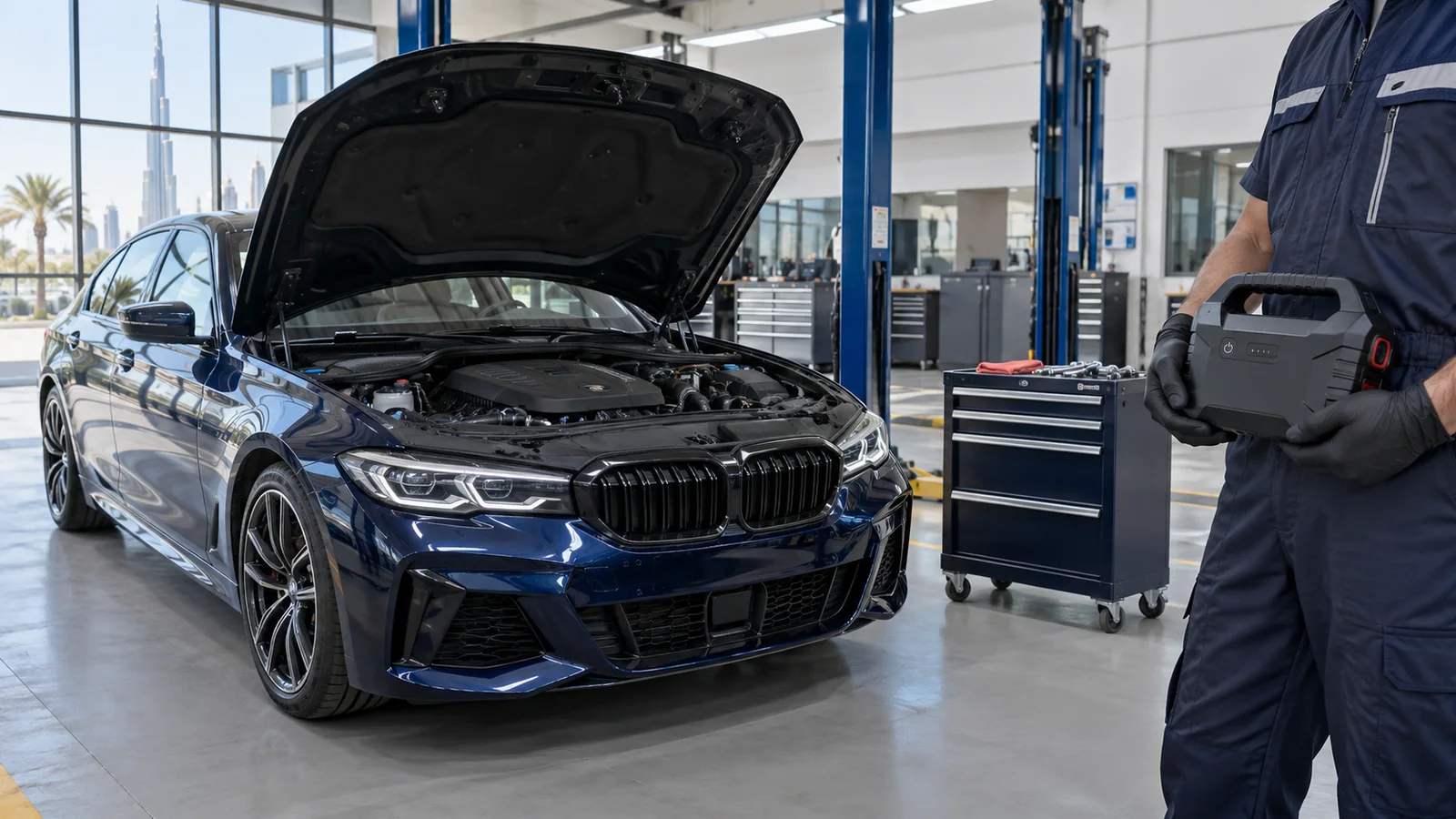
Decide whether a jump-start is appropriate
A jump-start supplies temporary electrical assistance. It does not repair the reason the battery discharged. Lights left on, extended parking, a deteriorated battery or an electrical fault can produce similar starting complaints, so the next decision depends on both the symptom and the vehicle’s instructions.
Stop if the battery is cracked, swollen, leaking or suspected to be frozen. Keep sparks, smoking and flames away. If there is smoke, unusual heat or a strong abnormal smell, keep clear and seek assistance. Do not lean over the battery or attempt to clean away damage before trying a boost.
Check the surroundings before opening the bonnet. Working beside moving traffic, in a poorly ventilated enclosed space or where you cannot position equipment securely changes the decision. If the vehicle is in danger, prioritise getting people to safety and contact the appropriate assistance service. A battery problem does not justify unsafe roadside work.
- Known vehicle instructionsYou can identify the exact model, year, powertrain and relevant handbook section.
- Suitable equipmentThe vehicle and equipment instructions agree on compatibility and use.
- Identifiable connection pointsYou can positively identify the prescribed terminals without guessing.
- Safe working conditionsThe location, battery and equipment show no reason to stop.
If any check fails, discuss BMW roadside assistance and suitable recovery. Confirm availability and the callout scope before relying on a dispatch.
Find the instructions for your BMW
Use the owner’s handbook supplied for your vehicle or the BMW Driver’s Guide linked to its vehicle identification number. A guide for another 3 Series, X5 or model year may describe different equipment. BMW’s official manual and Driver’s Guide information explains how vehicle-specific information is selected. Choose documentation appropriate to your vehicle and market.
Search the handbook for jump-starting, starting assistance or breakdown assistance. Read the preparation and warnings as well as the connection sequence. If the car’s display will not power up, use the printed handbook or the appropriate downloaded guide on your phone. Do not substitute an unrelated online diagram.
Before proceeding, identify the permitted voltage and equipment, the positive jump terminal, the designated negative or earth point, the starting sequence and the disconnection instructions. Also check whether the vehicle may receive assistance, provide assistance, or neither.
Where your handbook specifies a 12V supply, use only equipment that meets that requirement. Never substitute a 24V source.
Petrol and diesel models, 48V mild hybrids, plug-in hybrids and electric BMWs must not be treated as one electrical arrangement. Low-voltage assistance is separate from charging a high-voltage traction battery. Do not connect ordinary jump equipment to a 48V or high-voltage system, touch orange high-voltage cables or assume a hybrid or EV is a suitable donor.
A battery mounted in the boot does not mean you should expose it for a jump. Where the handbook specifies under-bonnet jump terminals, use those exact points. A random bolt or any convenient bare metal is not an adequate substitute for a positively identified connection.
Choose between a booster pack and a donor vehicle
A portable jump starter and a second vehicle are alternative sources of assistance when permitted. A portable pack does not also require a donor car. Neither option becomes suitable simply because its clamps fit.
Portable jump starter
Check the pack’s instructions for the vehicle’s specified low-voltage battery system, battery chemistry, engine application and operating conditions. Confirm the pack is ready for use and its leads and insulation are intact. A starter’s headline current rating alone does not establish compatibility.
Follow the equipment’s temperature and retry limits. Do not leave a pack in direct sun during use or assume that a unit stored in a hot boot remains within its specified operating range. Do not bypass reverse-polarity protection or force an override because the pack does not detect the battery. Ask for help if the equipment refuses to operate.
Donor vehicle and jumper cables
Both vehicle handbooks must allow the arrangement. Check the prescribed voltage and use suitable cables with insulated clamp handles. Do not assume an electric or hybrid vehicle can provide assistance. Position permitted vehicles so they do not touch, and keep leads away from fans, belts and other moving parts.
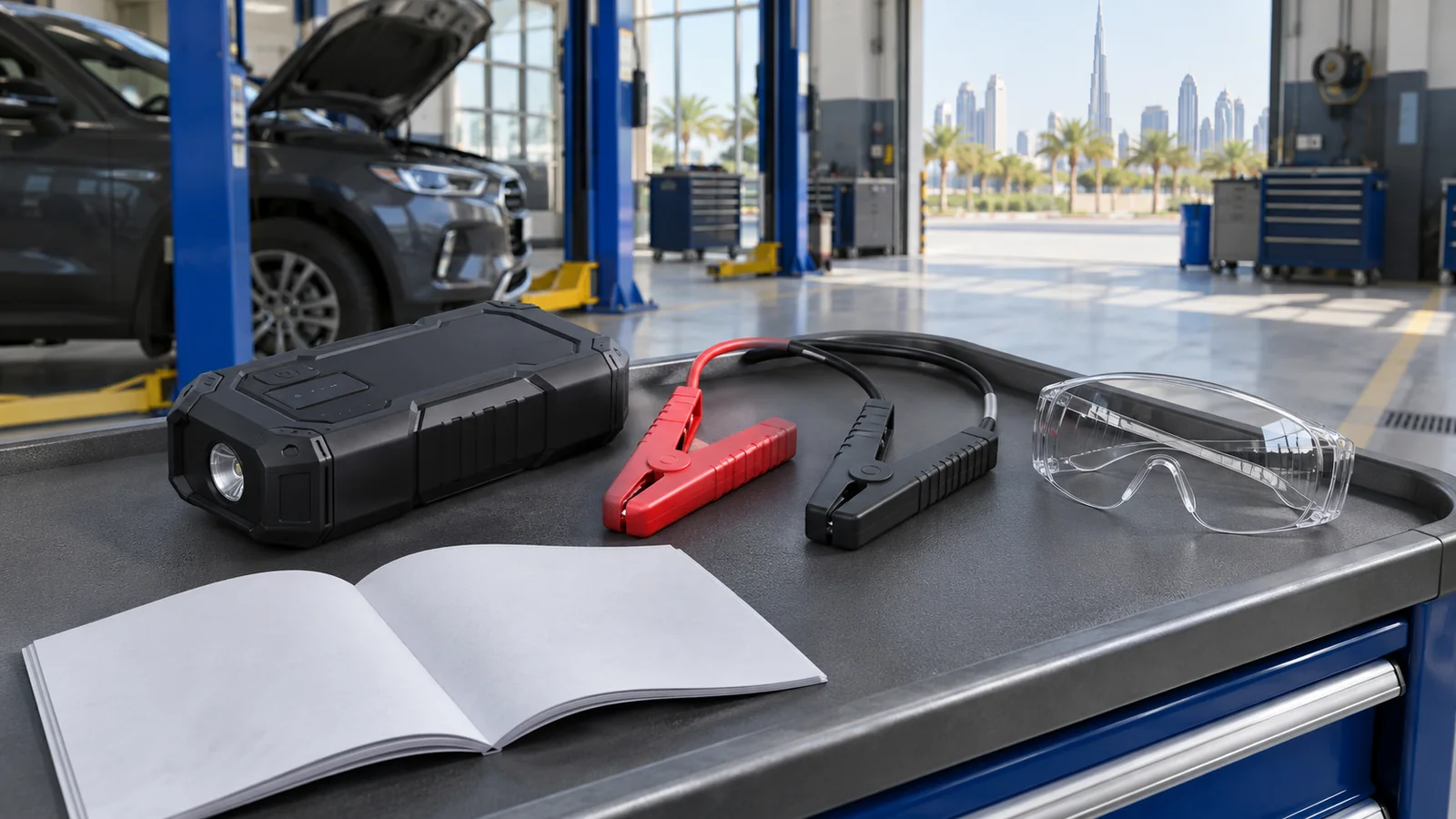
Follow the vehicle’s jump-start procedure
Keep the correct handbook and equipment instructions available throughout. The steps below explain what to verify at each stage; the exact clamp order, operating sequence and retry limits come from those instructions.
- Prepare the vehicle and the equipmentSecure the parked vehicle and switch systems off as directed. For a donor vehicle, follow both handbooks’ preparation rules. For a pack, follow its own power and connection instructions. Resolve any conflict before connecting.
- Identify the prescribed connection pointsMatch the handbook’s diagram to the actual vehicle. Confirm the positive marking and designated earth point. Do not rely on cable colour alone, remove electrical covers beyond the prescribed access, or improvise a connection.
- Connect in the specified orderUse the sequence supplied for the permitted setup. Keep free clamps from contacting one another or unintended metal. If you cannot reach securely, stop rather than stretching leads across moving parts.
- Attempt the start only as instructedFollow the handbook and equipment limits for preparation, starting and pauses between attempts. Do not repeatedly crank the engine, increase the voltage or bypass a protection feature to force a result.
- Disconnect according to the instructionsFollow the specified shutdown and removal sequence while keeping leads clear of moving parts. Keep free clamps separated and clear of unintended metal as you remove them.
- Check what happened afterwardsRecord whether the engine started normally, warnings remained or the attempt made no difference. Arrange the follow-up checks described below rather than treating the boost as a completed repair.
BMW handbooks specify vehicle-specific starting-aid terminals and connection sequences. See the BMW-authored 2021 3 Series handbook example, including its following page. This example is not a procedure for every BMW. The NOCO GB40 user guide likewise shows why equipment compatibility and safety limits must be checked; it is not a recommendation for every model.
What to do after a successful boost
A running engine does not establish a full battery charge. There is no reliable promise that 15 minutes of idling or a 20–30 minute drive will fully recharge every discharged BMW battery. Battery condition, discharge level, charging control and electrical demand affect the outcome. Interstate Batteries’ explanation of driving after a jump-start challenges the familiar 30-minute recharge assumption.
Check the actual warning messages and how the vehicle behaves. If a charging warning remains, the engine runs badly, the vehicle stalls or another serious warning appears, do not use a test drive to prove that the problem has cleared. Follow the handbook’s warning instructions and discuss recovery when appropriate. Our BMW charging malfunction guide explains that separate symptom.
If the vehicle operates normally and its instructions allow continued use, arrange battery and charging-system assessment. A compatible external charger may be needed, with its mode and connection points matched to the vehicle. A jump starter and a battery charger perform different jobs.
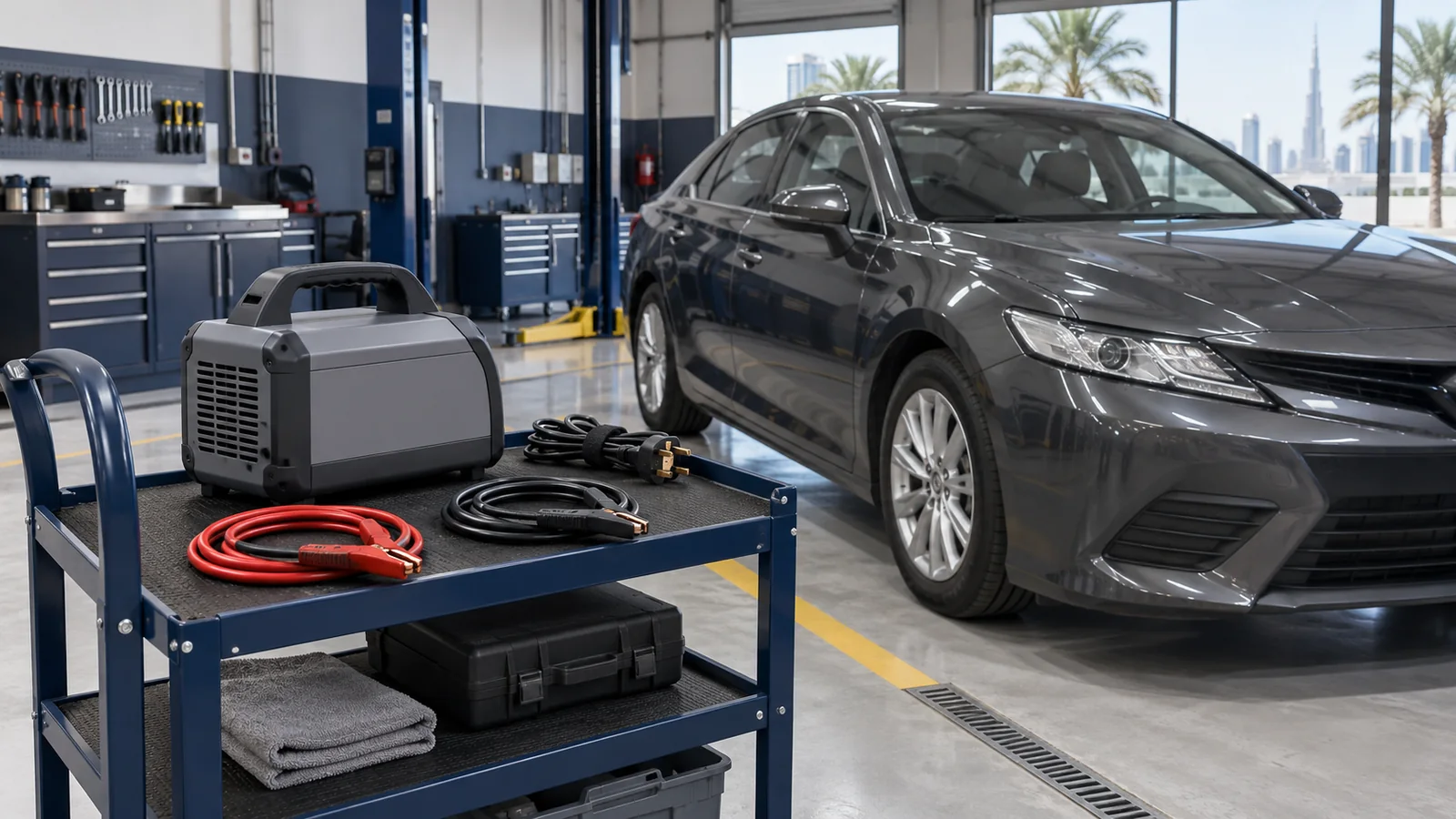
Tell the workshop whether the car was left unused, an accessory was connected or a similar failure happened recently. A clear history helps distinguish an isolated discharge from a recurring fault. Do not rely on another boost as the routine way to start the car.
If your BMW still will not start
Stop when the handbook or equipment limit is reached. A failed attempt does not identify a replacement part. Describe the sound and whether the engine actually turns; “it will not start” can mean several different things.
| What you notice | What it may suggest | What testing should establish |
|---|---|---|
| No crank or rapid clicking | Insufficient supply or a starting-circuit problem | Battery condition, cable connections and supply under load |
| One click without rotation | A starter command without normal engine rotation | Battery and cable condition, starter supply and starter operation |
| Engine turns slowly | Weak electrical supply or excessive starting load | Battery performance, connection resistance and starting demand |
| Engine cranks normally but does not fire | A different no-start path may be needed | Relevant fault information and engine-management checks |
| Hybrid or EV does not become drive-ready | A readiness fault requiring the vehicle’s own guidance | Exact messages and the affected electrical system |
Do not select a starter because you heard a click or an alternator because a boost failed. For a detailed explanation of no-crank symptoms, read BMW clicking noise and not starting. Avoid disconnecting the battery as an improvised reset or replacing fuses without establishing the fault.
Test before choosing a replacement battery
A discharged battery and a failed battery are different findings. Testing should establish state of charge and condition using an appropriate method. Connections and the charging system also need attention when the symptom or test results point that way. If the battery is too discharged for a meaningful condition assessment, a suitable recharge and retest may be necessary.
On BMWs equipped with an Intelligent Battery Sensor, or IBS, battery information is part of the energy-management system. That is a reason to follow the correct testing and connection procedures, not proof that a sensor or control module has failed. Do not disturb the sensor or battery wiring to experiment.
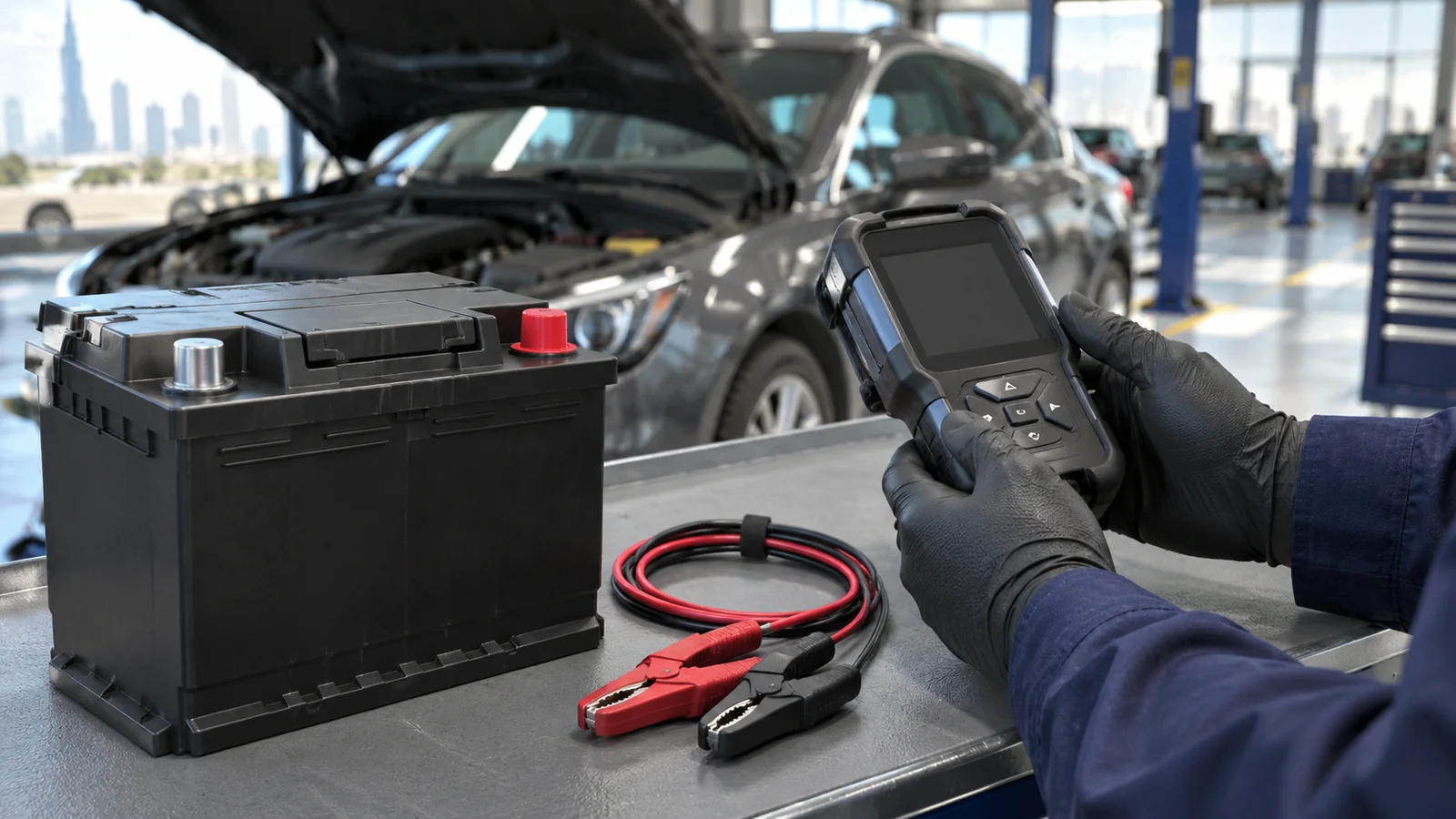
Repeated discharge may call for a drain investigation after normal shutdown, alongside charging and battery checks. A new battery will not necessarily correct an accessory or circuit that continues drawing power. Age is useful history, but a three-to-five-year estimate is not a universal replacement rule.
If replacement is justified, confirm the required specification and whether registration or coding applies to the actual vehicle. The BMW battery testing and replacement service covers that work. Our DIY BMW battery replacement guide discusses the separate decision about attempting a replacement yourself.
What changes the jump-start callout cost in Dubai
Ask for the total callout scope before dispatch. A starting attempt, battery condition test, extended diagnosis, replacement and recovery are different services. Location, basement access, vehicle position and the work required can change the quote.
- Confirm the attendance charge and what testing or starting assistance it includes.
- Ask what is payable if the vehicle cannot be started.
- Confirm whether waiting, after-hours attendance and recovery are included or charged separately.
- Approve replacement parts or further diagnosis only after the findings and price are explained.
Check current availability through the roadside service page. Workshop opening hours do not establish round-the-clock roadside coverage. Existing BMW assistance or insurance arrangements may have their own eligibility and dispatch process; independent workshop assistance is a separate enquiry.
Reduce the chance of another starting failure
Address the cause found during testing. That may mean correcting a connection, dealing with an accessory draw, repairing charging operation or replacing a failed battery. Keep the assessment results so a recurring fault can be compared with the earlier findings.
For extended parking, ask about a compatible maintenance charger and follow the vehicle and charger instructions. Occasional short drives are not a guaranteed charging plan. Do not leave accessories connected indefinitely, and investigate repeated low-battery messages rather than accepting them as normal.
Store portable equipment within its manufacturer’s temperature limits and check its condition and readiness before relying on it. Keep the correct handbook accessible offline. Knowing the permitted assistance procedure before a battery fails is more useful than searching for an unfamiliar connection point while stranded.
BMW jump-start questions
Can I jump-start every BMW in the same way
No. Check the handbook for your model, year and powertrain. Permission to receive or provide assistance, connection points and equipment requirements must be established for the actual vehicle.
Do I connect directly to the battery in the boot
Follow the specified jump points. If the handbook directs you to under-bonnet starting-aid terminals, do not expose the boot-mounted battery or choose a different connection for convenience.
Does a portable starter also need another car
No. A compatible portable pack supplies assistance itself. A donor vehicle uses a different setup with its own instructions and suitable jumper cables.
Will driving for 30 minutes fully recharge the battery
There is no universal full-charge time. Arrange condition and charging checks, then follow the appropriate charging plan. A successful start does not establish full charge.
Does clicking mean the starter must be replaced
No. Battery condition, cables and starting supply need checking before a starter is condemned. Describe whether there is one click, rapid clicking or actual engine rotation.
Can an electric BMW provide a jump-start
Do not assume so. Use it as a donor only if its exact handbook explicitly permits that role and setup. Receiving low-voltage assistance and providing assistance are separate questions.
Should I replace the battery after one jump-start
One boost alone does not justify replacement. Establish why it discharged and whether it passes an appropriate condition test. A damaged battery requires professional handling without another attempt.
Independent BMW workshop in Al Quoz
Discuss help for a BMW that will not start
Share your model, year, powertrain, location and exactly what happens when you try to start. Confirm attendance availability, the assessment scope and charges before approving dispatch or work.
Independent BMW specialist. Not affiliated with BMW AG.