
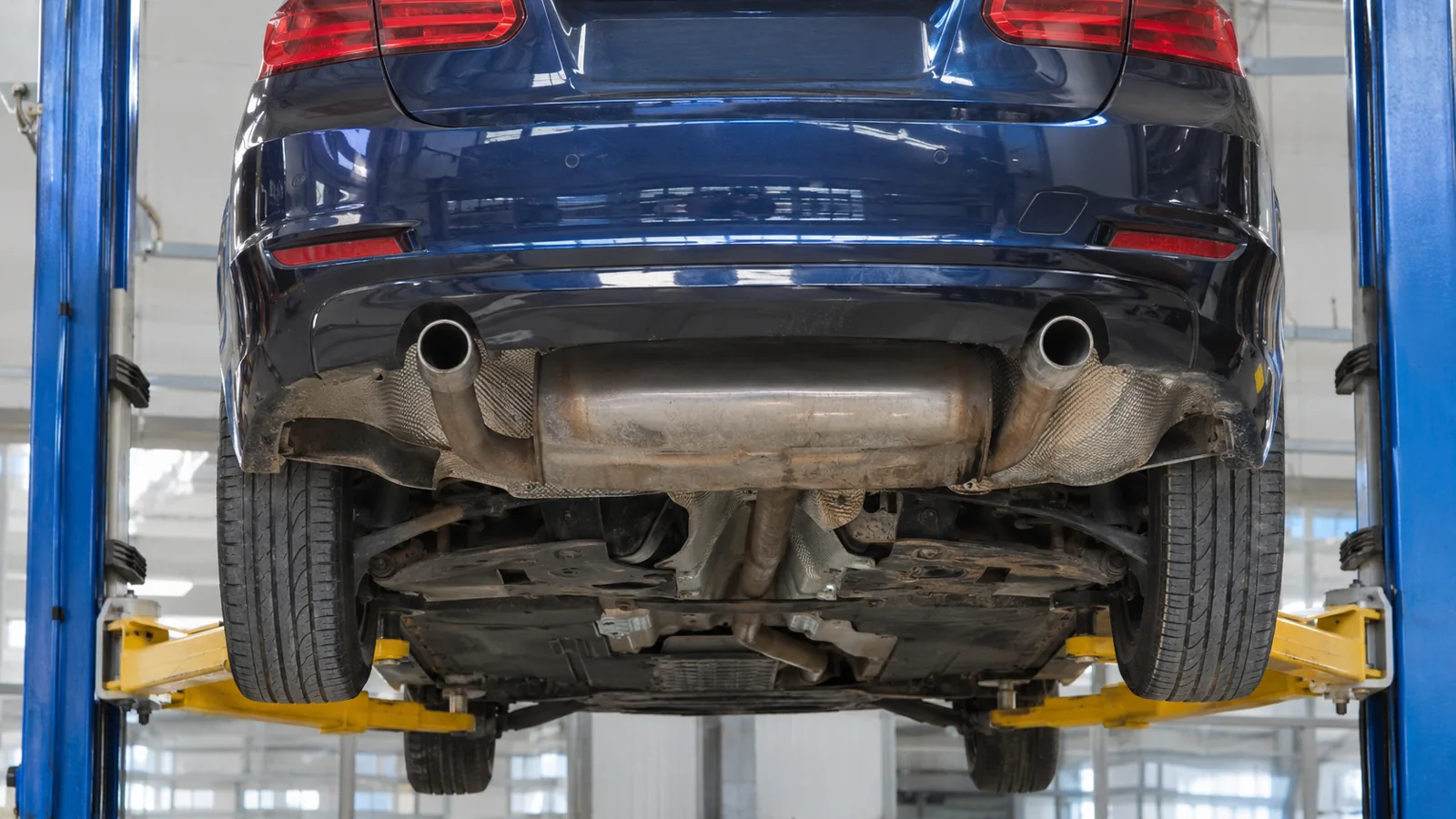
Check urgency before investigating
BMW exhaust rattling noise needs a different response when it comes with fumes, damage or a change in how the car runs. Do not assume that a light metallic sound is harmless, or that a loud sound automatically means the complete exhaust needs replacing. The first decision is whether further use or testing is appropriate.
Exhaust fumes inside the cabin, a pipe dragging or hanging loose, visible smoke, or a marked loss of power are reasons to stop as soon as it is safe, switch off and seek assistance. Follow any warning message and the vehicle handbook. Do not continue a test drive simply to reproduce the noise.
Do not reach around hot exhaust parts, crawl beneath a car supported only by a jack, or try holding a moving flap to silence it. Underbody inspection and running tests need appropriate workshop support and precautions. Never run the engine in an attached garage, even with its door open.
An exhaust leak can allow carbon monoxide to build up inside a vehicle, and carbon monoxide itself is odourless. Absence of an exhaust smell is not a safety test. If occupants feel unwell with a suspected exposure, move to fresh air and seek urgent medical help. The CDC explains the exhaust-leak risk. A sound recording cannot establish whether a vehicle is safe to drive.
When the rattle happens changes the checks
Describe the condition before choosing a part. A brief noise at the rear during the first start of the day, a warm-idle buzz and a clunk over bumps can send the investigation in different directions. Record the conditions you have already noticed; do not deliberately recreate a potentially unsafe event.
| What you notice | What it may help investigate | What the workshop should establish |
|---|---|---|
| Rear rattle during cold start | Flap operation, its coupling or nearby contact on an equipped vehicle. | Where the sound originates and whether the fitted mechanism follows the relevant operating instructions. |
| Buzz at warm idle or within a narrow engine-speed range | A vibrating shield, fixing or insufficient clearance. | The contact point and the condition in which it occurs, rather than tightening parts indiscriminately. |
| Clunk or rattle over a bump | Exhaust support, alignment or contact; suspension can sound similar. | Which system produces the sound, using safe controlled checks. |
| Noise after an impact or exhaust work | Damage, altered routing, support position or a loose fitting. | Leak integrity, clearance and correct installation of the affected assembly. |
| Noise with warnings or poor running | An issue that needs broader diagnosis than an external rattle. | The warning, fault information and physical findings before a repair decision. |
A phone microphone can make a small buzz sound louder or place it in the wrong area. Use a recording to help describe the event, not to order a component. Noise that follows road speed rather than engine speed also deserves careful localisation instead of being labelled an exhaust fault.
Useful observations you can make safely
You can help the diagnosis without lifting the car or touching the exhaust. From a normal safe position, note whether the sound seems to come from the front, middle or rear, whether the engine was cold or warm, and whether the vehicle was stationary or already moving when you noticed it.
- Describe the first occurrenceGive the date, approximate mileage and whether it followed a speed-bump impact, maintenance or exhaust modification.
- Record the operating conditionSay whether it appeared at start-up, idle, acceleration, deceleration or over an uneven surface.
- Keep warnings separate from guessesShare the exact message or a safe photograph of it. A warning and a rattle do not automatically have the same cause.
- Share relevant historyPrevious exhaust, engine-mount or underbody work can help identify what changed.
If a recording already exists, send the original clip with that context. Do not hold a phone while driving, put it beneath a running vehicle, or ask someone to stand behind the tailpipes to capture a louder sound. If the noise cannot be recorded safely, a clear written description is still useful.
For a clunk mainly over bumps, the BMW suspension-noise guide covers a different diagnostic route. If the sound is strongest around the engine, use the BMW engine-noise guide. Keep these possibilities separate until inspection establishes the source.
Heat shields and exhaust supports
A shield or support fault can sometimes be corrected without replacing an otherwise serviceable silencer. The useful finding is the failed fixing, damaged support or actual point of contact. A guess based only on a metallic sound is not enough to decide the repair.
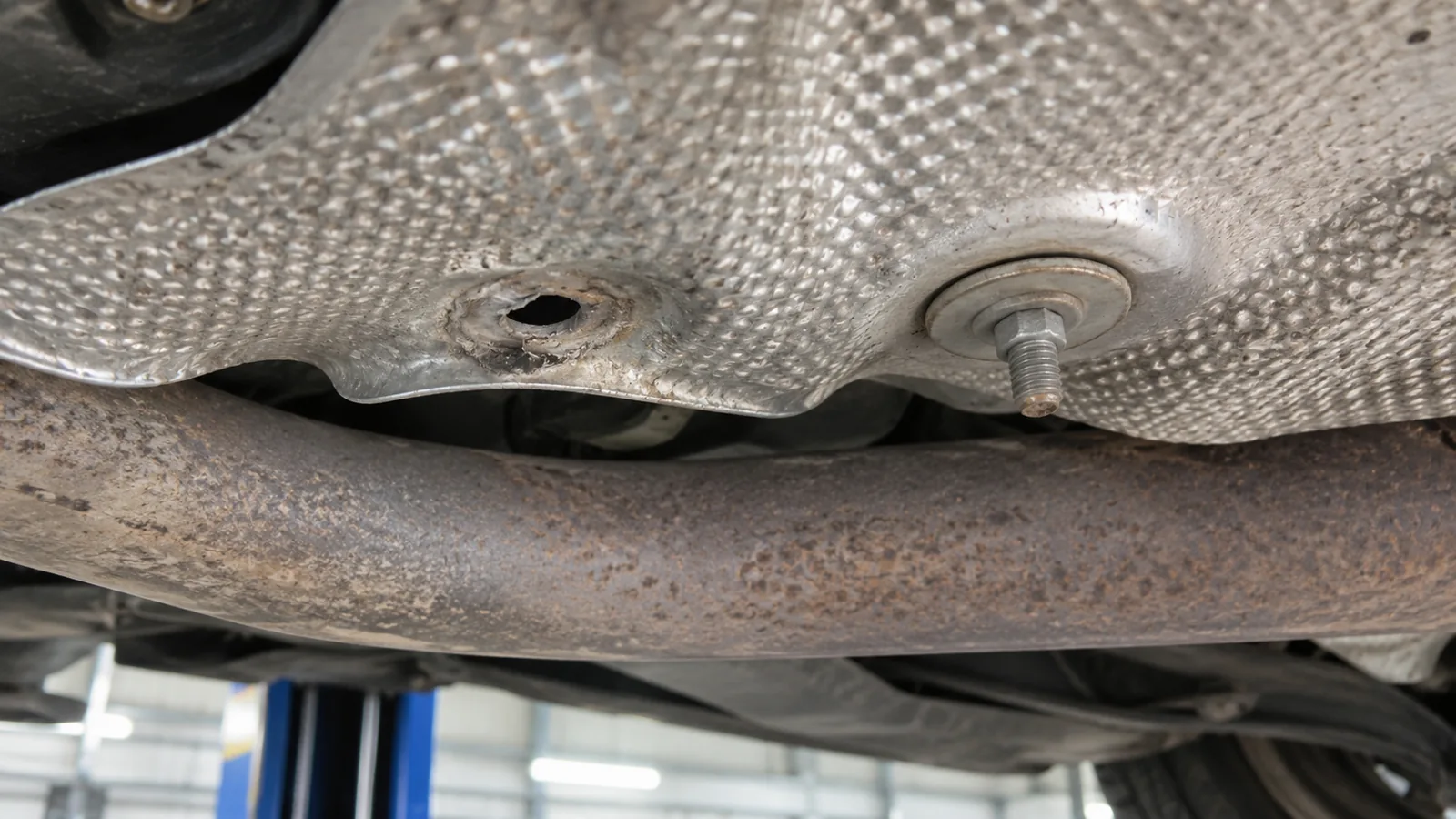
A shield needs its attachment and clearance checked
Heat shielding sits close to the exhaust to protect surrounding areas. An inspection should establish whether the shield is securely attached, whether an attachment area is damaged and whether it touches another component in the condition that produces the noise. The fastener and the material around it both matter.
Tightening a fixing will not necessarily restore a torn mounting area. Equally, a visible loose edge does not prove that it caused every sound the driver heard. Ask the workshop to show the finding and explain the compatible repair. Removing a protective shield simply to eliminate the sound is not a substitute for restoring the correct arrangement.
A hanger can affect more than the height of the tailpipe
Exhaust supports help hold the assembly in its intended position. The workshop should look at the rubber support, metal hanger, mounting point and clearance around the pipe or silencer. A fresh support may be part of the answer, but damage or incorrect alignment elsewhere can leave the same contact problem in place.
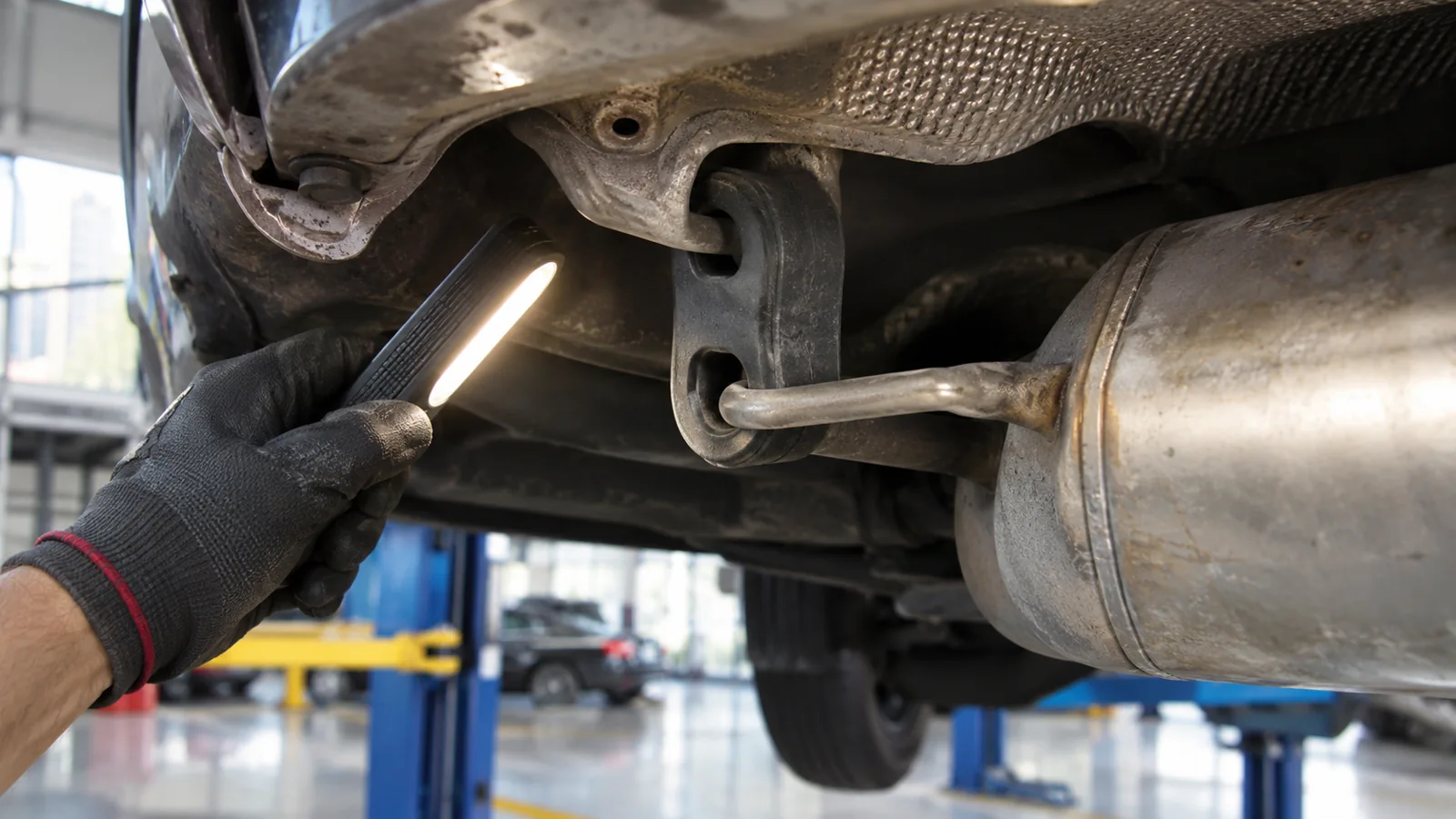
Tailpipe appearance alone is an incomplete check. After recent fitting work, the silencer may look centred from behind while a different section sits too close to the body. A useful report identifies the affected location and checks the arrangement after the repair, rather than promising that new hangers cure every rattle.
Diagnose the exhaust flap before replacing parts
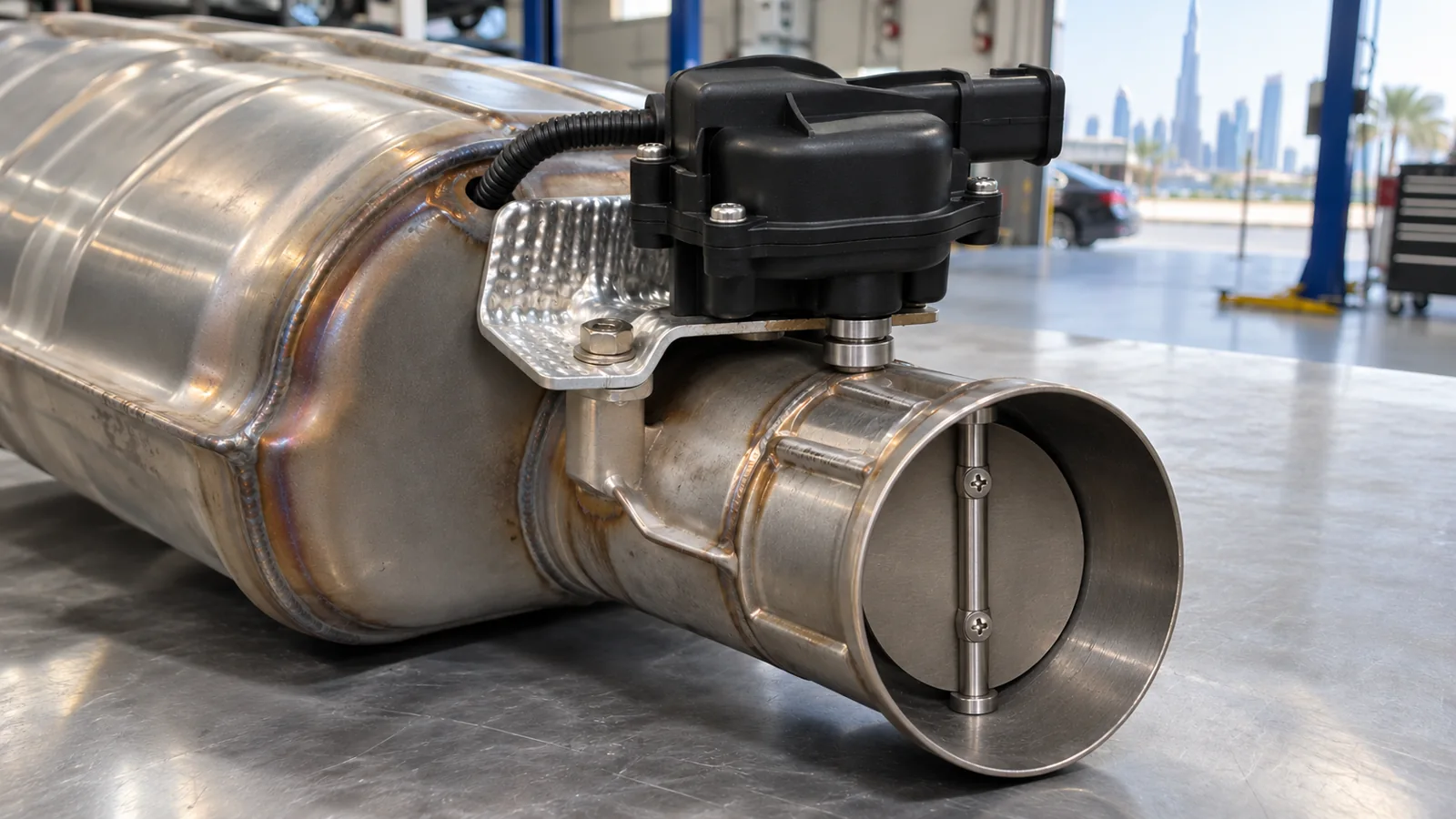
On a vehicle with an exhaust flap, the actuator moves a mechanical valve. Its fitted design and serviceable parts vary. A sound near the outlet does not establish whether the actuator, coupling, valve support or another nearby part is responsible. Confirm the car's engine, equipment and exhaust specification first.
What BMW service information can tell you
BMW Service Information Bulletin (SIB) 18 01 18 Revision 1 addresses a cold-start rear-flap rattle on listed B58-equipped F22, F23, F30, F32, F33, F34 and F36 vehicles. It distinguishes engine-control software behaviour, a loose or failed actuator coupling clip and flap-bushing play. The sequence checks software before condemning the rear silencer.
This is historical BMW North America service information, not a recall or a universal repair instruction for every BMW. A workshop should check current vehicle-specific information and applicability before using it. It does not establish warranty cover for a car in Dubai.
What to ask before approving an actuator
Ask which observation confirms the failed component and which alternatives were ruled out. A diagnostic fault entry can guide testing, but it does not automatically prove that fitting a motor will stop a mechanical rattle. Likewise, a damaged coupling may call for a different compatible repair from wear within the valve assembly.
Do not unplug, tie open or immobilise the flap to make the sound disappear. That changes how the system operates and can hide the original condition. Ask for the fitted system to be tested and restored correctly. Whether a small component is available separately or a larger assembly is required must be checked against the actual vehicle.
What a useful workshop diagnosis should establish
The first visit should establish the source, the evidence for a repair or the specific next test needed. It should not automatically end with a whole-exhaust quotation. Tell the workshop in advance if the noise happens only on the first start, so it can decide how to assess that condition.
- Reproduce the relevant condition safely
- Agree how the noise will be assessed and whether the car needs to arrive cold. A road test is a workshop decision only when appropriate, not a compulsory first step for every rattle.
- Localise the sound
- Separate an external fixing or contact noise from a sound within an assembly or a different system. The loudest point in a phone recording may not be the source.
- Inspect the fitted arrangement
- Check supports, shielding, fasteners, routing, damage and any relevant leakage. Record access limits rather than marking unseen parts as passed.
- Use applicable diagnostic information
- Where fitted equipment warrants it, combine physical checks with fault information and controlled actuation using suitable diagnostic equipment. DME means the engine control unit; software relevance must be established for the specific car.
- Explain the finding and next step
- Show the failed item or explain what remains uncertain. Seek approval before additional tracing, dismantling, programming or repair beyond the agreed assessment.
Why silence on a lift is not always a completed diagnosis
A change in the test condition can remove the noise without removing the underlying problem. For example, BMW SIB 18 02 25 describes a warm rear-silencer rattle on G45 X3 vehicles with the B48P engine that disappears on a lift. It identifies heat-shield-to-silencer clearance as the issue.
That North America bulletin is a specific example, not permission to apply its repair to another model. The general diagnostic lesson is to compare the test conditions. If your noise occurs with the car on its wheels but not while raised, that difference belongs in the findings rather than being reported as proof that no fault exists.
Repair choices and the assessment budget
A repair should follow the confirmed finding and the parts available for the vehicle. A fixing or support repair can be a smaller job than changing a silencer, but access, damage and associated work still determine the actual scope. There is no reliable single price for every BMW exhaust rattle.
| Confirmed finding | Possible repair route | What the quote should clarify |
|---|---|---|
| Damaged fixing or shield attachment | A compatible fixing or shielding repair. | Condition of the attachment area and restored protection and clearance. |
| Failed support or incorrect alignment | Compatible support replacement or correction of the fitted arrangement. | Whether damage or prior installation work also needs attention. |
| Verified coupling or actuator issue | The applicable component repair after the mechanism is tested. | Part fitment, testing and any required setup. |
| Applicable software issue | Vehicle-specific programming after confirmation. | Applicability, programming scope and required precautions. |
| Confirmed non-serviceable internal damage | Repair or assembly replacement as permitted by the fitted system. | Evidence for the decision, part specification and associated work. |
Initial noise-assessment budget in Dubai — Our current allowance is AED 250–450 for initial inspection, a relevant fault scan and a safe road test where appropriate. It includes a allowance. Extended tracing, dismantling and repairs are separate. Confirm the assessment scope and charge before the visit; any fee credit must be stated in writing.
The BMW noise-assessment service page explains the commercial scope. This allowance is not an exhaust-replacement price. If the first assessment identifies only the next test required, ask for its purpose and cost before authorising it.
For a repair quote, request the affected component, part specification, labour, exclusions and verification included. Ask whether access involves seized fixings or associated damaged parts. If warranty is offered, have its terms written down. Do not treat an old overseas service bulletin as proof that a Dubai repair will be free.
Completion time depends on the confirmed job, access, parts and any further diagnosis. A small attachment repair and an ordered assembly do not share a reliable universal timetable. Ask for the expected assessment and repair stages separately rather than relying on an unsupported promise of a one-hour fix.
Confirm the original noise has been addressed
Ask how the workshop checked the same condition that brought you in. If the complaint was a warm-idle buzz, an observation with a cold engine is not the complete confirmation. If the sound occurred only at the first start, the workshop should explain whether that condition could be reassessed during the visit.
- Check the physical resultConfirm the intended support, shielding and clearance after the work, rather than only listening for a quieter exhaust note.
- Record operating checksWhere a flap repair was involved, document the applicable function check and any remaining relevant faults.
- Keep limits visibleIf an intermittent noise could not be reproduced, distinguish a verified defect repair from an unconfirmed explanation for every sound.
- Know what to report nextKeep the work details and describe any returning noise by location, temperature and operating condition.
Replacing more parts is not automatically the next step when a noise returns. The useful question is whether the same sound and condition have returned, or whether another noise was present. A clear initial record makes that comparison easier.
BMW exhaust-rattle questions
Does a short cold-start rattle mean the exhaust is faulty
Duration alone cannot decide that. The location, fitted system and accompanying symptoms matter. A workshop should compare the actual noise with vehicle-specific information rather than declaring every brief rattle normal or recommending parts from a recording.
Can a heat shield be repaired without changing the silencer
Sometimes, if inspection confirms a shield or fixing problem and the surrounding attachment area is serviceable. The repair must restore the intended protection and clearance. Silencer replacement needs its own supporting finding.
Does a rattle prove the catalytic converter has failed
No. A rattle does not identify the failed part by itself. A workshop should localise the sound and confirm any suspected internal damage with appropriate checks before recommending an expensive component.
Will an exhaust-flap actuator always fix the noise
No. The fitted mechanism may have a coupling, mechanical wear, control issue or nearby contact that needs a different repair. Ask which test supports the actuator diagnosis and whether the component is correct for the car.
Should I book a cold appointment for a start-up noise
Tell the workshop the noise occurs at the first start before arranging the visit. It can advise whether the car needs to arrive cold or remain with it for assessment. Do not repeat starts or rev the engine simply to make the noise louder.
Can I continue driving until the appointment
A noise description cannot confirm safe driving. Report any warning, fumes, visible damage, dragging component or change in performance when arranging help. If there are concerning signs, stop as soon as safe and discuss assistance instead of continuing to test the car.
Independent BMW workshop in Al Quoz
Arrange an exhaust-noise assessment
Share your BMW model, year, mileage, where the sound seems to come from and whether it occurs cold, warm or over bumps. Include any warnings and a recording only if it was obtained safely. Confirm the scope and charge before the assessment; discuss suitable assistance first if driving may be unsafe.
Independent BMW specialist. Not affiliated with BMW AG.