
Low coolant warning, sweet smell or a puddle
BMW Coolant Leak Repair in Dubai
Losing coolant, noticing a sweet smell or seeing a warning? Our independent BMW workshop in Al Quoz investigates the loss, explains the findings and quotes for the necessary repair. Pressure testing, suitable follow-up checks and correct filling help address the cause. Your fitted price depends on the leaking component, access and parts choice.
Overheating, steam or rapid coolant loss? Stop safely, switch off and call with your location to arrange assistance. Do not open a hot reservoir or restart to demonstrate the fault. Check the urgency and recovery handoff
Compare the repair scope
BMW coolant leak repair cost in Dubai
Use these published specialist references to plan a budget. They are not fixed BMW Repair Dubai offers. Confirm the leaking component and affected circuit before comparing prices or buying parts.
Budget references checked 6 November 2026 against published radiator and hose scopes and pump scopes. They cover different work and VAT terms. Ask for one itemised payable total including diagnosis, parts, labour, specified coolant quantity, filling, testing and VAT. Count shared access once; confirm any diagnostic credit, recovery charge and written warranty before approval.
Early warnings
Signs Your BMW Is Leaking Coolant
Arrange diagnosis when you first notice coolant loss. Early attention can reduce the risk of overheating, but the number of parts required depends on the inspection. A warning, smell or puddle is a symptom, not proof of a particular failed part.
Many newer BMWs do not show a coolant temperature needle at all, so the low coolant message on the dashboard is often the first warning you get.
A check control message asking you to top up coolant, sometimes returning a few days after you have topped up.
A syrupy smell after driving, often from coolant dripping onto hot engine parts.
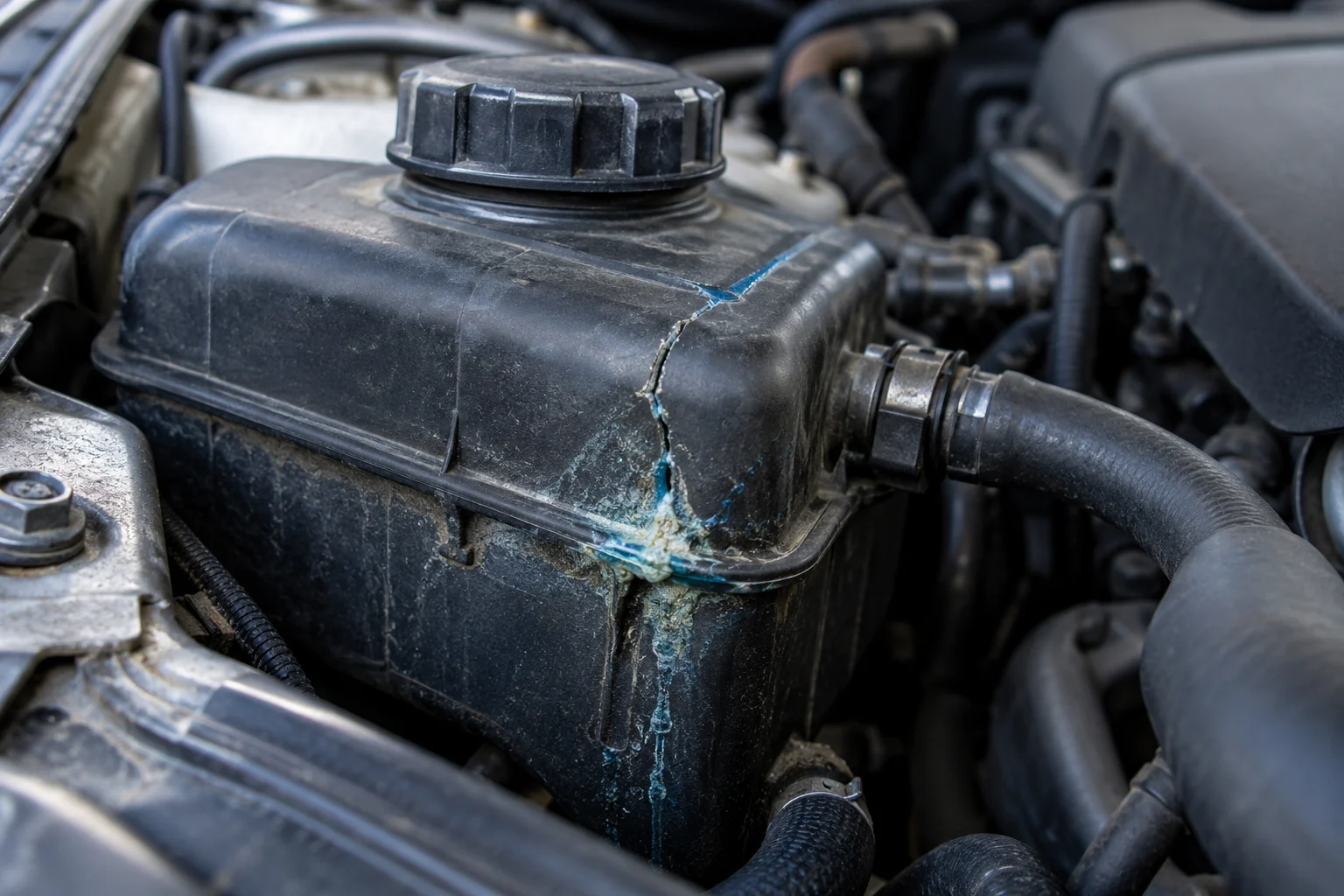
Coloured fluid or dried deposits around hoses, the tank or radiator. Coolant colour varies and cannot identify the correct replacement specification.
Follow any overheating or stop-engine warning immediately. Fan after-run alone can be normal and does not prove coolant loss.
A film on the inside of the windscreen or a damp passenger footwell can point to the heater side.
Where to look
Common BMW Coolant Leak Points
BMW cooling systems use a lot of plastic, which saves weight but becomes brittle after years of heat. These components are relevant inspection points. On older cars it is common to find more than one weak part once the system is pressure tested.
Plastic end tanks crack and seams weep, often at the top corners where the hoses join.
Tank seams, cap seals and bleed screws can leak. Cap operation also needs checking where indicated.
Many BMWs use an electric pump that can leak at the seal or stop working.
Plastic housings and their seals weep at the joint to the engine.
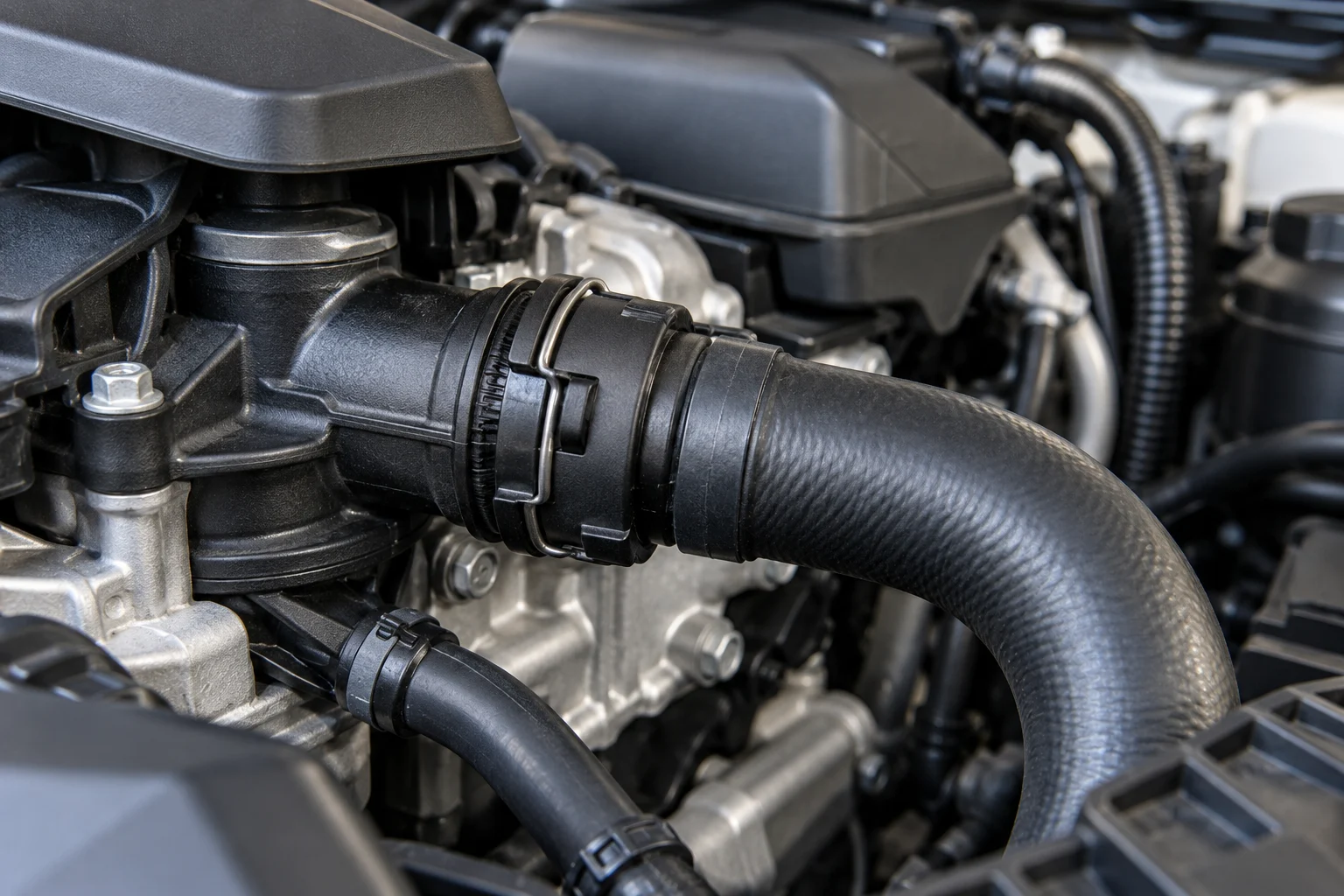
Rubber hoses harden and swell, and the plastic clip fittings crack where they join pipes.
Pipes running back to the cabin, the heater valve and the heater core.
Identify the circuit
Cooling layouts change the diagnosis
The model badge alone does not identify the pump, reservoir or heat exchanger. Confirm the installed engine, production date and affected circuit before selecting parts or a filling procedure.
| System to identify | What the assessment distinguishes | How it changes the quote |
|---|---|---|
| Engine cooling | Main radiator, tank, cap, pipes, pump and thermostat versus a separate circuit | Price the confirmed component, access and engine-specific filling |
| Charge-air or auxiliary cooling where fitted | Which reservoir and heat exchanger are losing coolant; relevant fault data and circulation | A main-radiator or engine-pump price may cover the wrong assembly |
| Heater circuit | Cabin smell, dampness and misting versus AC condensation or water ingress | Agree source confirmation and any dashboard access before major labour |
| Hybrid or electric thermal management | Exact circuit, warning and required electrical safety competence | Confirm workshop support or a specialist referral before booking; standard engine prices do not establish HV capability |
For example, BMW's bulletin for selected G05, G06 and G07 vehicles with the B58C engine up to 26 August 2019 addresses the low-temperature circuit. Its model, date and symptom conditions matter; it is not a universal B58 repair. The i8 also has its own specified filling and bleeding procedure. See the manufacturer references below.
What to do now
Driving a BMW with a coolant leak
A slow loss does not establish that the car is safe to drive. Follow the exact dashboard message and your vehicle handbook. If you are unsure, arrange advice before continuing the journey.
Unexplained coolant loss
Record the cold level and any recent top-ups. Contact us promptly even without a temperature warning. Do not wait for summer or rely on repeated refilling.
Returning warning or visible leak
Stop somewhere safe and assess the warning. If the level is below minimum, falls rapidly or a leak is active, do not continue driving to the workshop. Discuss recovery.
Overheating or steam
Pull over safely, switch off and arrange recovery. Do not restart just to check whether the warning disappears. Reduced power with overheating also needs urgent attention.
Never open a hot coolant reservoir. Let the system cool fully and follow the handbook. Routine driver pickup is not a substitute for recovery of an unsafe vehicle.
What to tell us for an overheating handoff
Call from a safe place with your location, exact warning, whether the engine is off, any steam or rapid loss, and whether it overheated before stopping. Share a dashboard photo only when safely parked. Discuss recovery availability and charges before collection; an enquiry does not confirm a booking.
Why a small leak matters
What Happens When a Coolant Leak Is Ignored
Coolant does more than stop the engine overheating. It also protects metal parts from corrosion and keeps the heater and some turbo parts at the right temperature. Running low for weeks puts all of that at risk.
These are possible consequences, not a fixed sequence. A leak may worsen suddenly. Diagnosing an external fault early can avoid more extensive work, although any existing overheating damage requires separate assessment.
A hose fitting or tank seam weeps a little after hot drives.
Air enters the system and the pump starts to run with less coolant.
Parts of the engine run hotter, and plastic parts nearby age faster.
A sudden failure in traffic can warp the cylinder head or damage the head gasket.
Evidence before parts
How We Track Down a BMW Coolant Leak
Coolant can travel along components or collect in the undertray, so a puddle does not locate the source. We choose checks from the symptoms and vehicle specification, explain what they show and discuss any further investigation before repair approval.
Look for wet joints, dried deposits and undertray traces; inspect accessible hoses, reservoir and cap seals.
Test the relevant circuit at its specified pressure. Check the cap where indicated; a pressure drop needs interpretation.
An intermittent leak may need a controlled warm inspection or compatible UV dye when appropriate.
Read relevant faults and temperature data. Test pump, thermostat or fan operation where findings justify it.
If internal loss is suspected, assess contamination and consider combustion-gas or leak-down checks. Residue alone is not proof.
Discuss findings, limits of testing and the repair estimate. Any additional investigation needs an agreed scope.
What the pressure-test record should show
Record the tested circuit, coolant temperature or cold-test condition, specified test pressure, hold time and observed pressure change. Note the visible source, cap result where tested and any inaccessible areas. A pressure drop alone does not identify the failed part.
Keep relevant fault data and photographs with the findings. Separate a confirmed leak from a suspected internal or intermittent loss. If the test does not reproduce the complaint, agree the next check and charge rather than replacing parts by elimination.
After repair, record the applicable filling procedure, leak recheck and operating observations, plus any remaining concern or follow-up instruction. Do not drive an overheating vehicle to complete a demonstration.

What the fix usually involves
BMW Cooling System Repairs We Carry Out
Repair follows the evidence. It may involve a seal or hose, or replacement of a leaking assembly. We separate necessary work from optional related work and explain labour overlap before you decide. A coolant flush alone does not repair a leak.
Correct filling and final checks
Bleeding the Cooling System After a Repair
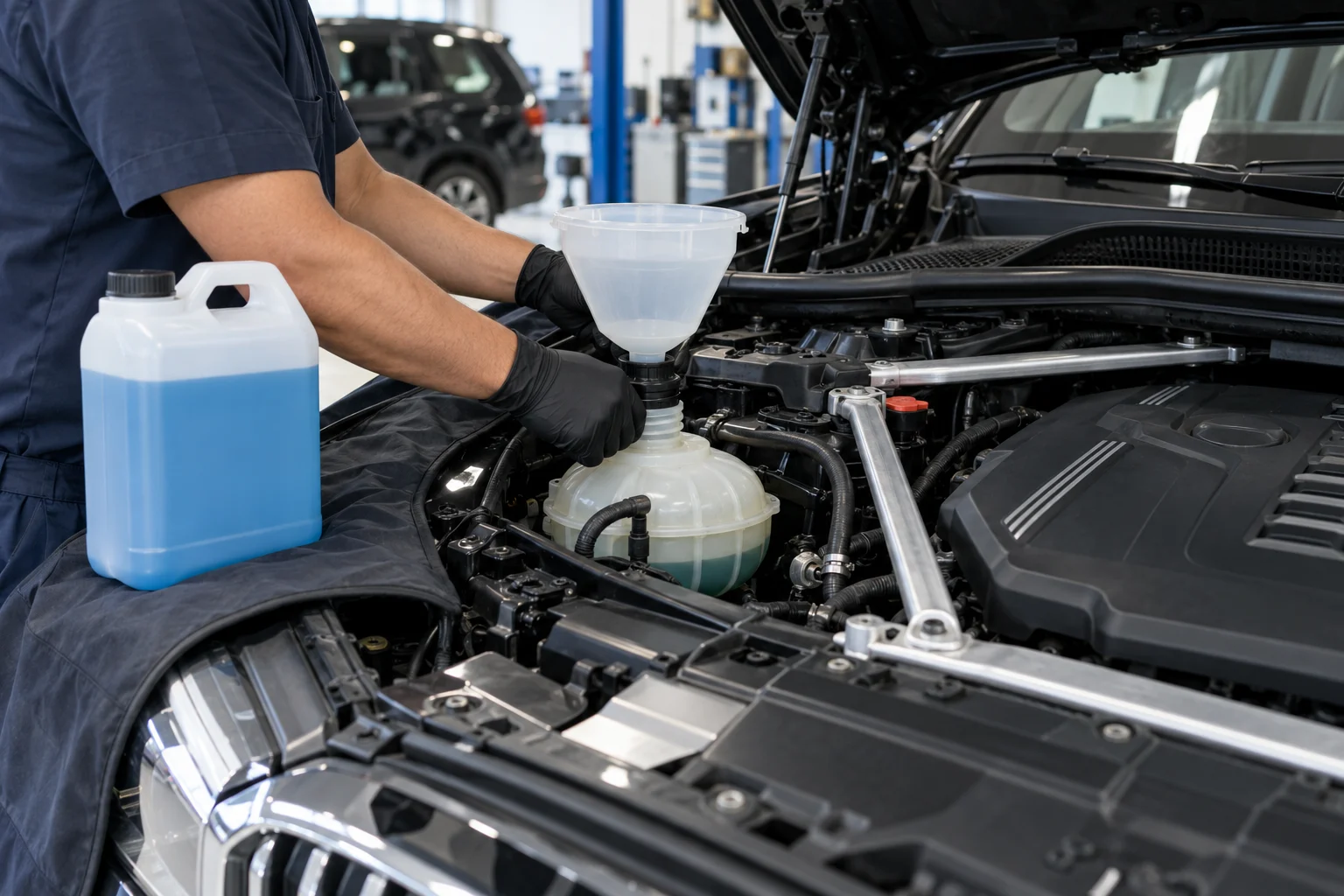
Air left after opening a cooling circuit can affect circulation and the level reading. Filling and bleeding must follow the repair instructions for the exact engine and circuit. Some systems require vacuum filling and diagnostic service functions; an ignition-on pump routine is not a universal BMW procedure.
What goes in matters
Choosing and Topping Up BMW Coolant
Coolant selection depends on the vehicle specification, not the colour in the bottle. Confirm the approved product and concentration for your engine and circuit. Repeated top-ups need diagnosis; they do not cure the cause of coolant loss.
Do
- Use the coolant specification approved for your exact BMW
- Dilute concentrate only as specified with suitable water; do not dilute ready-mixed coolant
- Check the level only when the engine is cold
- Keep the level between the min and max marks
- Mention every top up when you book a service
Avoid
- Assuming matching colours make different coolants compatible
- Topping up with tap water for long periods
- Opening the cap while the engine is hot
- Using stop leak products in the system
- Ignoring a message that returns after a top up
Photograph the level only when the engine is fully cold and record the date, product and quantity of any top-up. Do not drive with a low level to preserve diagnostic evidence. Follow the handbook and ask about recovery if the warning returns, the level falls rapidly or the engine overheats.
Before you approve
Parts choices and clear repair terms
Compare the complete fitted repair, not the price of a component alone. Our independent Al Quoz workshop offers genuine BMW and OEM parts routes. Ask which manufacturer and part number are proposed for your vehicle.
Your written estimate
- Confirmed leak or the next diagnostic step
- Necessary repair separated from optional related work
- Part brand, labour and coolant requirements
- Tax, extra testing and recovery charges if applicable
Your handover questions
- Which parts and labour are covered by warranty
- The written duration, mileage limit and exclusions
- Expected completion after parts and access are confirmed
- What was tested and what to do if a warning returns
Ask for the terms applicable to your quoted repair before authorising it. A general website statement is not a substitute for written warranty coverage. Further faults or additional work should be discussed before the scope changes.
Why summer finds weak parts
Dubai Heat and Your BMW Cooling System
Long summer days, slow traffic and AC running at full all put extra load on the cooling system. The AC condenser sits in front of the radiator, so the radiator works in air that is already hot. Plastic parts that have been heat cycled for years become brittle, and an existing small leak can worsen. A winter leak also needs attention.
Inspection can reveal visible deterioration; it cannot predict every future failure.
Low-speed traffic reduces natural airflow. Overheating can occur at other speeds too.
The electric cooling fan must work hard at low speed, so a noisy or slow fan should be checked quickly.
Note the date each time you top up so you can tell if the loss is getting faster.
By model
Help us assess your BMW
The engine, production date and fitted cooling equipment matter more than the badge alone. Confirm these details before comparing parts prices or repair times.
Share the model, year and engine if known. Use our 3 Series cooling checks or X5 cooling checks to prepare your enquiry. The VIN helps confirm the correct circuit and parts.
Tell us which warning appears, when the level drops and whether the car has overheated. Mention recent repairs or coolant additions.
Confirm diagnosis, access requirements and parts availability before agreeing the repair time. Discuss recovery if the car cannot safely be driven.
Independent BMW workshop
Speak to our Al Quoz team
Find us at 39 Al Quoz 4, Dubai, open Monday to Saturday, 9am to 7pm. We are independent of BMW and its authorised dealer network. Ask us to explain the findings and proposed parts before deciding on a repair. Manufacturer warranty claims and recall work should be checked with the authorised dealer.
BMW technical guidance is vehicle-specific. Examples include the i8 filling and bleeding procedure and a bulletin for specified B58C low-temperature circuits. These documents do not establish that a bulletin applies to your car; confirm fitment and current repair instructions.
Related work
More BMW Engine Cooling Services
Questions before booking
BMW coolant leak questions answered
Why is my BMW losing coolant without a visible leak?
Coolant may collect in an undertray, escape only when hot or leak from a concealed component. Internal loss is another possibility. A pressure test is a starting point; intermittent symptoms can require further checks.
Can I keep topping up and driving?
Repeated top-ups do not make a leaking system safe. Follow the exact warning and handbook. Do not continue with overheating, steam, rapid loss or an active leak with a low level. Arrange advice and recovery where needed.
How much does BMW coolant leak repair cost?
Published planning references include AED 350 to 600 for an accessible hose or seal and AED 1,200 to 2,800 for selected standard radiator replacement, with the listed scope and VAT. A selected pump reference of AED 1,200 to 2,200 covers pump and labour, with coolant, seals, testing and VAT still to confirm. These are not fixed workshop offers. Ask for your complete itemised payable quote.
Is a pressure test the same as a diagnostic scan?
No. A pressure test checks the cooling circuit for leakage under specified conditions. A scan reads faults and operating data. One does not replace the other, and neither guarantees that every intermittent leak will be found immediately.
Which coolant should I use?
Use the specification approved for your exact vehicle and circuit. Colour alone is not a compatibility guide. Follow the product and vehicle instructions for concentration; ready-mixed coolant should not be diluted.
Does the system need bleeding after repair?
When the circuit has been opened, filling and bleeding must follow the applicable BMW procedure. Depending on the vehicle, this can include vacuum filling and a diagnostic or pump routine, followed by level and leak checks.
Can coolant leak into the engine oil?
Yes, but milky residue under a cap can also be condensation. Contamination, persistent exhaust vapour or unexplained loss must be assessed together. A head gasket should not be condemned from one visual symptom.
Does a sweet cabin smell mean the heater core has failed?
It can point to a heater-side leak, especially with misting or a damp footwell. Other water ingress and air-conditioning causes need distinguishing before dismantling the dashboard.
Should I use a stop-leak additive?
Do not use an additive as a substitute for diagnosis. It can obstruct small passages or complicate repair. Tell the workshop if any sealant has already been added.
Will replacing the water pump fix every coolant warning?
No. The warning can relate to low level, a leak elsewhere, circulation, temperature or sensing. Confirm the cause before ordering a pump.
How long will the repair take?
Timing depends on diagnosis, parts availability, access and the cooling time needed for filling and final checks. Ask for a completion estimate after inspection rather than assuming every leak is a same-day repair.
Are diagnosis and pressure testing free?
Confirm the diagnostic charge and agreed test scope before booking. Also ask whether any charge is credited against an approved repair. This page does not promise free pressure testing.
What parts and warranty are available?
Ask for the genuine BMW or OEM option available for your vehicle, with the part manufacturer identified. Obtain the applicable parts and labour warranty duration, mileage limit and exclusions in writing before approval.
What if coolant drops again after a repair?
Contact the workshop with the warning, cold-level record and repair details. A returning warning needs reassessment; do not assume it is normal settling or keep topping up indefinitely.
Do you offer pickup in Dubai?
Ask about collection availability and terms for your location. If the car has overheated or is unsafe to drive, discuss suitable recovery and any charge before travel. The workshop is at 39 Al Quoz 4, Dubai, open Monday to Saturday, 9am to 7pm. Sending an enquiry does not confirm collection.
Do hybrids and electric BMWs use the same procedure?
No. They can have several separate thermal circuits. Send the exact model and warning so the affected system and required capability can be confirmed. Engine-cooling instructions should not be applied to high-voltage battery cooling.
Take the next step
Find the Leak Protect the Engine
Tell us what your BMW is doing. We’ll discuss the right checks, a vehicle-specific repair quote and suitable collection arrangements.
Mention any overheating or recent cooling repair. If the car is overheating or losing coolant rapidly, stop safely and discuss recovery before travelling.
Your message is an inquiry. Availability, repair timing and collection arrangements are confirmed separately.