
Put warnings ahead of the noise
BMW cooling fan noise needs a different response when it accompanies a temperature warning, steam, smoke or severe mechanical contact. Do not keep the engine running to obtain a better recording. The immediate decision is whether further operation is appropriate, rather than how to make the car quieter.
Stop as soon as it is safe and switch off if the vehicle instructs you to stop, or if there is steam, smoke, an electrical burning smell or severe scraping or contact. Follow the exact warning and your vehicle handbook, and arrange suitable assistance. Do not open a hot coolant expansion tank.
Keep hands, tools, clothing and cleaning brushes away from the fan and belt area. An electric fan can operate with the vehicle switched off. Stationary blades are not proof of safe isolation. Hands-on inspection, debris removal and controlled activation belong to an equipped workshop using the procedure for the fitted system.
Do not pull a fan fuse, unplug the motor or try to hold the blades to silence the noise. Do not reach through the grille or place a phone in the engine bay. If the car has no urgent signs, describe the condition from a normal safe position and ask what assessment is appropriate.
Identify which fan you can hear
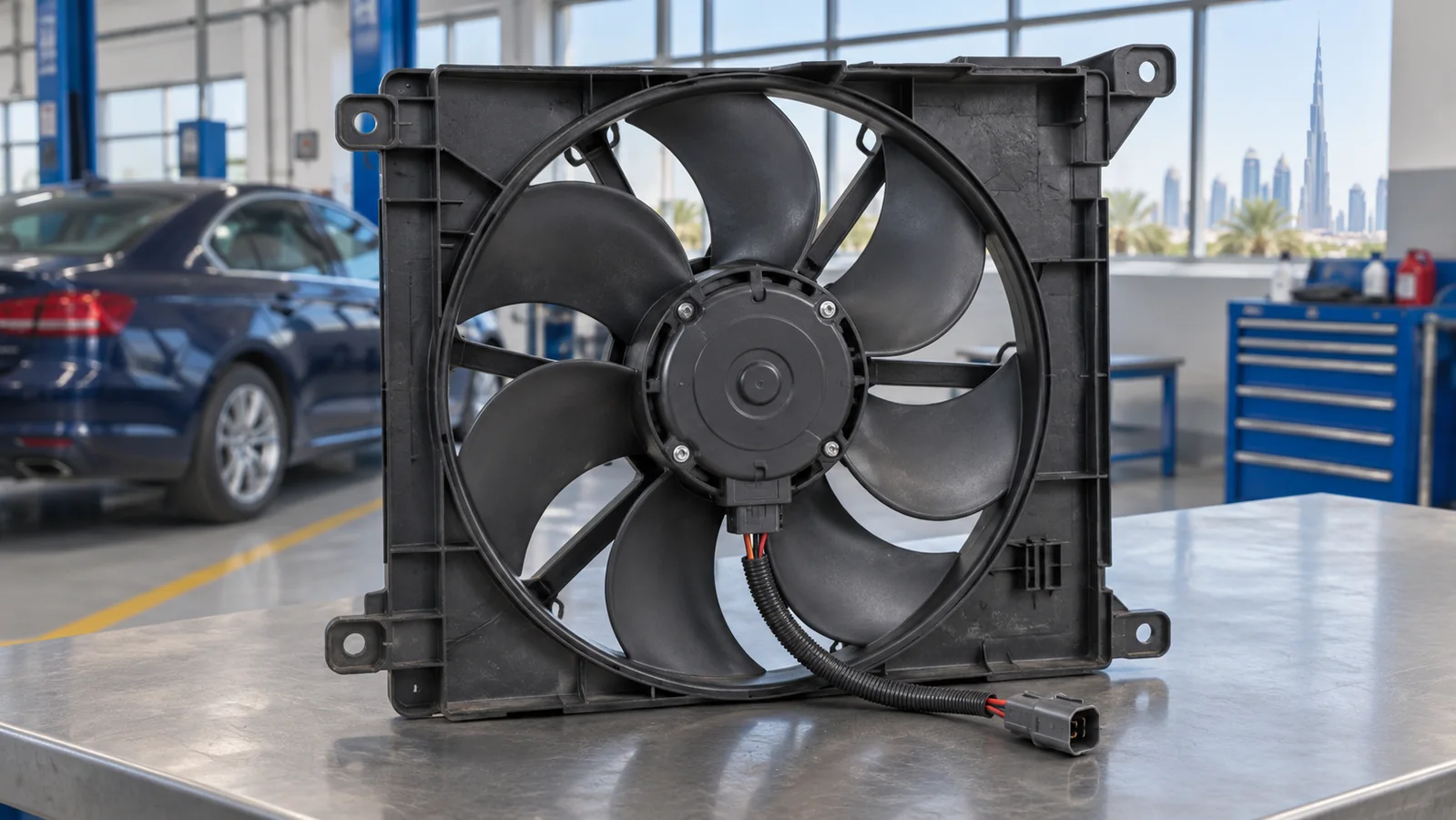
The engine cooling fan moves air through the heat exchangers at the front of the vehicle. The cabin blower moves air through the interior ventilation system. They perform different jobs, and a noise from one does not establish a fault in the other. The vehicle's equipment determines the exact arrangement.
| What you notice | Which system to distinguish | Useful next step |
|---|---|---|
| Strong air noise from the front of the car | Engine cooling fan and its operating demand | Record whether the engine is cold or warm, whether the car is stationary and any warnings. |
| Noise inside the cabin that follows blower settings | Cabin blower, air path or climate components | Describe whether air volume changes with the sound; use the cabin-noise guide. |
| Chirp or squeal linked to engine speed | Accessory belt, pulley or another engine-area source | Have the source localised rather than assuming the cooling fan is belt-driven. |
| Noise continues after parking | Which fan or other component remains active | Note its location, operating state and duration without touching or disabling anything. |
A change when you alter a cabin setting is useful information, not proof of a particular failed component. For interior airflow noise, the BMW AC-noise guide explains blower, flap and cooling-related sounds. For a belt-area chirp or grind, use the BMW pulley-noise guide.
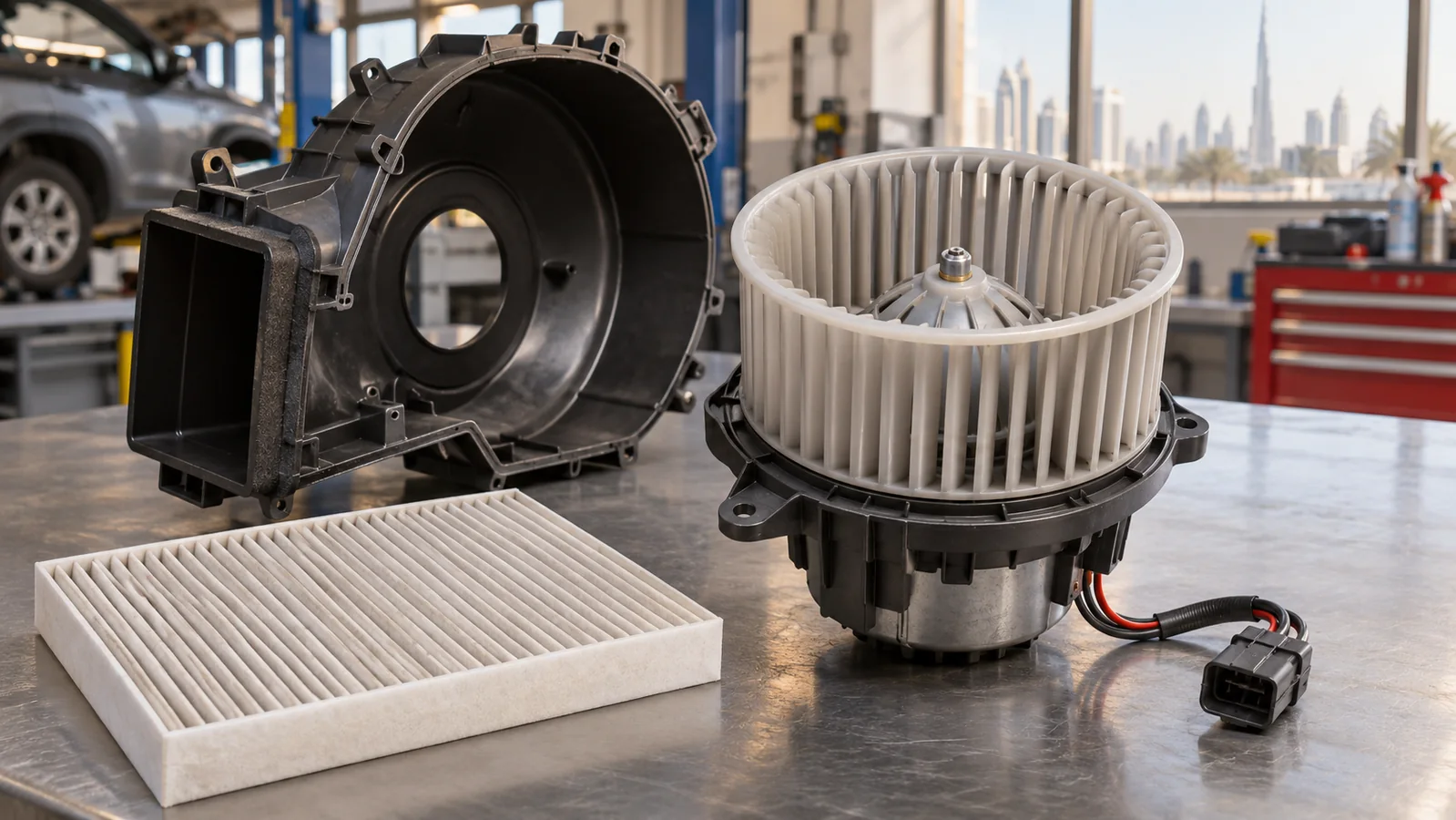
If the problem is a cabin blower that is noisy, weak or unresponsive, the blower-motor service page explains that assessment. This guide focuses on the engine cooling fan; it does not treat every interior fan sound as an engine-cooling fault.
Separate airflow noise from mechanical contact
A fan designed to provide cooling airflow will not always be silent. A smooth increase in air noise and a repeated scraping sound are different observations. Neither the volume of a phone recording nor the description of a sound can establish whether the fan, its mounting or another part needs replacing.
- A smooth rush of air
- The workshop should establish whether the fan is responding appropriately to the conditions. Record the engine's temperature state and climate operation instead of assuming that louder automatically means defective.
- Scraping or a repeated tick
- Contact, damage or an obstruction needs investigation. The relevant evidence is the affected location and physical condition. Do not reach in to find the contact or try moving a blade while the assembly is fitted.
- Rattle, vibration or an uneven sound
- Mounting, shroud condition and the rotating assembly are among the checks. A rattle close to the fan can also come from another component. Localisation matters before any part is ordered.
- A persistent change from the car's usual behaviour
- Explain when the change began and whether it occurs cold, warm, with climate operation or after parking. That pattern helps select checks; it does not identify a sensor or control module by itself.
HELLA's radiator-fan guidance distinguishes fan types and identifies noise and visible damage as reasons for assessment. Its general guidance is not a BMW fitment list or permission to apply the same repair to every vehicle.
Fan operation after parking needs context
A fan still operating after the engine stops is not a diagnosis by itself. Identify the sound's location, whether the engine was warm and how the behaviour differs from previous use. There is no single useful shutdown-time limit for every BMW engine, climate configuration and operating state.
Use the handbook for your vehicle and market. BMW provides a digital owner-manual lookup for supported vehicles; your in-car handbook or Driver's Guide may provide the appropriate local instructions. Engine-compartment precautions still apply after switching off. Do not use a timed wait as permission to handle the fan.
If a new pattern repeats, accompanies warning messages or is associated with a starting or battery problem, report those facts together. Ask the workshop to determine whether the operation is being requested and why. Do not disconnect the battery as a generic reset before the condition and fault information are assessed.
On a hybrid or electric BMW, record whether the car was drive-ready, charging or using preconditioning. Thermal-management activity cannot be interpreted simply as an engine fan running after shutdown. Leave high-voltage systems and their isolation to appropriately trained personnel; the badge alone does not identify the fitted cooling layout.
Useful observations without dismantling the car
You can make the first assessment more useful by describing a condition you have already noticed. Do not deliberately heat the engine, repeat a warning event or arrange a long drive to provoke the noise. If a recording cannot be obtained safely, a written description is sufficient.
- Identify the vehicleShare the model, year, engine if known and approximate mileage. Include recent cooling-system or underbody work.
- Describe the locationSay whether the sound seems strongest at the front grille, engine bay or inside the cabin.
- Record the conditionsNote cold or warm operation, stationary or moving, climate use and whether it continues after parking.
- Keep warnings exactShare the displayed message and any cooling or performance change separately from a guess about the cause.
A safe recording should be made from outside the moving-component area, with the vehicle parked appropriately. Do not handle a phone while driving, lean over the fan or ask someone to reach into the engine bay. A recording can help reproduce a complaint, but it cannot confirm that continued driving is safe.
Bring previous repair details if the noise started after work. A changed mounting position, an unresolved cooling complaint and an unrelated new noise call for different follow-up. Accurate history can reduce repeated investigation without assuming the last part fitted caused the problem.
The fitted fan changes the checks
Electric fan assemblies and mechanically driven fans do not have the same controls or service procedures. A fan clutch is relevant only when that arrangement is fitted. Likewise, a belt noise should not automatically be explained as a fault in an electrically driven radiator fan.
The workshop should establish the actual engine, cooling equipment, part arrangement and applicable service information. A model name such as 3 Series or X5 covers many different vehicles. Do not select a repair or replacement part from the model badge, an online sound clip or a photograph of another engine bay.
Some components may be separately serviceable; other designs require an assembly. Confirm that against the vehicle and repair information. A workshop should explain what failed, what can be retained and why the proposed part is compatible. Replacing every nearby cooling component is not an evidence-based shortcut.
Inspect the shroud mounting and rotating assembly
Physical inspection should establish a defect, not simply find a dusty fan. Relevant checks include the shroud, mounting points, clearance, visible blade damage, trapped material and the condition of the assembly. The technician must make the system safe using the correct procedure before hands-on examination.
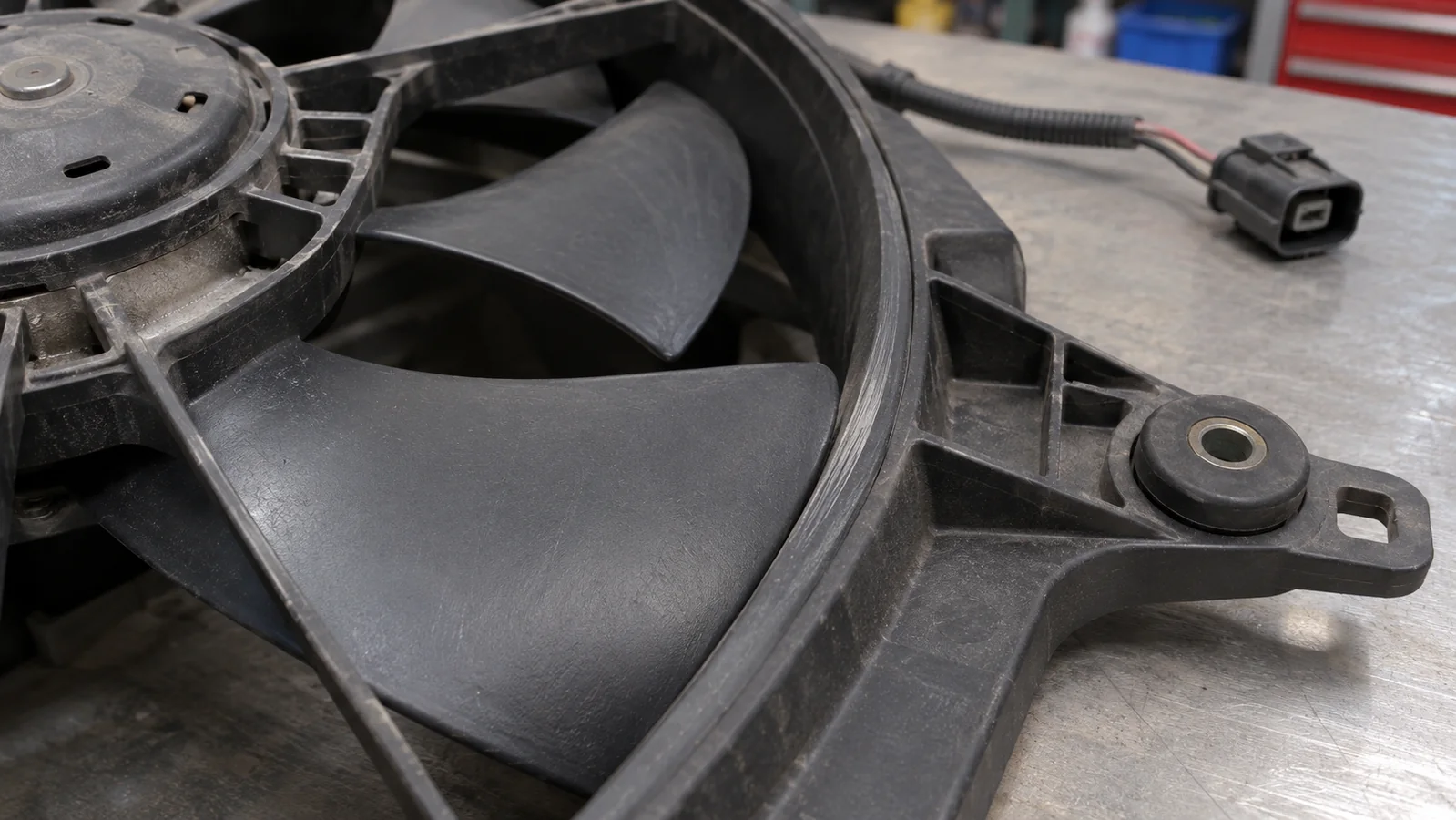
A confirmed obstruction or mounting issue may be corrected without replacing a complete fan assembly. That benefit depends on checking for damage and restoring the intended arrangement. Removing material while leaving a damaged blade or broken support in service is not a completed repair.
Do not bend blades back into shape, add balancing weights, spray lubricant into a sealed motor or treat bearing replacement as a universal fix. The permitted service route depends on the design. If damage requires replacement, the quote should identify the affected component or assembly and explain the finding.
Cleaning is also a defined job. An obstructed heat-exchanger face and a restricted internal coolant passage are different findings. Ask what is blocked and how it was established. A general wash or a coolant change should not be promised as a cure for an unexplained fan noise.
Workshop tests should explain why the fan behaves that way
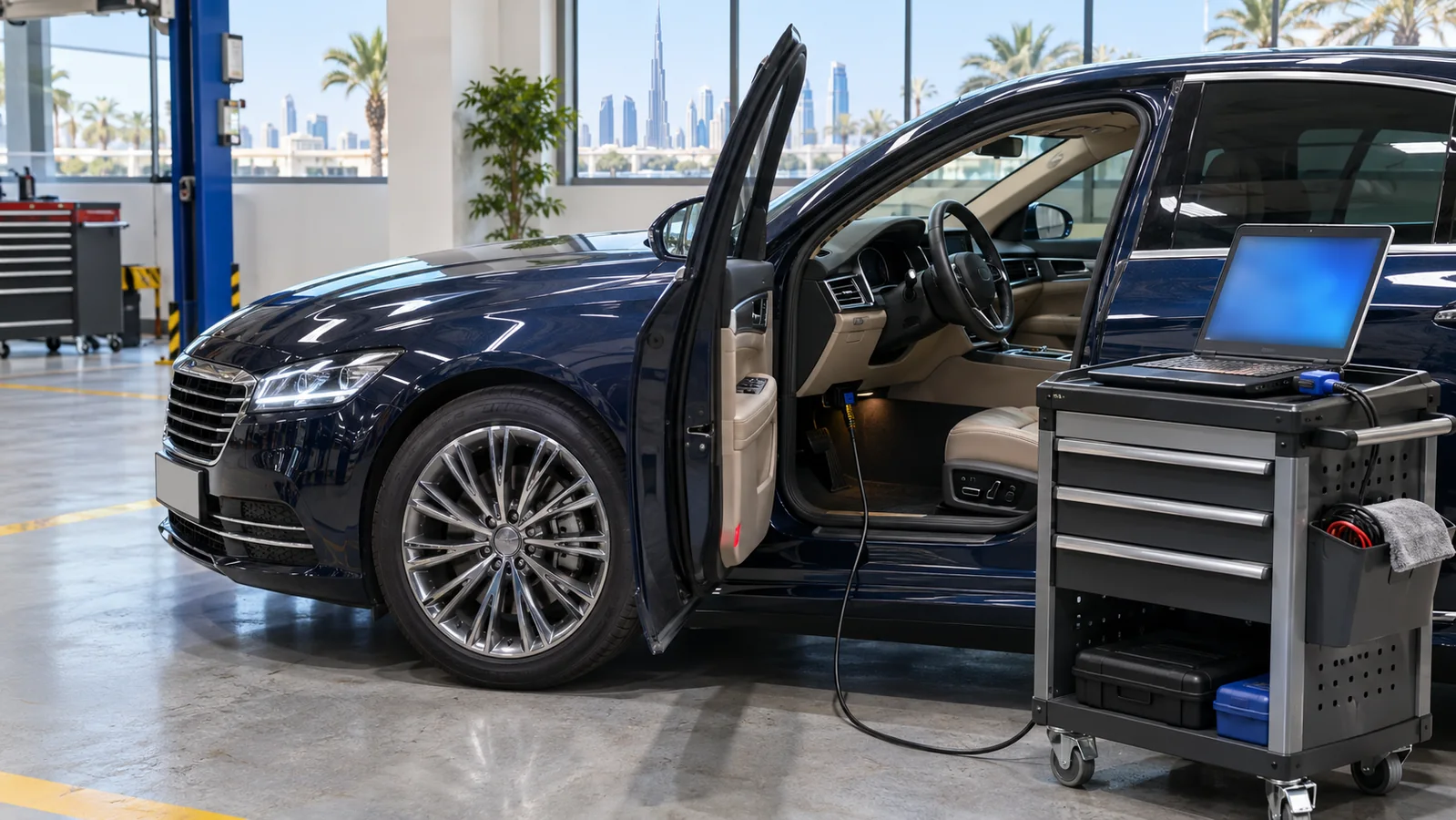
A useful assessment connects the complaint with physical findings and the vehicle's control information. The diagnostic tool supports that process; a stored fault alone is not a parts order. Ask which observation confirms the proposed repair and what remains uncertain if the noise cannot be reproduced.
- Confirm the operating condition
- Compare the actual noise under appropriate, safe conditions. Record warnings, temperature state, climate operation and whether the complaint was reproduced.
- Read the relevant systems
- Check applicable faults and live values. DME means the petrol engine control unit; DDE is the diesel equivalent. Fitted systems determine which modules and test plans matter.
- Assess cooling demand and fan response
- Review coolant-temperature readings and relevant climate-system information for plausibility, including refrigerant-pressure information where the fitted system supports it. Where supported, compare the requested fan operation with its measured response. A loud fan may require investigation of its demand as well as its motor.
- Test the indicated circuit or component
- Use the correct wiring and repair information for supply, earth, connectors and control checks. Fan activation and electrical isolation are workshop procedures, not owner experiments.
- Explain the finding before additional work
- State whether the cause is confirmed, a defect has been found without proving every symptom, or another test is needed. Obtain approval for extended tracing or dismantling.
Cooling-system concerns such as a leak, temperature-regulation issue or circulation problem need their own evidence. Fan noise alone does not prove a failed water pump, thermostat or sensor. The BMW overheating-prevention guide explains the wider cooling checks without treating them as automatic replacement jobs.
A historical BMW example shows why applicability matters. Service Information Bulletin 12 29 14 discusses a fan hardware/software issue on specified F3x vehicles, engines, equipment and production dates. It is not a universal fan-noise repair. Current vehicle-specific information must determine whether any bulletin applies; the North America document does not establish warranty cover in Dubai.
Choose the repair from the confirmed finding
The best result is a clearly defined job rather than a promise to make every fan silent. Ask for the failed item or test result, the compatible repair route and what will be checked afterward. A new motor will not resolve a mounting fault, and a mechanical repair will not explain every control-related operating pattern.
| Confirmed finding | Possible repair route | What to clarify |
|---|---|---|
| Obstruction or mounting defect | Correct the obstruction or fitted support arrangement. | Whether blades, shroud or nearby components also suffered damage. |
| Damaged or failed fan component | Replace the serviceable component or assembly required by the design. | Correct fitment, associated work and the function check. |
| Verified electrical or control fault | Repair the identified circuit or applicable component. | Measured evidence and whether the fan itself passed testing. |
| Cooling demand caused by another defect | Repair the confirmed cooling or related system issue. | How that finding explains the complaint and how the result will be verified. |
Confirm the assessment charge before the visit and ask whether further testing needs separate approval. For the repair quotation, check parts, labour, exclusions and any stated warranty terms. An initial assessment is different from a complete fan-replacement price.
Our BMW noise-assessment service page explains the workshop scope and current assessment allowances. Share the fan-specific conditions when enquiring. If there are urgent warnings or damage, discuss suitable assistance before deciding to drive to the workshop.
Check the original condition after repair
A quieter fan at one moment is not the whole verification. The workshop should check the original complaint under comparable conditions where appropriate, confirm the physical arrangement and test the relevant operation. If the fault was intermittent, the report should distinguish what was verified from what could not be reproduced.
- Physical result — correct mounting, intended clearance and no remaining identified contact or damage.
- Operating result — applicable fan function and relevant faults checked after the work.
- Complaint result — the condition and test duration used to reassess the reported noise.
- Follow-up — what to record if the same pattern returns and what warnings require immediate action.
Follow the maintenance and coolant requirements for your vehicle. Do not add a generic lubricant, periodic fan-bearing service or arbitrary coolant-change interval solely to prevent noise. If the sound returns, compare the location and conditions before assuming that another fan assembly is the next step.
BMW cooling fan noise questions
Does a loud cooling fan mean it is broken
No. Strong airflow can be audible when cooling is required. Mechanical contact, visible damage, warnings or an unexplained change in behaviour need assessment. Volume alone does not identify a failed component or establish that driving is safe.
Can the fan operate after I switch the car off
It can, depending on the vehicle and operating state. Keep clear of moving components and follow your handbook. Record an unusual new pattern rather than applying one universal time limit or unplugging the fan.
Can I straighten a blade to stop it rubbing
Do not attempt that as an owner repair. Have the damage, clearance and mounting checked after proper isolation. The fitted design and repair instructions determine the compatible component or assembly replacement.
Does a noisy cabin blower mean the radiator fan needs replacing
No. They are different systems. Describe the location and whether the noise follows cabin airflow settings. A blower assessment checks the interior air path and fitted electrical controls rather than assuming an engine-cooling fan fault.
Will a scan identify the exact part to replace
A scan can guide diagnosis, but the technician still needs the relevant physical checks, operating data and circuit tests. Ask which finding confirms the failed part and what alternatives were checked.
Can I drive with a noisy fan until my appointment
A sound description cannot establish that. Follow the exact vehicle warning. Steam, smoke, a burning smell, severe contact or a stop instruction means stopping safely and arranging assistance. Discuss the symptoms before travelling if suitability is uncertain.
Independent BMW workshop in Al Quoz
Arrange a cooling fan assessment
Share your BMW model, year, mileage, where the sound occurs and whether the engine is cold, warm or switched off. Include warning messages and recent repair history. Confirm the assessment scope and charge first, and discuss suitable assistance if driving may be unsafe.
Independent BMW specialist. Not affiliated with BMW AG.