
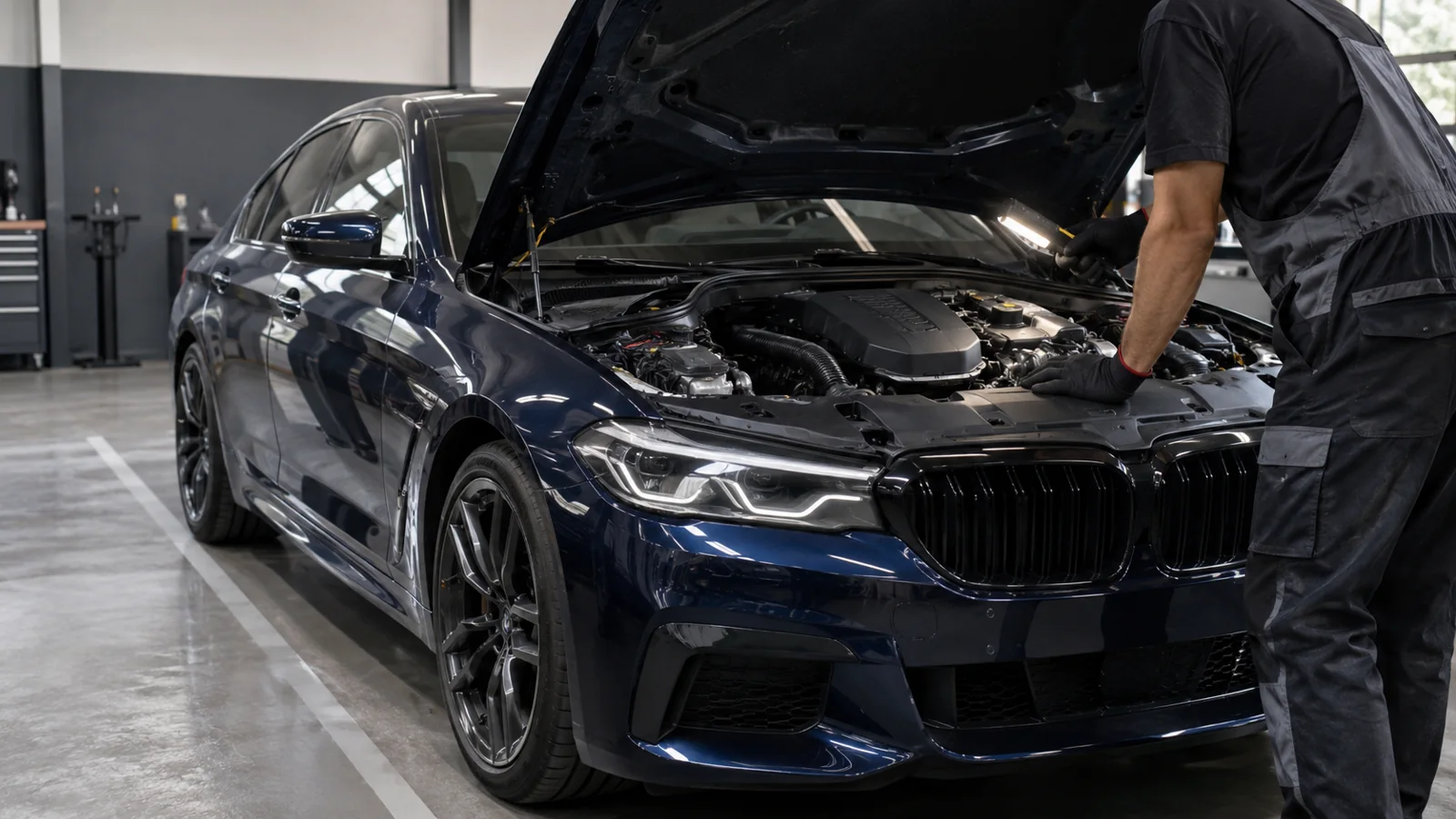
Check the accompanying symptoms first
A familiar sound that has not changed is different from a new noise with poor running, vibration or a warning message. Neither a quiet sound nor the absence of a fault code confirms that continued driving is safe. Start with what changed and how the car is behaving, rather than deciding whether the noise sounds expensive.
Severe knocking or grinding, strong vibration, smoke, an overheating or oil-pressure warning, a hanging component, or a marked change in power or control needs prompt attention. Stop as soon as it is safe, follow the displayed instruction and vehicle handbook, and discuss suitable assistance. Do not keep accelerating to reproduce the fault.
For a new sound without these signs, describe it to the workshop before deciding how to bring the car in. A phone clip cannot establish a safety clearance. Do not hold a phone while driving, work near moving belts or hot turbo and exhaust parts, or crawl under a car supported only by a jack. Running and underbody tests belong in an appropriately equipped workshop.
What the noise follows helps narrow the checks
The useful question is often what changes with the noise. Engine speed means revolutions per minute, or RPM; road speed means how fast the car is travelling. Pressing the accelerator can change both, as well as the load through the drivetrain, so a sound noticed during acceleration is not automatically an engine fault.
| Pattern you noticed | Candidates worth separating | What it cannot prove |
|---|---|---|
| Pitch rises with engine RPM | Engine, intake, turbo or driven accessories, depending on the fitted system. | It does not identify a turbo, pulley or timing component by sound alone. |
| Hum rises mainly with road speed | Tyres, wheel bearings or final-drive components. | It does not establish which wheel or assembly is responsible. |
| Noise begins under throttle and eases when load changes | Intake or exhaust leakage, mounts, driveshaft or final-drive behaviour. | Its disappearance when lifting off does not clear the drivetrain or prove a differential fault. |
| Clunk coincides with taking up drive or a gear change | Mounts, driveline joints, supports or a transmission-related event. | A clunk during a shift does not automatically mean the gearbox needs rebuilding. |
| Click changes while turning | Joint, wheel or suspension-related possibilities alongside the reported acceleration condition. | The description cannot identify the failed joint or side. |
| Rattle occurs within a narrow RPM range | A resonating shield, contact point or other component requiring localisation. | A resonance is not proof that the engine internals are damaged. |
Share approximate speed and RPM only if you already know them. Do not watch the instruments instead of the road, select neutral while moving or perform repeated hard acceleration to create a recording. A workshop can decide whether a controlled road test is appropriate after considering the symptoms.
Useful details to give the workshop
A short description with context is more useful than a long list of suspected parts. Say whether the sound seems to come from the engine bay, beneath the centre of the car, a wheel area or the rear. Sound travels through the body, so treat the apparent location as a clue rather than a confirmed source.
- Identify the vehicleShare model, year, mileage, engine if known and whether it has xDrive. The workshop can confirm the exact specification from the vehicle details.
- Describe the conditionSay whether the car was cold or warm, the noise appeared on light or stronger throttle, and it coincided with a shift, turn or uneven road.
- Describe the changeNote when it began and whether it followed servicing, tyre replacement, an impact or other repair.
- Keep associated symptoms separateReport vibration, hesitation, loss of power, smells, smoke and the exact warning message without assuming they share one cause.
Send an existing recording only if it was obtained safely. Do not place a phone beneath a running car or ask someone to lean into the engine bay to find a louder sound. If the event is intermittent, explain its frequency and the circumstances in which it has already happened.
Whistling hissing and exhaust rattles
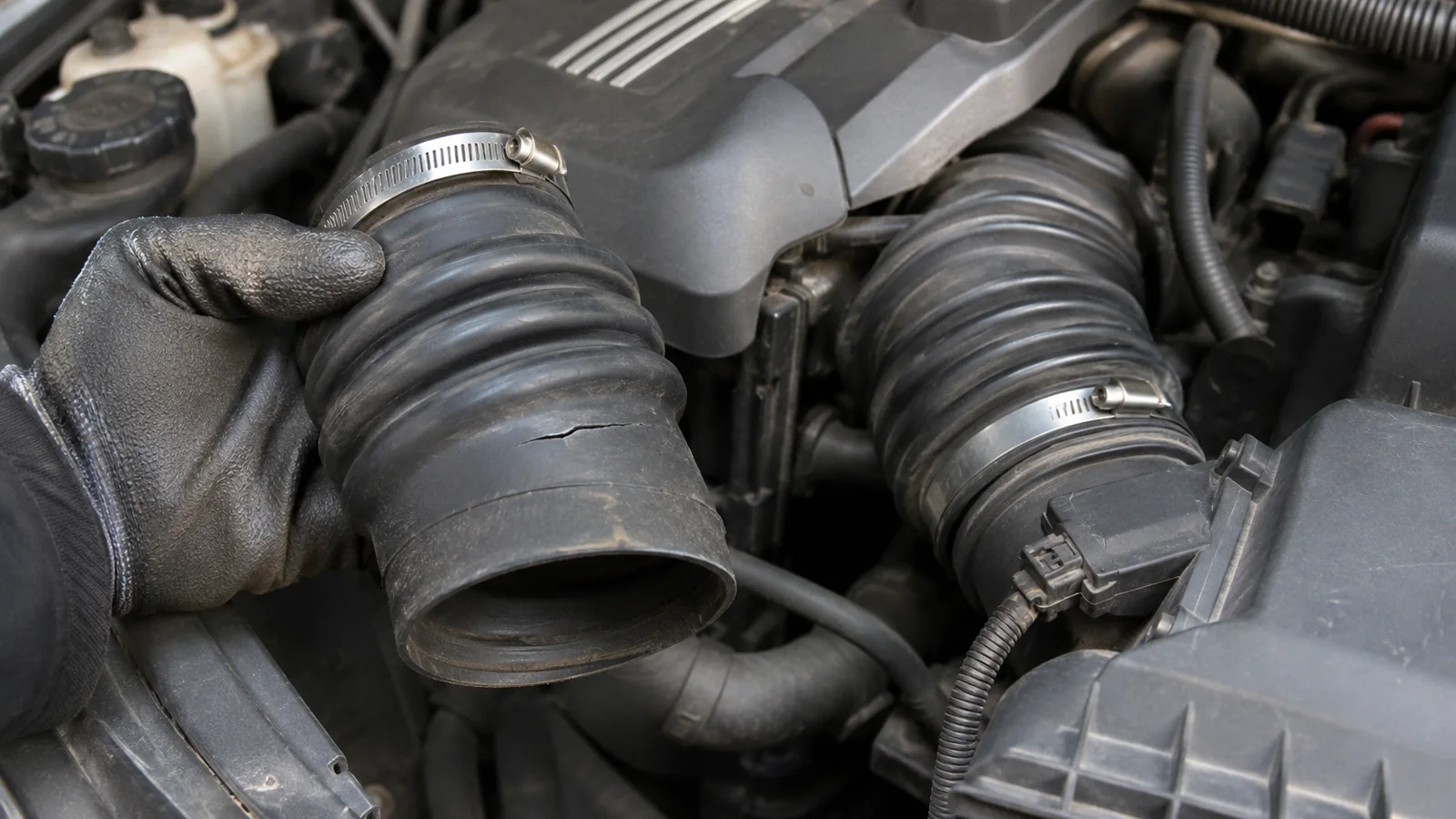
A new whistle or hiss under acceleration can lead to checks of intake pipework, charge-air connections and the turbo system where fitted. An exhaust leak or a loose support can also change the sound. The workshop needs to establish the source and whether it accompanies a pressure, airflow or performance problem.
Inspect the air path before condemning the turbo
A split hose or leaking connection may call for a smaller repair than a turbocharger replacement. The relevant air path depends on whether the engine is naturally aspirated or turbocharged and where the suspected leak lies. A visual inspection, applicable leak test and supporting diagnostic data should agree before a repair is chosen.
Garrett's turbo diagnostic guidance recommends checking pipework, brackets, connections and intercooler integrity for noisy performance. It also explains that another engine or system issue can be behind suspected turbo trouble. A whistle alone is not sufficient evidence to replace a turbo.
A metallic buzz needs its own location check
Exhaust shielding, supports or contact can produce a rattle that becomes noticeable under load. A workshop should check the actual fixing, attachment area and clearance rather than removing shielding or replacing the entire exhaust to silence it. The BMW exhaust-rattle guide explains those checks in more detail.
A familiar turbo sound may be part of a particular vehicle's established operation. A new, louder or changed sound, especially with reduced power or another symptom, deserves assessment rather than a blanket “normal turbo noise” label.
Engine knocks ticks and accessory squeals
Knocking, rattling and ticking describe different experiences but are not diagnoses. A technician needs the engine specification, sound location, operating condition and relevant measurements before deciding whether the cause involves combustion, an accessory or an internal mechanism. A misfire fault entry does not by itself prove an injector or spark plug caused every reported sound.
Belts pulleys and driven accessories
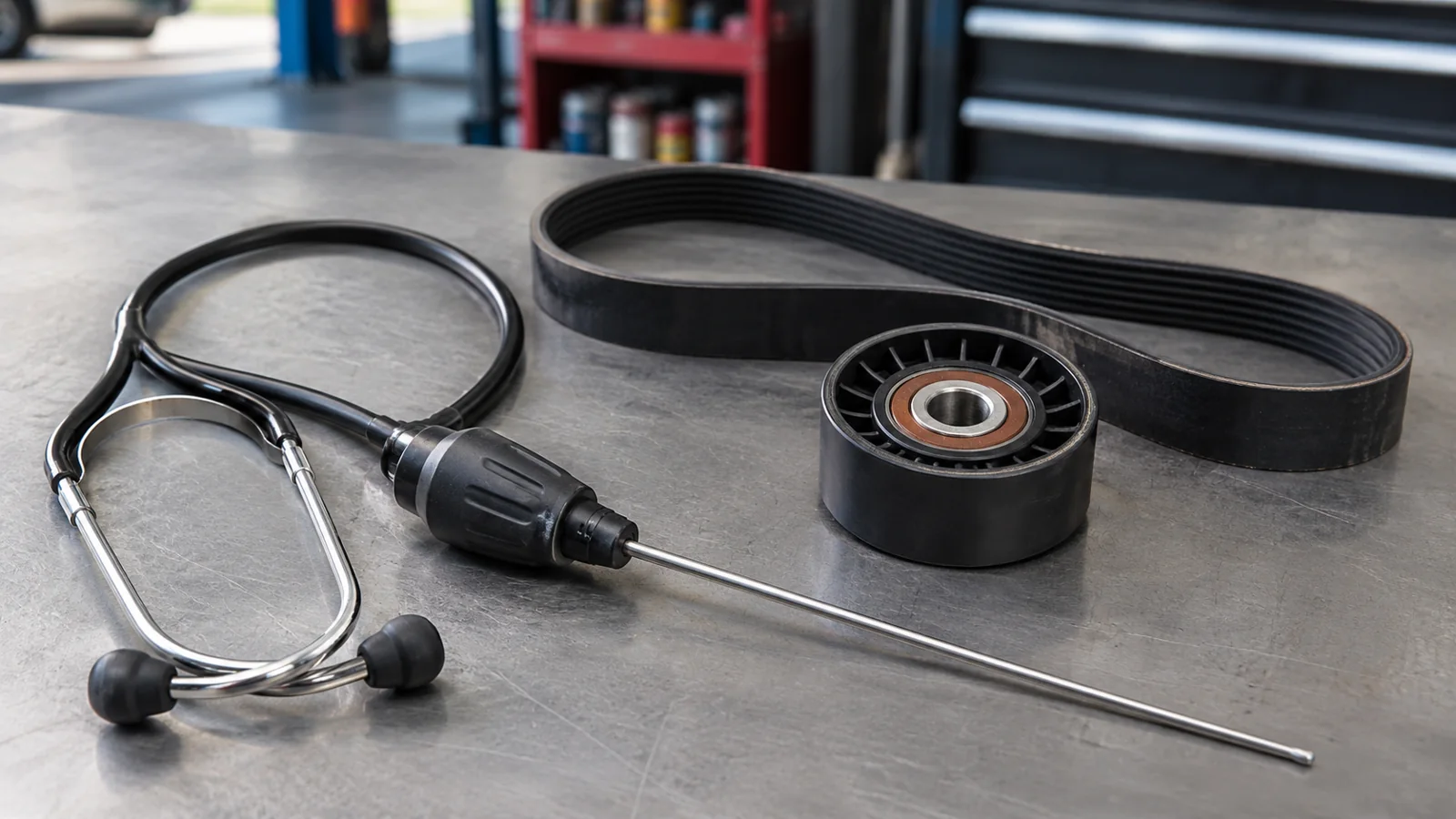
A squeal or chirp can prompt checks of belt condition, tracking, tensioning and driven components. Replacing the belt without identifying why it is noisy can leave the same problem in place. Stethoscope use and other localisation checks near a running engine require professional precautions; they are not owner instructions.
The BMW pulley-noise guide covers that narrower subject. For a sound centred on the engine, the BMW engine-noise guide addresses a different set of checks and urgency considerations.
Why engine and production details matter
BMW SI B11 03 17 describes lower-engine whine that increases with RPM on listed N20/N26 applications produced before March 2013. It associates that specific condition with oil-pump chain-drive sprocket wear. It demonstrates why a whine cannot universally be labelled turbo or transmission noise.
This historical BMW North America bulletin is a limited technical example, not a diagnosis for every N20/N26 engine, a recall notice or evidence of UAE warranty coverage. A workshop must confirm the actual vehicle and current applicable information before following any repair route.
Road speed and load can point beyond the engine
A hum that increases as the car travels faster needs tyre, wheel-bearing and final-drive possibilities separated. Acceleration may simply be when the driver first notices the rising speed. A change with the road surface, steering or load is useful information, but none of these clues identifies a component reliably on its own.
Driveshaft joints supports and mounts
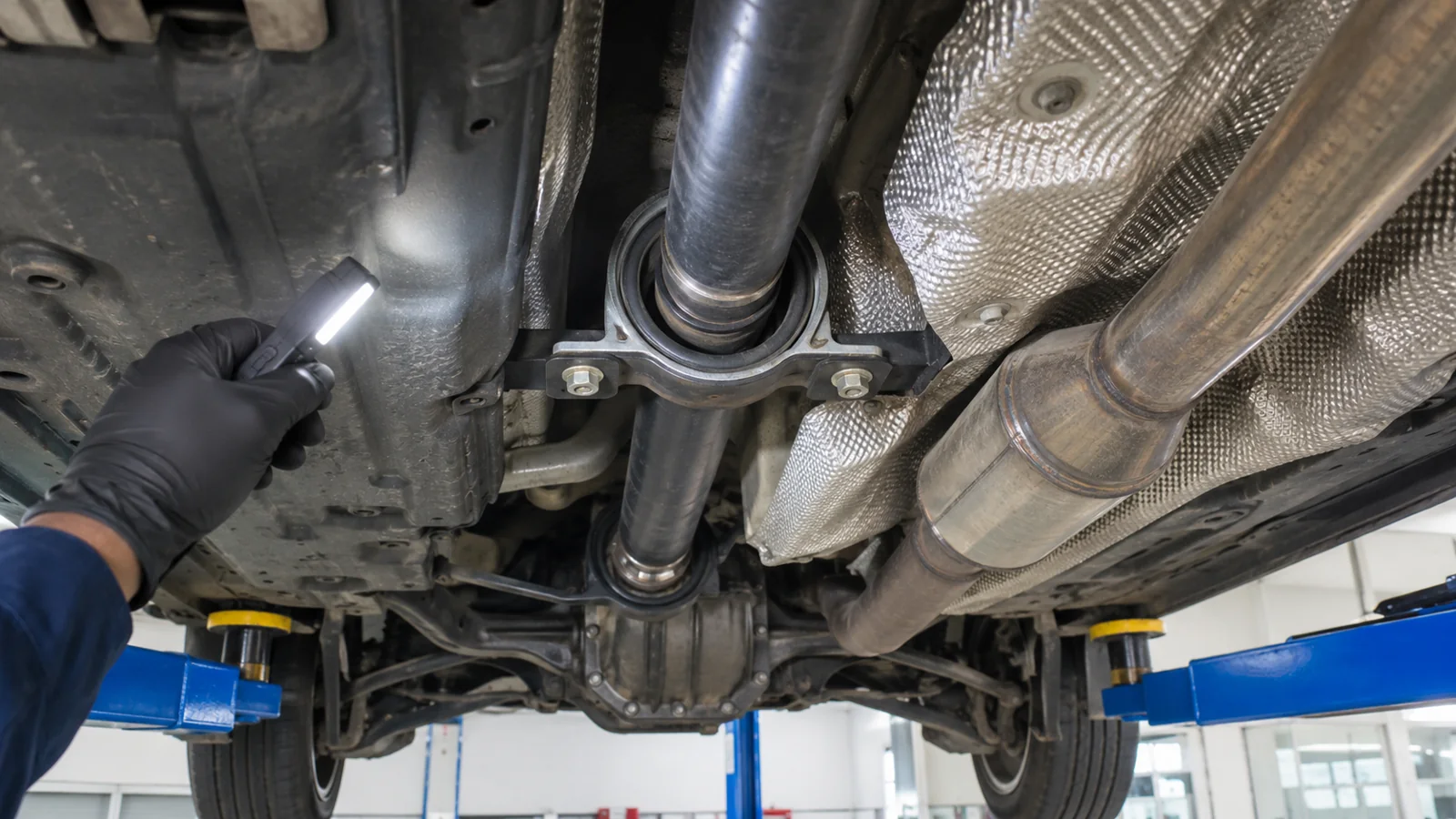
A clunk as drive is taken up or vibration under load may lead to checks of mounts, joints, couplings and driveshaft supports where fitted. The inspection should establish deterioration, abnormal movement, contact or another relevant defect. Replacing a visible rubber part without connecting it to the complaint is an incomplete explanation.
BMW SI B26 01 16 concerns acceleration-related centre-of-vehicle knocking or vibration on F34/F36 xDrive vehicles built up to July 2015. That specific BMW driveshaft bulletin shows the importance of drivetrain and build limits. It is not a universal explanation for an acceleration clunk or a reason to replace every similar-looking shaft.
Differential and transmission possibilities
A final-drive whine may change with load, while a transmission concern may be associated with a particular shift, ratio or other operating event. These patterns can overlap with mounts, tyres and bearings. The BMW differential-noise guide explains the final-drive distinction more closely.
Ask what evidence separates a transmission or differential fault from the alternatives. A scan is useful where relevant, but mechanical noise can require physical inspection and targeted measurements even when no fault code is stored. Conversely, a stored code does not establish the source of every noise.
What the assessment should establish
The first assessment should identify a supported finding or explain the next test needed. It should not automatically become a quotation for the most expensive candidate on a parts list. Agree the initial scope and charge before leaving the car, including whether further tracing requires separate approval.
- Confirm the complaint and conditions
- Compare your description with the actual event when it can be assessed safely. A cold-only problem may require different scheduling from a warm running noise.
- Localise the source
- Separate engine RPM, road speed, load and shift effects. The technician decides which controlled checks are suitable; not every complaint needs a road test.
- Inspect and measure the relevant system
- Combine applicable fault information with physical checks, leak testing or other targeted measurements. Explain what was tested and any access limits.
- Connect the finding to the proposed repair
- Show the defect or explain the test result supporting it. Distinguish a confirmed repair from a further diagnostic step.
- Confirm the result
- Reassess the original condition when safe and practical, and document remaining symptoms or limits rather than claiming every noise is resolved.
If a noise cannot be reproduced during the visit, that does not establish that nothing is wrong. The workshop should record the conditions assessed, any verified defect and what remains uncertain. Further work should have a clear purpose before it is approved.
Choose the repair from the finding
A useful quotation explains why the work is necessary and what result it is intended to achieve. Some faults can be corrected at a connection, fixing or support; others require a component or assembly. The actual finding, serviceability and vehicle-specific parts determine that choice.
| Confirmed finding | Possible repair route | What to clarify |
|---|---|---|
| Leaking hose or connection | A compatible hose, seal or connection repair. | Which part of the air path was tested and how sealing will be checked afterwards. |
| Shield or exhaust contact | Restore a sound attachment and correct clearance. | Condition of the mounting area and retained heat protection. |
| Accessory-drive defect | Repair the confirmed belt, tensioning, alignment or driven-component issue. | Why the proposed part addresses the cause rather than only the sound. |
| Driveline support or joint defect | Applicable component or assembly work. | Fitment, associated damage and verification under the relevant condition. |
| Internal engine or transmission concern | Further scoped testing or repair supported by the evidence. | What is confirmed, what remains uncertain and what needs separate approval. |
The BMW noise-assessment service covers workshop assessment and enquiry details. An initial diagnostic charge is separate from a confirmed repair quotation. Ask for parts, labour, exclusions, any additional access work and the verification included. Completion time depends on the diagnosis, access and parts availability; there is no reliable universal timetable for “acceleration noise”.
Maintenance advice needs the actual vehicle
Use the fuel grade and maintenance requirements specified for your BMW. Higher-priced fuel is not a universal cure for knocking, and a fuel change cannot establish why a mechanical sound occurs. Report a persistent or changed sound instead of trying to mask it with products or repeated driving.
Transmission fluid specification, level-check conditions and service procedures depend on the fitted transmission. Leave checks that require temperature control, special access or equipment to the workshop. Do not apply a generic top-up method across BMW gearboxes.
Software is relevant only where an applicable issue and diagnostic findings support it. An update is not routine treatment for an unidentified rattle or whine. After repair, keep the findings and part details so a returning symptom can be compared with the original condition.
BMW acceleration-noise questions
Can I keep driving with a noise under acceleration
A description alone cannot establish safe driving. Report warnings, vibration, smoke, power changes and the severity of the noise before arranging the visit. With concerning signs, stop as soon as safe and discuss assistance instead of continuing to test the car.
Why does the noise disappear when I release the accelerator
Releasing the accelerator changes engine operation and load through several systems. That can alter an air leak, exhaust resonance, mount movement or driveline sound. It is a useful condition to report, but it does not identify a failed component.
Does a whistle mean the turbo needs replacing
No. Pipework, connections and associated systems need checking before a turbo decision. Whether the sound is new and whether it accompanies a performance change also matter. A sound recording cannot replace those checks.
Can tyres or wheel bearings sound like an engine problem
A road-speed-related hum can be heard while accelerating and may be mistaken for an engine sound. A workshop needs to separate tyre, bearing and drivetrain possibilities rather than deciding from the apparent cabin location alone.
Why can there be a noise without a warning light
A mechanical contact, support or other noise may not produce a monitored fault code. A clear scan therefore does not complete the diagnosis. Inspection and appropriate condition-specific checks may still be needed.
What should I ask before approving replacement parts
Ask which finding supports the repair, which alternatives were ruled out and how the result will be checked. If the proposed work is further investigation rather than a confirmed repair, its purpose, scope and charge should be clear.
Independent BMW workshop in Al Quoz
Discuss your acceleration-noise symptoms
Share your model, year, mileage, where the sound seems to come from, when it occurs and any warnings or change in performance. Include a recording only if it was obtained safely. Confirm the assessment scope and charge before the visit; discuss suitable assistance first if driving may be unsafe.
Independent BMW specialist. Not affiliated with BMW AG.