
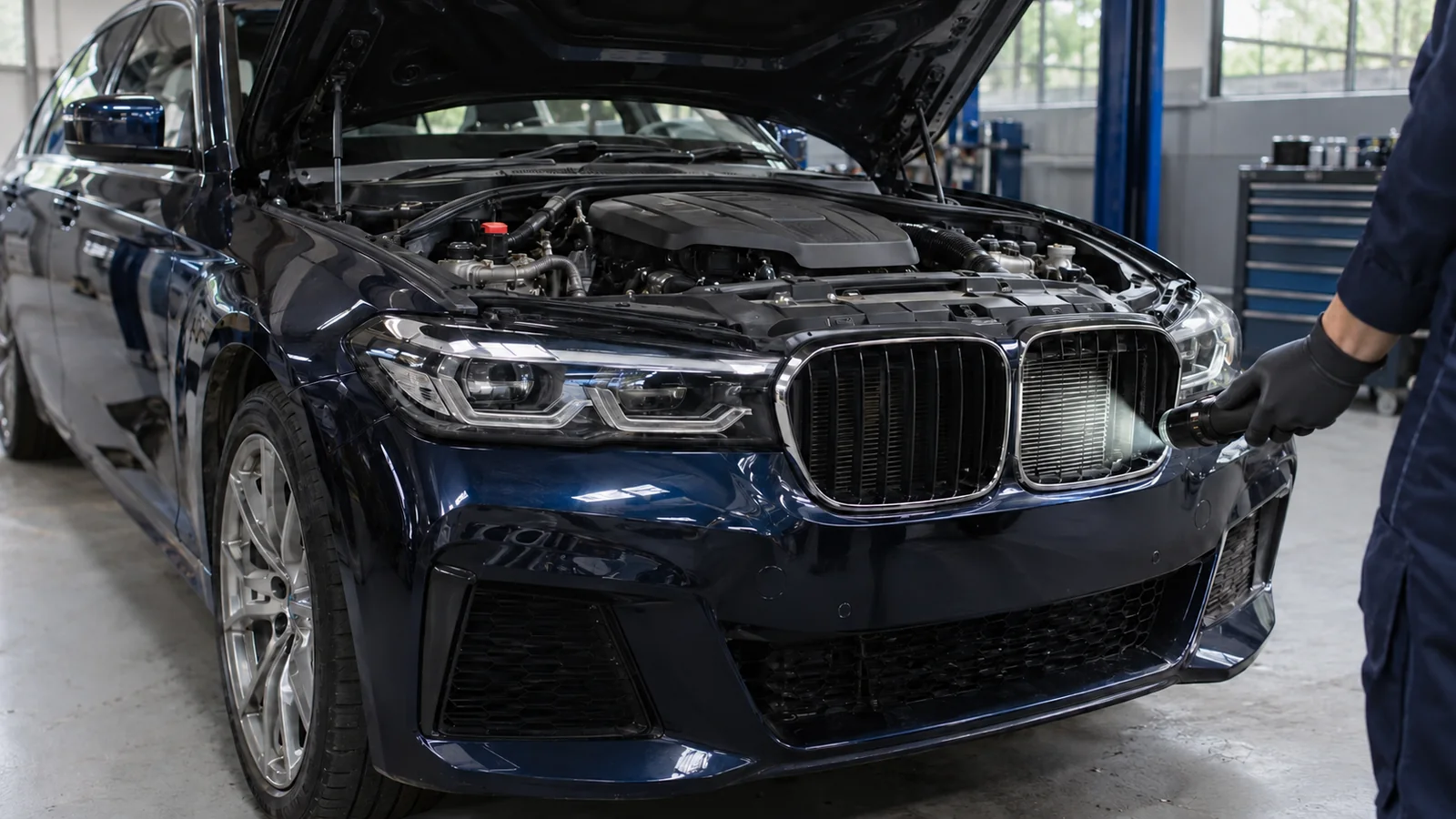
Put the warning ahead of the inspection
Hot pressurised coolant can escape and scald you. Do not remove the expansion-tank or radiator cap to check a level, investigate bubbles or add fluid while hot. Keep clear of escaping steam and follow the vehicle’s instructions before opening the bonnet.
For an overheating warning, steam or rapid coolant loss, pull over where safe, switch off the engine and discuss recovery. Do not keep driving to reach a workshop or restart the engine repeatedly to see whether the warning clears. A normal-looking display afterwards does not prove the fault has been repaired.
A low-coolant message also needs attention. Stop safely and use the handbook to assess the next step once the system is fully cold. An empty reservoir, an active leak, a level that cannot be maintained or recent overheating calls for assistance rather than a trial journey.
There is no universal safe driving distance or cooling-down time for every BMW. Tell the assistance provider the exact message, whether steam appeared and whether coolant was added. Confirm roadside assistance or recovery arrangements before relying on a dispatch.
Which signs suggest coolant loss
Repeated coolant loss, damp connections or dried deposits justify investigation. They do not, on their own, establish that the radiator needs replacement. Record what you can observe safely without touching hot parts or reaching near fans and belts.
| What you notice | What it can suggest | What still needs checking |
|---|---|---|
| Wetness at a radiator edge | A nearby seam, core or connection may be leaking | The actual escape point rather than fluid running down from above |
| A puddle under the front | Fluid has reached the floor | Fluid identity and its route over covers or the undertray |
| Low coolant without a puddle | A concealed, intermittent or internal loss is possible | The correct circuit and tests for the reported pattern |
| Temperature warning or poor heater output | A cooling or heating-system fault needs assessment | Leakage, circulation, airflow and control as relevant |
Clear water after AC use may be condensate. Coolant colours vary, and colour or smell alone cannot identify the fluid or its approval. Do not touch or taste an unknown puddle. Note the cold coolant level and seek advice if fluid loss is uncertain.
Persistent white exhaust with coolant loss needs a separate investigation for possible internal coolant entry. An external hole in a radiator does not directly send coolant into a cylinder. It also does not follow that white exhaust proves a failed head gasket. Fel-Pro explains the internal head-gasket leak mechanism; diagnosis must establish the actual fault.
Bubbling is not a reliable owner test for a radiator leak. Trapped air, boiling and combustion-gas entry require different interpretations. Do not open or run a hot system to watch for bubbles.
Where a radiator leak can start
Inspect the radiator and its connections as separate parts. Many contemporary radiators combine an aluminium core with plastic end tanks, while other constructions exist. The Nissens radiator overview shows why construction matters. Confirm the actual unit fitted to your BMW before choosing a repair.
Core tubes and surrounding fins
The tubes carry coolant and the fins help transfer heat to air. Damage or corrosion affecting a tube can allow leakage. Bent fins alone do not prove a coolant leak, and coolant on the face may have come from an adjacent component. The finding should identify the damaged area and whether it leaks.
End tanks and their seams
Inspect the plastic tank body and its joint to the core. A crack, a joint leak and residue from an earlier spill are different findings. Deposits help direct the inspection, but current leakage must be confirmed before the part is condemned.
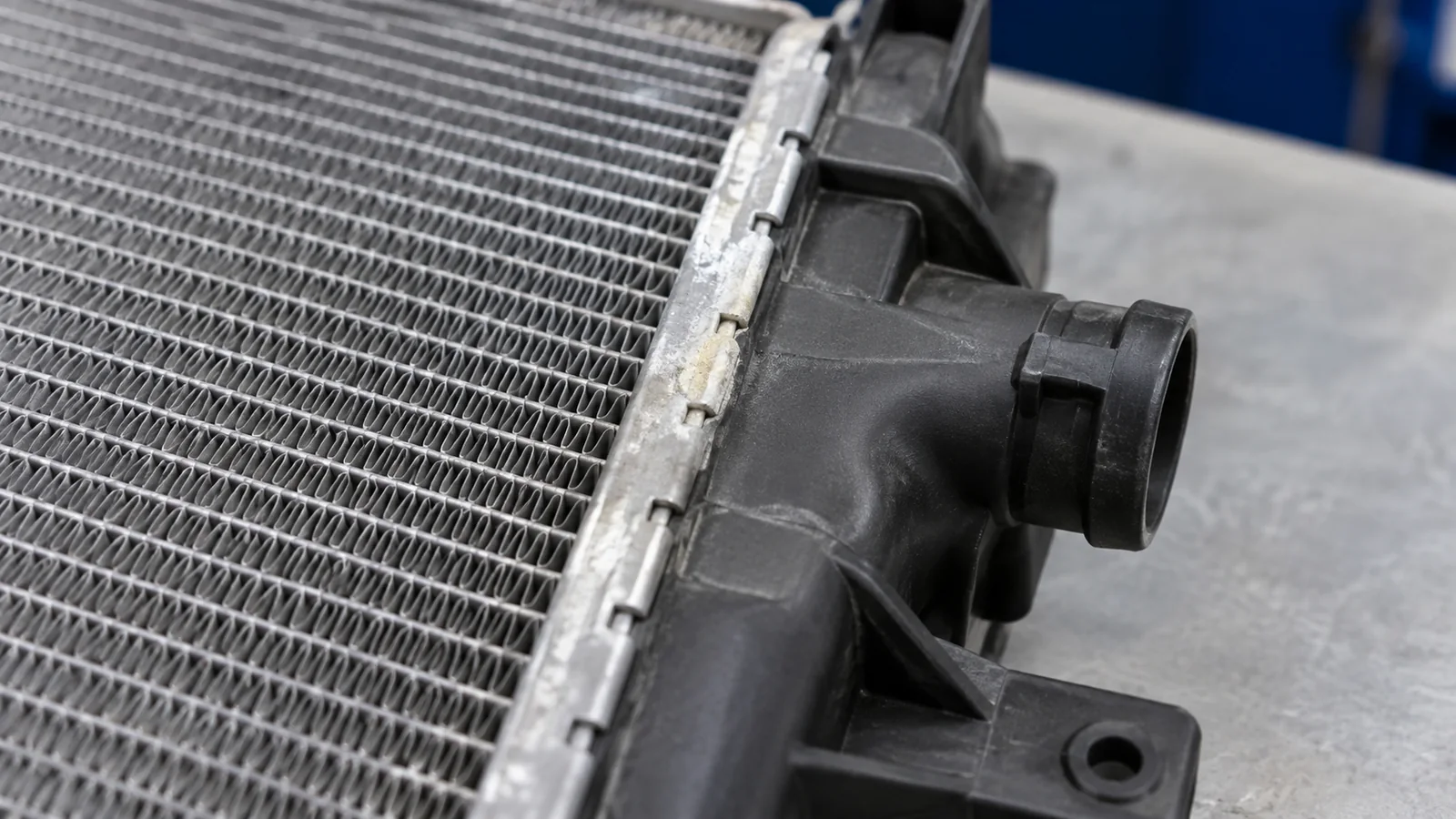
Hose necks and quick connections
A wet connection may involve a hose, retaining clip, sealing ring or the radiator’s moulded neck. Replacing a connector seal cannot repair a broken neck, while replacing a sound radiator may be unnecessary when a separate connection is responsible. Check both mating surfaces and the supplied repair scope.
Coolant from a reservoir, pump, thermostat housing or another pipe can reach the same area. If the radiator is not confirmed as the source, use the broader BMW coolant-leak diagnosis service rather than treating every front-end drip as a radiator job.
What you can check with the engine cold
Use the handbook for the exact model, engine and cooling circuit. Reservoir locations and level indicators differ. Some vehicles have more than one circuit, and the AC condenser contains refrigerant rather than engine coolant. Do not assume every front heat exchanger or reservoir belongs to the same system.
- Compare cold levelsUse the prescribed conditions and indicator. A hot reading is not a like-for-like comparison with an earlier cold reading.
- Look without disturbing partsNote visible wetness, deposits or damaged connections. Do not remove covers or hoses to search deeper.
- Record the historyKeep the date, quantity and product details of any top-up, plus recent repairs and warning messages.
- Respect the stopping pointIf the correct reservoir, level or condition is unclear, ask for help instead of opening an unfamiliar system.
A top-up does not seal a leak. Add coolant only when fully cold and when the vehicle instructions and circumstances support doing so. Use the specified product and preparation; a matching colour does not establish compatibility. Do not continue driving simply because a warning disappears after filling.
The BMW-authored 2024 X3 handbook, printed pages 367–368, warns about hot-system scalding and describes model-dependent reservoir arrangements and cold checks. It is an example; use your own vehicle and market-specific handbook.
What workshop testing should establish
The useful result is a finding that connects the complaint to the proposed work. Ask which part is leaking, what evidence supports that conclusion and whether further testing is needed. Diagnosis comes before a replacement decision.
- Identify the vehicle and circuitConfirm the engine, fitted radiator, recent work and warning history. Additional or low-temperature cooling circuits can require different parts and procedures.
- Inspect the source of the traceFollow wetness and deposits back to an accessible source. Separate an active leak from an old spill and check nearby hose connections before condemning the radiator.
- Choose the appropriate leak testUse the correct adapter, safe system conditions and specified test pressure. Check the pressure cap separately where indicated. A pressure drop needs interpretation, not an automatic parts order.
- Investigate what remains unexplainedA fault that appears only under particular conditions may need further controlled checks. Compatible tracer dye may be appropriate. If internal loss is suspected, select relevant engine-condition tests rather than assuming a radiator fault.
- Explain the findings and limitsAgree the repair or next diagnostic stage and its charge. An inconclusive test should be reported as such.
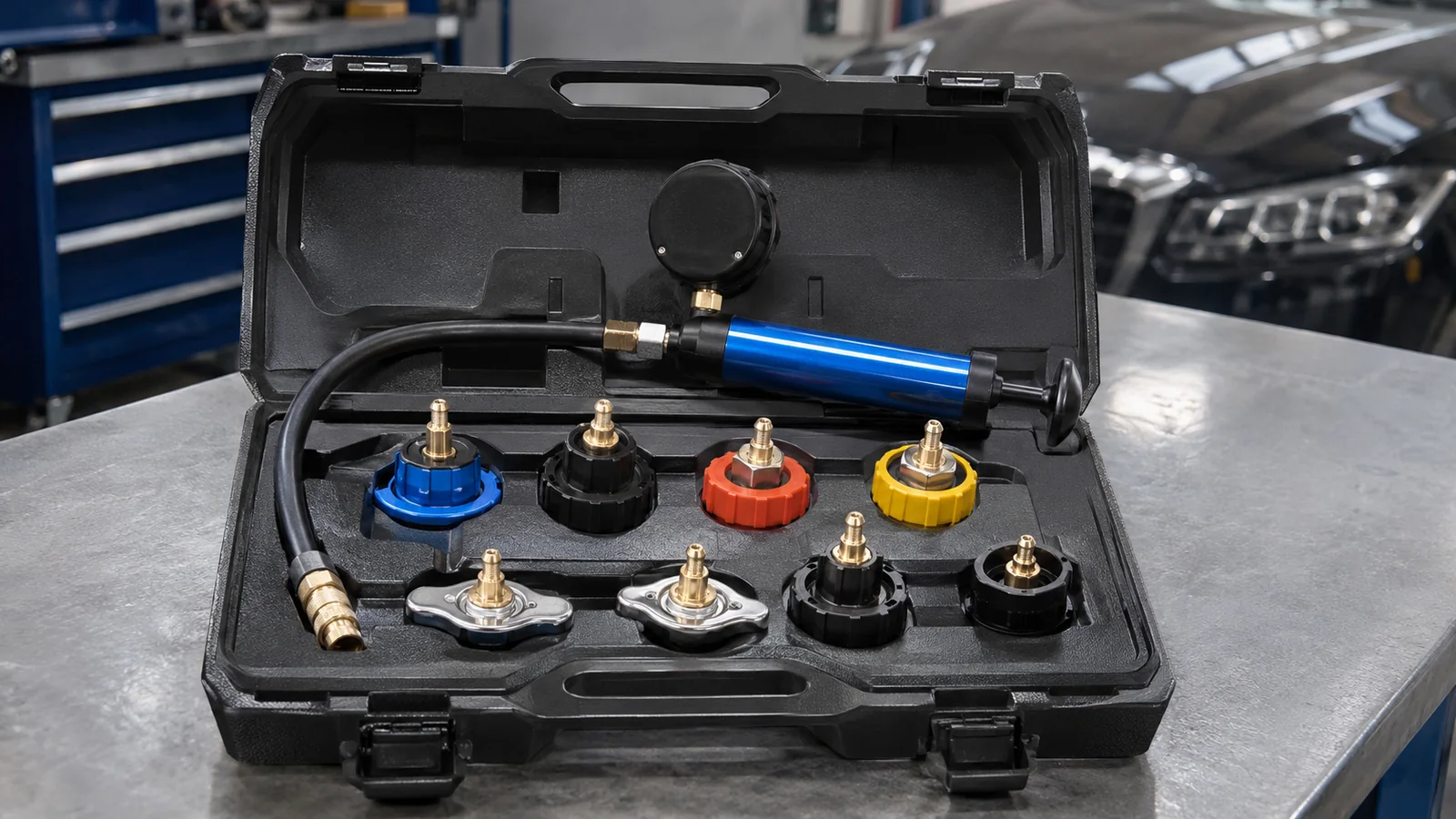
A system holding pressure during one test does not prove that fan operation, pump performance or thermostat control is correct. If overheating was part of the complaint, those questions may also need assessment. HELLA’s diagnostic guidance treats temperature indication, airflow and circulation as separate checks.
Choose repair or replacement from the finding
A smaller connected-part repair can be appropriate when the radiator itself is sound. A damaged radiator assembly needs a different decision. Compare what has actually failed, the available approved repair method and the expected verification.
When a connection repair may be sufficient
If testing identifies a serviceable hose, connector or sealing ring, repair that confirmed fault and inspect its mating surfaces. Check for a damaged neck, distorted joint or broken retaining feature that would prevent the new seal from working correctly. Related work should follow evidence or installation requirements rather than an automatic complete-system replacement.
When the radiator needs further repair assessment
A specialist repair is only an option when it suits the construction and damage. A cracked plastic tank, a leaking seam, an impact-damaged tube and widespread deterioration cannot be treated as interchangeable small leaks. Ask whether the method is supported for the application and how the repaired assembly will be checked.
When replacement is justified
Replacement may be the appropriate route when the confirmed damage cannot be reliably repaired by a suitable method. Select the correct part number and specification, including necks, mounting points and any integrated connections. A model badge or similar appearance is not enough to establish fitment.
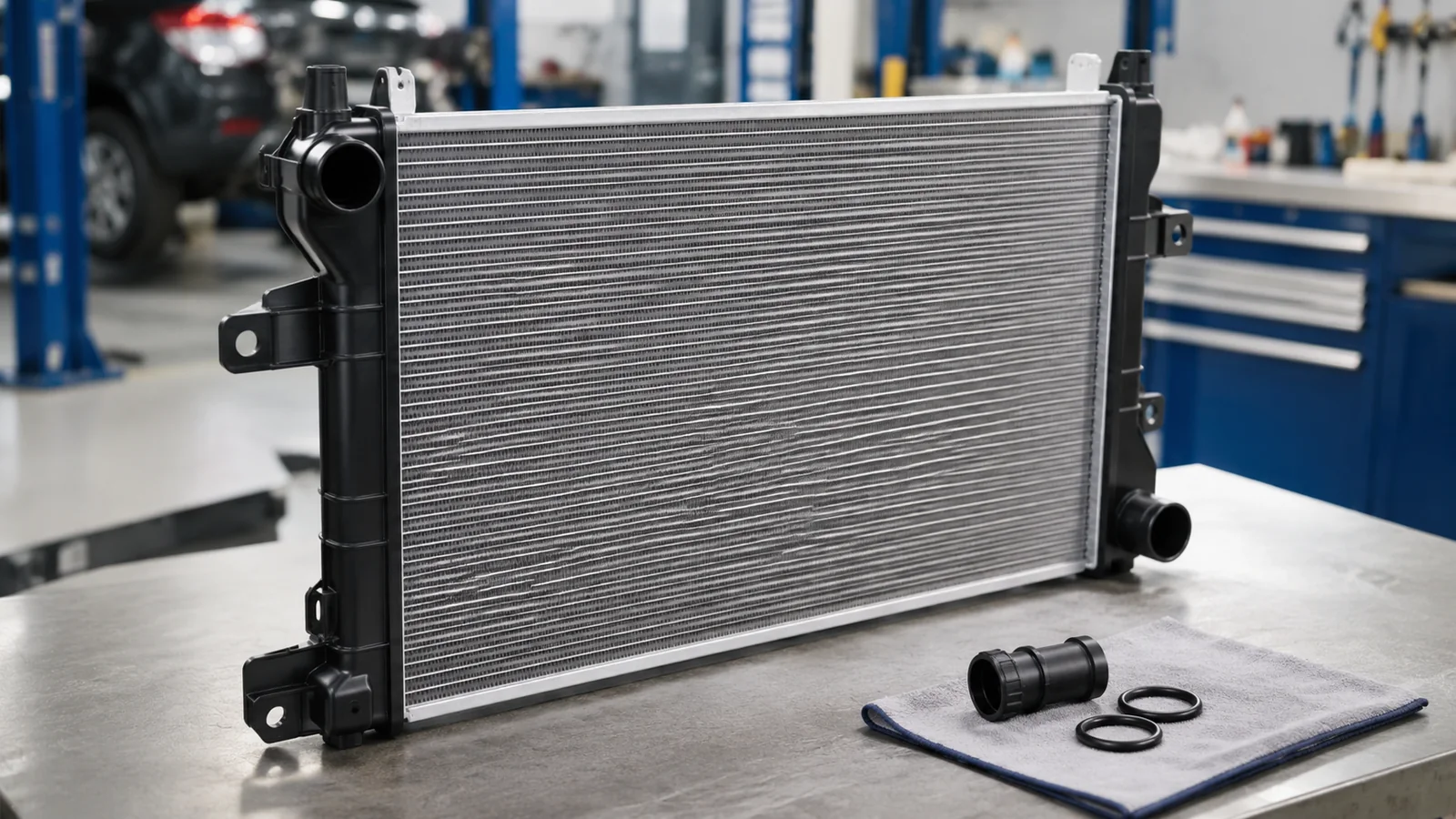
Avoid stop-leak products without vehicle-manufacturer approval. Ask why the proposed repair method suits the confirmed damage. The BMW radiator repair and replacement service explains the professional repair scope and quotation process.
Finish with filling and verification
Replacing the leaking part is only one stage. The opened circuit must be filled with the correct coolant and prepared using the procedure for that vehicle. A flush is not automatically required after every radiator repair; contamination, an unsuitable mixture or the applicable repair instructions may change the work needed.
Bleeding removes air that can affect circulation and level readings. Some systems call for vacuum filling or diagnostic service functions. Do not copy an ignition-and-pedal routine from another BMW. HELLA’s filling, bleeding and leak-testing guidance describes general methods; the actual instructions remain vehicle-specific.
The workshop should explain the repaired leak, coolant used, required filling procedure and verification completed. Relevant checks can include leak-tightness, operating behaviour, warning status and the level after cooling. A road test is only appropriate when the vehicle’s condition allows it.
Keep the repair record and follow the agreed cold-level recheck instructions. A returning warning, falling level, fresh leak or overheating needs reassessment. Do not accept repeated refilling as the normal long-term outcome of the repair.
Compare the complete repair quote
A hose-seal repair and radiator replacement are different jobs. Before comparing prices, ask for the confirmed fault, proposed part and complete fitted scope. An initial diagnostic charge may be separate from the approved repair.
- Identify the part brand, number and fitment basis.
- Confirm labour, coolant, seals, filling and verification inclusions.
- Ask whether recovery and additional diagnosis are included.
- Separate necessary work from optional related work and agree any additional approval limit.
- Get the applicable parts and labour warranty terms in writing.
Do not compare a parts-only radiator listing with a fitted repair, or add an hourly labour estimate to a quote that already includes labour. Confirm current availability and completion expectations after the part and work are identified.
Reduce repeat problems without replacing parts blindly
Investigate recurring loss, retain coolant and repair records, and follow the vehicle’s servicing requirements. An inspection can identify visible deterioration; it cannot guarantee that no future leak will occur. Use the service requirements for your engine rather than assuming one inspection or flush interval applies to every BMW.
Have the radiator air path and neighbouring heat exchangers checked when damaged or obstructed. Avoid pushing tools through the grille or using close-range high-pressure cleaning on delicate fins. Airflow maintenance does not repair a leak, and replacing a radiator does not automatically correct a fan or circulation fault.
For wider maintenance decisions, read how to prevent BMW engine overheating. Keep an existing warning or active leak ahead of routine prevention.
BMW radiator leak questions
Does a puddle at the front prove the radiator is leaking
No. Fluid can travel along components and undertrays. Identify the fluid and confirm its escape point before choosing a repair.
Can I drive if the leak looks small
Puddle size does not establish a safe journey. For overheating, steam or rapid loss, stop safely, switch off and discuss recovery. Follow the handbook for other warnings.
Can I open the cap after waiting a few minutes
There is no universal waiting time. Never open a hot cooling system. Let it cool fully and follow the vehicle’s instructions.
Does white exhaust mean I need a new radiator
No. Persistent white exhaust with coolant loss can require investigation of internal coolant entry. It does not prove a radiator or head-gasket replacement is needed.
Does a pressure test identify every cooling fault
No. It helps investigate leakage under the test conditions. Fan, pump, thermostat and intermittent operating faults may need different checks.
Will a coolant flush stop the leak
A flush does not repair a cracked component or failed seal. First identify and repair the fault, then perform the required coolant service.
Does every leak require the whole radiator to be replaced
No. A confirmed hose or connection fault may be repaired while retaining a sound radiator. The decision depends on the finding and the applicable repair method.
Independent BMW workshop in Al Quoz
Discuss your BMW coolant-loss concern
Share the model, year, exact warning, recent top-ups and any safe observations. Ask about the assessment scope and charge before approving work. Mention overheating or active loss when discussing suitable recovery.
Independent BMW specialist. Not affiliated with BMW AG.