

Check for changed steering before investigating the sound
Follow any instruction to stop. New heaviness, binding, unexpected free play, instability or a sudden change in steering response needs suitable assistance and assessment before deciding how to move the BMW. A car still starting, or a noise sounding quiet, does not establish that steering is safe.
Describe the warning and the change in feel first. A controlled professional road test may be useful after assessing the vehicle, but it is not a universal first step for an owner with an unexplained steering concern.
If the sound appears to be a light cabin rub and steering feels unchanged, record the observations you already have and ask about the appropriate assessment. Do not repeatedly turn against the stops, force a binding wheel or provoke a noise on rough roads. The exact handbook and fitted system govern operation.
Owners should not remove a steering wheel or airbag, dismantle the column, spray lubricant into trim openings or get underneath an unsupported car. If recovery is needed from a Dubai basement, explain access height, whether the wheels can move and any braking or steering concern so suitable equipment can be arranged.
Compare the sound with the condition in which it occurs
Location and timing are often more useful than a description such as “steering noise”. A sound linked to steering-wheel movement while parked differs from a hum linked to road speed. Sound can travel through the structure, so the place where you hear it is not always its source.
| What you noticed | Useful distinction | What the workshop may need to check |
|---|---|---|
| Rub or squeak near the wheel or dashboard | Cabin contact and column concerns differ from road-wheel bearing noise | Localise trim, spindle or support contact and assess the actual column system |
| Creak or knock near a front corner | Steering input and suspension movement can load different components | Relevant joints, mounts, bushes, tyre clearance and steering connections |
| Whine on a hydraulic-assisted vehicle | Hydraulic condition must be assessed on a system that actually uses fluid | Correct fluid specification, level, leakage, supply and pump operation where indicated |
| Hum or growl mainly while moving | Vehicle speed is a different clue from steering-wheel rotation | Tyre, hub-bearing and related road-wheel concerns using appropriate checks |
| Noise with a warning or changed effort | The control concern takes priority over identifying the sound | Follow the warning and assess the fitted electrical and mechanical systems |
Use this comparison to explain an existing symptom, not as a list of driving tests. Note whether the noise was noticed parked, moving slowly, over a bump or after recent work. Do not recreate an unsafe event to complete the table.
Establish whether the BMW has hydraulic or electric assistance
Steering equipment varies with model, generation, powertrain and specification. Hydraulic systems use a pump and fluid circuit; electric power steering, or EPS, uses electrical assistance and does not have the same hydraulic-fluid service. A broad E90, X5 or 1 Series label is not enough to choose a repair procedure.
Give the workshop the model, year and relevant vehicle details, and use the matching handbook. BMW's Driver's Guide description explains access to model-specific information using the VIN. Share identifying details privately with the workshop rather than posting a VIN publicly.
A fluid top-up cannot diagnose an EPS noise. Conversely, a hydraulic whine should not automatically lead to an electric-rack repair. The steering assessment service should establish the equipment and complaint before proposing work.
Localise the noise before choosing a component
Sounds near the steering wheel and column
A rub, squeak or click close to the dashboard may involve contact between parts, a column or spindle support, or another fitted component. It should not be labelled a steering-rack fault simply because it occurs during a turn. Ask whether the sound was actually traced to the cabin, shaft passage or another location.
For specified E70 and E71 vehicles, BMW's historical steering-column noise bulletin describes a boot-position or plastic-bearing lubrication concern and directs the workshop to the relevant diagnosis. This is a model-specific BMW North America example, not a recall or a general instruction to lubricate every BMW column.
The useful lesson is to inspect the contact or support involved before selecting a repair. Do not copy a forum's spray location, remove restraint components or assume an electronic switch assembly is defective from a sound. Access and any adjustment or lubrication must follow the procedure for the fitted vehicle.

Sounds near the front wheels and suspension
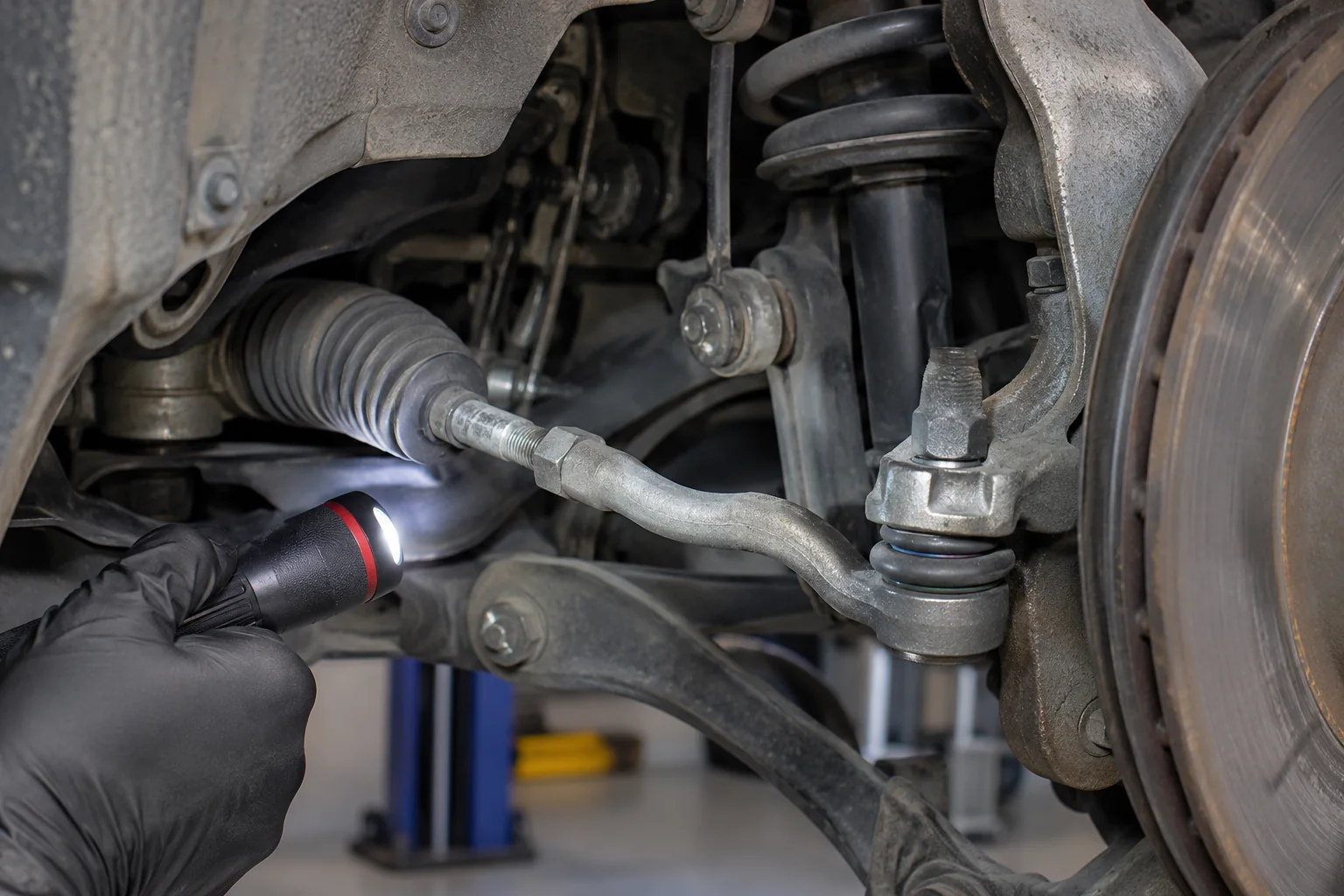
Tie rods, ball joints, bushes, mounts, tyre contact and steering connections can be relevant depending on the condition. A creak while steering and a knock over a bump may not come from the same part. A sound description alone cannot identify which joint or side needs replacement.
Component manufacturer SIDEM's tie-rod inspection guidance covers physical joint and gaiter checks. These are workshop procedures, not an invitation to lift the vehicle at home. The technician needs suitable support, access and the appropriate test method.
If bumps and suspension movement are the main trigger, the suspension-noise guide covers that adjacent concern. If the sound mainly follows vehicle speed, the wheel-bearing noise guide is a different diagnostic path. Road-wheel hub bearings and steering-column bearings are not interchangeable terms.
Whining on a hydraulic-assisted system
A hydraulic concern needs more than the observation that fluid is low or a pump is noisy. The correct fluid specification, level and condition, signs of leakage and the relevant supply components may need checking. A leak, an unsuitable fluid or another circuit concern can change the repair needed.
Do not add an arbitrary fluid, overfill a reservoir or treat repeated top-ups as a completed repair. A workshop should explain where loss or air entry is occurring if applicable and what findings support a pump diagnosis. The hydraulic steering-leak service is relevant where that equipment and concern are actually present.
Noises on an EPS-equipped BMW
With EPS, the investigation accounts for the electrical assistance, relevant fault records and mechanical steering assembly. An electrical warning does not automatically prove an internal rack failure. Supply, wiring, communication or another finding may need assessment alongside the noise and steering feel.
Not every mechanical sound will produce a fault code, and a stored code does not by itself establish today's cause. Ask which findings connect the complaint to the proposed work. A general software update, reset or calibration is not a universal noise cure. The steering-malfunction service is useful when a warning or change in assistance is part of the complaint.

Record useful details with the car safely parked
Write down the first observation and the exact warning wording. Keep a recording that was already obtained safely, but do not film while driving or repeatedly operate the steering to reproduce a concerning noise.
- Describe whether it seems near the steering wheel, footwell, engine bay or a front corner, allowing for sound travelling through the car.
- Note whether it was noticed parked or moving, cold or warm, during ordinary steering or over a bump.
- Report heaviness, binding, free play, pulling, vibration or any unexpected change in response.
- Mention recent tyre, alignment, suspension, steering or battery work and keep the relevant invoice.
- Record accessible visible leakage or tyre concerns without reaching into a wheel well, removing trim or going underneath.
These observations help define the complaint. They do not establish that a particular bearing, rack, pump or joint has failed. Let the workshop decide whether any controlled reproduction is appropriate after assessing the safety concern.
What the workshop should establish before repair
A useful diagnosis explains where the noise comes from, under what condition it occurs and what evidence supports the remedy. “It sounds like a rack” is weaker than a finding that has been localised and checked against the fitted system.
- Confirm the vehicle and assess control concerns
- Identify the assistance system, warning history, actual change in feel and recent work before deciding how the vehicle should be moved or tested.
- Localise the complaint
- Separate cabin contact, column or spindle, steering connections, suspension movement and road-wheel noise using suitable inspection methods.
- Corroborate the suspected cause
- Use the relevant physical, hydraulic or electrical checks. Appropriate diagnostic access may help with warnings, while mechanical noise also needs direct investigation.
- Explain the repair and confirmation
- State what was found, why the proposed work addresses it and how the original condition will be reassessed after the repair.
If the sound is intermittent and cannot be reproduced, the workshop should explain what was checked and what remains uncertain. Agree useful further observation or testing rather than a speculative list of replacement parts. A recording can guide attention, but cannot substitute for confirming component condition.
Choose the repair that matches the finding
A contact adjustment or supported lubrication procedure may address some localised noises without replacing a rack. A worn joint, leak, damaged support or internal steering fault calls for a different remedy. Ask whether the finding explains the original complaint or is a separate maintenance item.
Where parts are needed, confirm the component, side where relevant, correct specification and the proposed repair or replacement option. Rack and tie-rod work may involve wheel alignment or applicable calibration, but those operations should follow the actual procedure and scope rather than being sold as a cure for every squeak.
Confirm the assessment charge first. A repair quote should separate parts, labour, fitting items and any required programming or alignment, explain the fitted total, and state written cover and approval for extra work. This warning or noise does not have one universal repair price.
At handover, ask whether the original sound and steering behaviour were reassessed and what remains unresolved. A quiet moment, cleared message or fresh alignment printout alone does not explain why the noise occurred. The agreed confirmation should relate to the supported fault and work performed.
Maintain the system without assuming every noise is preventable
Follow the correct vehicle maintenance and tyre guidance, preserve repair records and report new symptoms promptly. On fitted hydraulic systems, fluid advice must match the vehicle; EPS does not need a hydraulic steering-fluid top-up. Avoid improvised spraying or repeated full-lock operation as a prevention routine.
Regular inspection can reveal developing wear, but cannot guarantee that every contact noise, intermittent fault or hidden defect will be found in advance. A fixed annual visit is not permission to wait when steering changes. Have recent impact damage, new leakage or altered control assessed on its merits.
Questions about BMW steering wheel noise
Can I drive if the steering wheel squeaks but the car still starts
Starting does not establish safe steering. Follow the warning and handbook. Stop safely if instructed or if effort, control or stability changes. For an unexplained noise, describe the symptoms and ask about assessment and suitable transport before deciding to drive.
Does a squeak mean the steering rack needs replacement
No. Cabin contact, column or spindle concerns, steering connections and suspension components can require different checks. The workshop should localise the sound and support the proposed repair with findings rather than replacing a rack from its sound alone.
Should I add power steering fluid to an EPS-equipped BMW
No hydraulic steering-fluid top-up applies to an electric power steering system. Confirm the actual equipment. Hydraulic vehicles need the correct specification and assessment of low fluid or leakage; adding fluid alone does not establish why the concern occurred.
Can I spray lubricant into the column to stop the noise
Do not spray into trim openings or dismantle the wheel or airbag as an experiment. A lubrication or adjustment procedure is appropriate only when the relevant contact is identified and the vehicle-specific instructions support it.
Why does the noise seem louder only while the car moves
Vehicle-speed-related noise can involve road-wheel, tyre or other components rather than a steering-column bearing. Record the condition without reproducing a risky event. The location and cause still need appropriate investigation.
Does an alignment or reset fix steering noise
Not automatically. Alignment, calibration or programming may be required for particular findings or repairs, but none is a universal noise cure. Ask which evidence supports the operation and how the original complaint will be checked afterwards.
Published by BMW Repair Dubai. Linked manufacturer material supports selected principles and its stated vehicle scope. It does not establish a diagnosis, a universal procedure, current warranty coverage or UAE recall entitlement.
Independent BMW workshop in Al Quoz
Discuss the steering change before arranging a visit
Share your model, year, exact warning, where the noise seems to come from, when it occurs and recent work. Describe any heaviness, binding, free play or change in control first. Our workshop at 39 Al Quoz 4, Dubai can discuss the assessment scope and charge and whether suitable recovery should be arranged.
Independent BMW specialist. Not affiliated with BMW AG.